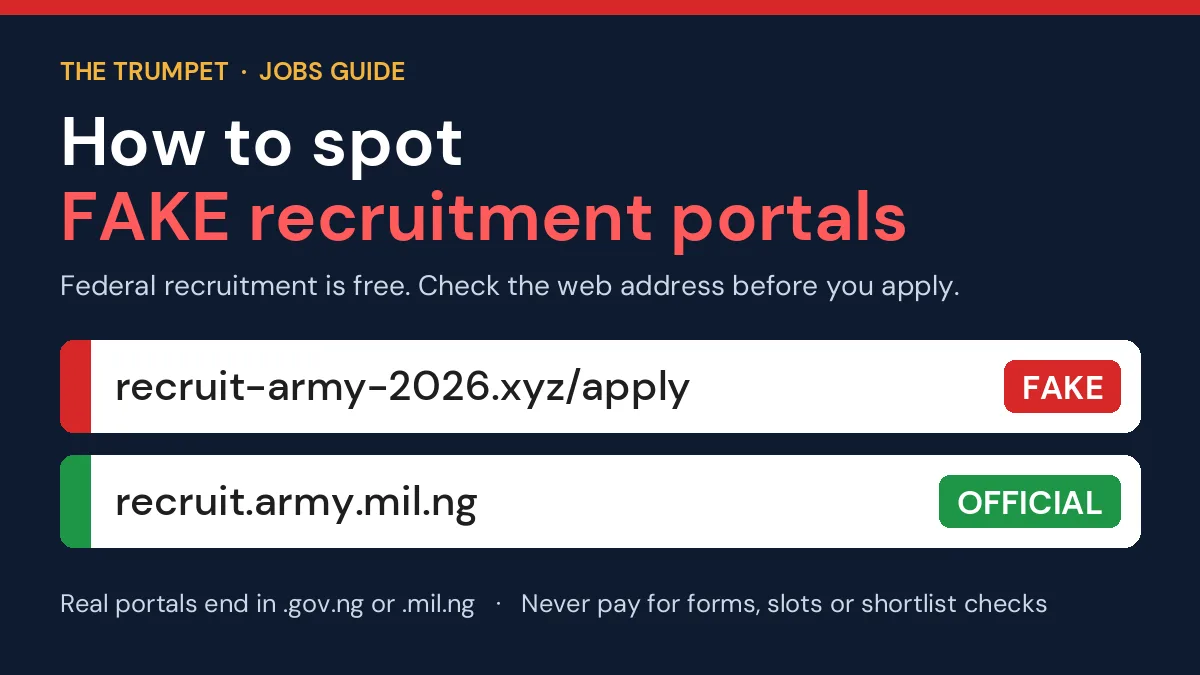
Federal government recruitment in Nigeria is free, and applications are taken only on official portals, almost all of which end in .gov.ng or .mil.ng. Any website, WhatsApp message or agent that asks you to pay for a form, a “slot” or a shortlist check is a scam.
Latest: Nigeria recruitment 2026: which portals are open now, shortlists and deadlines (live tracker)

Key Highlights
- No federal agency charges for application forms, slots, shortlist checks or “processing”.
- Official portals end in .gov.ng or .mil.ng. INEC is the main exception: its ad hoc staff portal is pres.inecnigeria.org.
- There is no official “full shortlist PDF”. Agencies publish results on their portals, so check your own dashboard.
- Never share your login, OTP, BVN or ATM PIN with anyone offering to check or fix your application.
- Before you apply, confirm the exercise is real and still open on The Trumpet’s recruitment tracker.
Fake recruitment notices spread fastest when a real exercise is in the news. In 2026, agencies including the Nigeria Customs Service, NECO, the Federal Ministry of Finance and the committee for the proposed Nigerian Coast Guard have all publicly warned job seekers about fraudulent adverts, portals or fee demands. This guide explains how to tell a real portal from a fake one, using the same checks The Trumpet applies before listing any exercise on its trackers.
8 signs a recruitment portal or message is fake
- It asks for money. A “form fee”, “registration charge”, “slot”, “shortlist check” or “processing fee” is the clearest sign of a scam. Federal recruitment is free.
- The web address is wrong. Real portals sit on the agency’s own domain, such as recruit.army.mil.ng or recruitment.efcc.gov.ng. Be wary of .com, .com.ng, .xyz, blogspot or free website addresses, and of look-alikes that add extra words or hyphens.
- You only saw it on WhatsApp, Telegram or a Facebook page. Agencies announce recruitment on their official websites and verified accounts. If the agency’s own site says nothing, treat the notice as fake.
- Someone is selling a “full shortlist PDF”. Shortlists are checked by logging in to the official portal or, for some exercises, on an official state list page. A PDF passed around on social media is not from the agency.
- It promises a guaranteed place. Nobody can “connect” you, reserve a slot or move you up a list.
- It asks for your login, OTP, BVN or PIN. Agencies never ask for your password, one-time code or bank PIN. Anyone who does wants to take over your application or your account.
- The exercise is closed or doesn’t exist. A common trick is a “reopened” or “extended” portal with no official notice, or registration for a programme that isn’t recruiting. For example, there is no new N-Power registration, and no new police constable portal is open.
- It pressures you to act now. “Apply within 24 hours”, personal Gmail or Yahoo contact addresses, poor spelling and agency logos that look slightly off are all warning signs.
Official recruitment portals in Nigeria
Type these addresses yourself rather than clicking links in messages. Whether each exercise is open right now is on the Nigeria recruitment tracker.
| Agency | Official portal | Live tracker |
|---|---|---|
| Nigerian Army | recruit.army.mil.ng | 92RRI shortlist · Armed forces |
| Nigerian Navy | joinnigeriannavy.navy.mil.ng | Armed forces tracker |
| INEC (ad hoc election staff) | pres.inecnigeria.org | INEC tracker |
| CDCFIB (Civil Defence, Correctional, Fire, Immigration) | recruitment.cdcfib.gov.ng | CDCFIB tracker |
| EFCC | recruitment.efcc.gov.ng | EFCC tracker |
| FRSC | recruitment.frsc.gov.ng | FRSC tracker |
| Nigeria Police (via the Police Service Commission) | npfapplication.psc.gov.ng | Police tracker |
| NAQS | recruitment.naqs.gov.ng | NAQS tracker |
How to check if a recruitment notice is real
- Look for the same announcement on the agency’s official website or verified social media account.
- Check that the application link uses the agency’s official domain, letter by letter.
- Confirm the exercise is open and the dates match on The Trumpet’s recruitment tracker.
- Read the advert for any payment request. If there is one, stop.
- If you are still unsure, contact the agency only through the phone numbers or email addresses on its official website.
Recent fake recruitment warnings
- Finance Ministry Warns New Staff Against Fake ₦50,000 Recruitment Fee Demand
- PC-NCG Warns Against Fake Recruitment Into Proposed Nigerian Coast Guard
- Customs Fake Recruitment Alert: Nigeria Customs Service warns applicants against fraudulent screening notices
- EFCC Dismisses Viral Secret Recruitment Claim, Warns Nigerians Against Fake News
Read also:
- NRS Warns Job Seekers Over Fake FIRS Recruitment Notice, Says Vacancy Advert Is Fraudulent
- NECO warns public against fake recruitment portals for SSCE supervisors
- CDCFFIB warns job seekers against fake shortlisting messages
What to do if you have been scammed
- Stop all payments and contact your bank immediately to report the transaction and ask about blocking or recovering it.
- Change the password on your recruitment portal account and email if you shared them.
- Report the fraud to the nearest police station or to the EFCC, and keep receipts, phone numbers and screenshots as evidence.
- Tell the agency that was impersonated, using the contacts on its official website, so it can warn other applicants.
Frequently asked questions
Do I need to pay to apply for federal government jobs in Nigeria?
No. Federal recruitment exercises, including the Army, Navy, Air Force, Police, CDCFIB, FRSC, EFCC and INEC, are free. Anyone asking for payment is not acting for the agency.
Do all official recruitment portals end in .gov.ng?
Most federal portals end in .gov.ng, and the armed forces use .mil.ng. INEC is the main exception: its ad hoc staff portal is pres.inecnigeria.org. If a portal uses any other address, check it against the agency’s official website.
Is the shortlist PDF on WhatsApp real?
No agency publishes its full shortlist as a PDF for sharing on WhatsApp or Telegram. Check your status by logging in to the official portal.
How do I know which recruitment exercises are open now?
The Trumpet’s Nigeria recruitment tracker lists every major federal exercise with its current status and next date, and is updated as each stage is announced.
For new recruitment alerts and scam warnings as they happen, follow us on X.