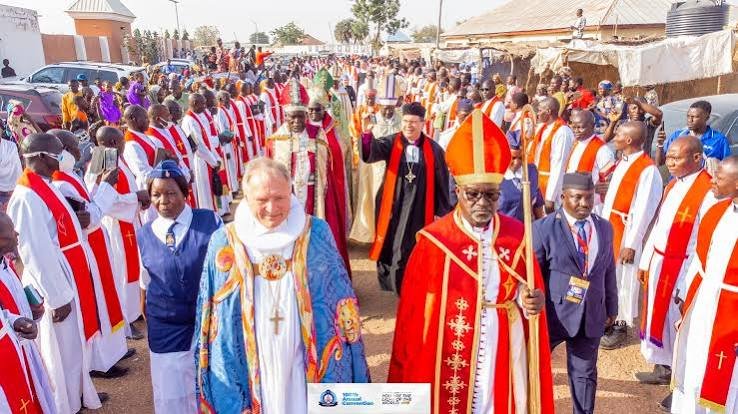
A Christian cleric of the Lutheran Church of Christ in Nigeria (LCCN), Adamawa State, Pastor Tonborokai Gajere, has sparked fresh debate ahead of the 2027 general election after questioning what he described as a double standard in the way religious voting is perceived in Nigeria.
Key Highlights
- Pastor Tonborokai Gajere of the Lutheran Church of Christ in Nigeria (LCCN) has sparked debate ahead of the 2027 elections by questioning what he described as a double standard in discussions about religious voting.
- Gajere argued that Christians, like other citizens, have the right to support candidates they believe will protect and represent their interests without being accused of practising religious politics.
- The cleric referenced the 2023 presidential election, stating that voting patterns across Christian and Muslim-majority states showed that Nigeria’s electoral choices are influenced by multiple factors beyond religion.
- He cited previous elections in Adamawa State, arguing that voters have historically supported candidates across religious and ethnic lines without widespread claims of religious bias.
- Gajere called for fairness and consistency in interpreting political choices, stressing that every Nigerian has a constitutional right to vote for any candidate regardless of religion, ethnicity, or identity.

Speaking on the ongoing political conversations, Gajere argued that Christians should not be criticised for supporting candidates they believe will protect and represent their interests.
According to him, when Muslims vote for fellow Muslims, it is generally regarded as part of the democratic process, but when Christians make similar choices, they are often accused of engaging in religious politics.
To support his position, Gajere cited the outcome of the 2023 presidential election, noting that both President Bola Tinubu and former Vice President Atiku Abubakar secured victories in several Christian-majority states, while Labour Party candidate, Peter Obi did not record victory in any Muslim-majority state.
He said the election results suggest that Nigeria’s voting patterns are more complex than simply attributing them to religion.
Read also:
- IPAC To Mobilize Over 2.5m Voters In Cross River For 2027 Election
- PDP Receives Defectors In Cross River As APC, ADC Chieftains Dump Parties Ahead Of 2027
- Tinubu Will Lose In 2027 The Way Argentina Lost To Spain, Says Sowore
- I Might Not Even Be Alive To Contest 2027 Presidential Election, Obi Raises Alarm
Gajere also referenced previous governorship elections in Adamawa State, including the contest between Boni Haruna and the late Adamu Mu’azu, arguing that political support across religious and ethnic lines was accepted without widespread allegations of religious bias.
He further observed that many Christians voted for Adamawa State Governor Ahmadu Fintiri in both the 2019 and 2023 governorship elections despite the participation of Chief Emmanuel Bello, adding that those elections were not widely characterised as religious contests.
Gajere maintained that every Nigerian has a constitutional right to vote for any candidate of their choice, irrespective of religion, and called for fairness and consistency in how political decisions and voting patterns are interpreted.
His remarks have added to the growing national conversation over the role of religion, ethnicity and identity in Nigeria’s electoral politics as political activities ahead of the 2027 general election continue to gather momentum.