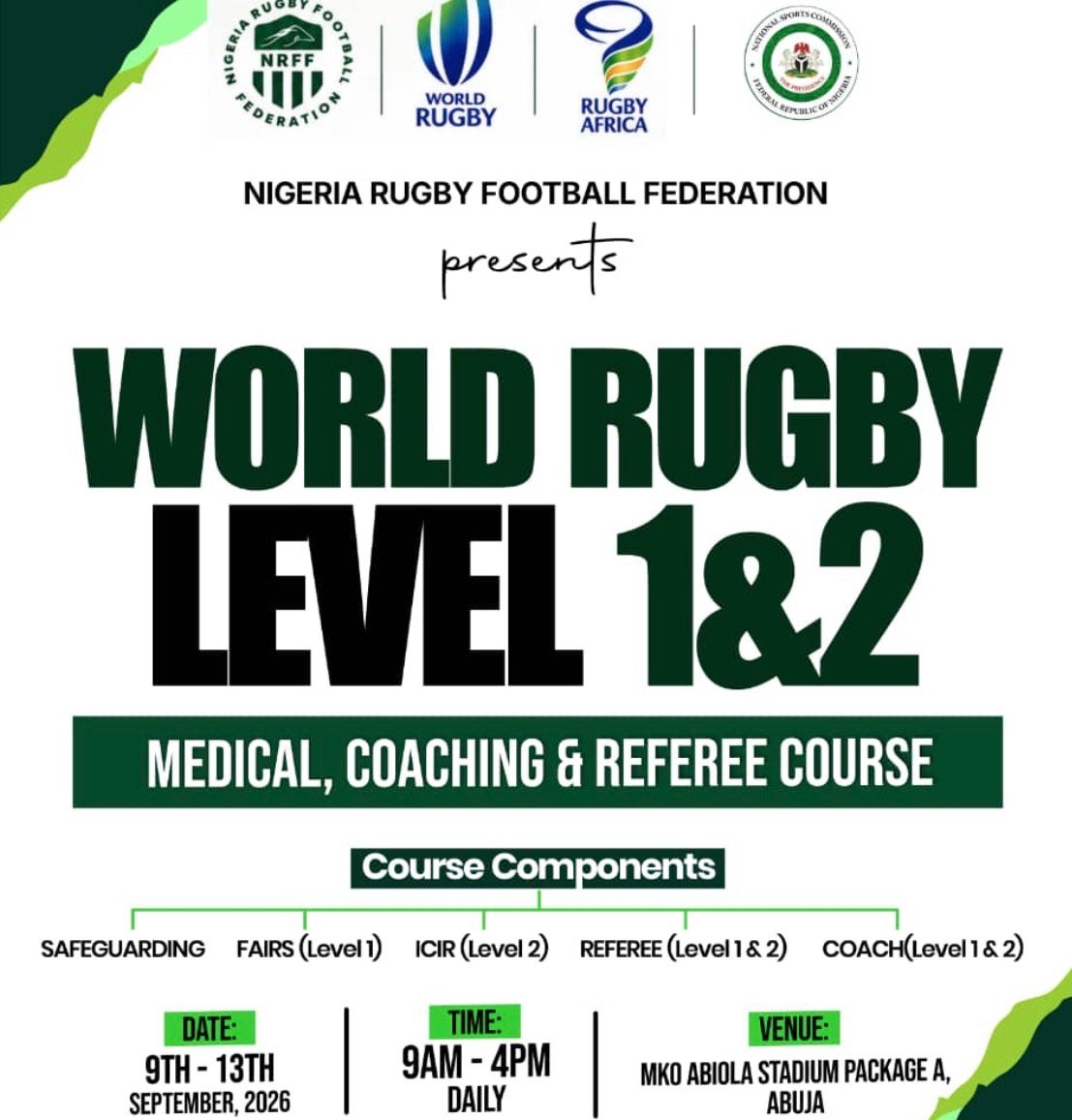
The Nigeria Rugby Football Federation (NRFF) has announced a major technical development programme following the arrival of World Rugby Educators in Nigeria for a three-day capacity-building exercise scheduled for September 10 to 12, 2026, in Abuja.
The initiative is aimed at strengthening Nigeria’s rugby development structures by providing coaches, match officials and other technical personnel with access to World Rugby courses, assessments and quality assurance exercises.

According to the NRFF on Saturday, the programme represents the final planned World Rugby visit under the federation’s current development programme and is expected to contribute significantly to building a more qualified and professional rugby workforce in the country.
Read also:
- NOC Boss Gumel Hails Nigeria’s Beach Volleyball Team For Historic LA 2028 Olympic Qualification
- Olopade Applauds Volleyball Federation, Backs Nigeria For Olympic Podium
- Nigeria Makes History, Secures Qualification For 2028 Olympic Beach Volleyball
- D’Tigress Suffer Opening Defeat To South Korea At 2026 FIBA Women’s World Cup
- Betis Hand Mourinho 1st Defeat Since Real Madrid Return
- Andy Ruiz Jr Loses Comeback Fight to Damian Knyba, Calls for Rematch
- Amaka Paul Finishes 4th On Top Scorers List At African Volleyball Championship
The training programme will cover several key areas, including Level 1 and Level 2 Coaching, Level 1 and Level 2 Match Officiating, First Aid in Rugby, Intensive Care in Rugby (ICIR) and Safeguarding Essentials.
Participants will also undergo assessments for Level 2 Match Officiating and World Rugby Educator qualifications.
The World Rugby delegation will further conduct quality assurance assessments for Nigerian educators, including Wuraola Hussain and Olatubosun Johnson.
Mohammed Salisu is also scheduled to undergo an assessment to complete his Match Officiating Educator course.
Meanwhile, Dr Fikunola Orafidiya, whose World Rugby Educator licence has been renewed after successfully completing his quality assurance assessment, will be monitored during the Abuja programme as he prepares to deliver another Level 2 ICIR course.
The NRFF has urged coaches’ associations, the Referees Society and other technical stakeholders to mobilise their members and take full advantage of the programme.
The federation said the initiative would help strengthen Nigeria’s coaching and officiating systems while creating a broader pool of qualified technical personnel capable of supporting the continued growth of rugby across the country.