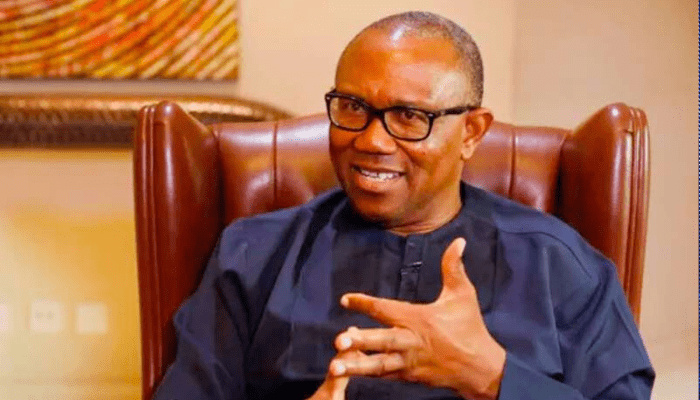
Former presidential candidate of the Labour Party (LP), Peter Obi, has raised fresh alarm over what he described as massive and systemic diversion of public funds, alleging that about ₦34 trillion in federation revenue failed to reach Nigeria’s central account within three years.
In a statement issued on Saturday, Obi said findings attributed to the World Bank reveal that out of approximately ₦84 trillion generated between 2023 and 2025, a staggering 41 percent, about ₦34.44 trillion, was deducted before remittance into the federation account.

He described the situation as “deeply troubling,” warning that such large-scale deductions point to entrenched corruption rather than administrative lapses.
“This is not a mere oversight; it is institutionalised corruption on a massive scale,” Obi said, drawing attention to what he called a dangerous pattern of financial opacity in Nigeria’s public finance system.
The former Anambra State governor argued that the scale of the deductions surpasses the country’s combined capital expenditure in recent budgets, stressing that the ₦34 trillion lost is roughly equivalent to allocations for capital projects in the 2024 and 2025 appropriation cycles.
Read Also:
- Edun advises developing countries to fashion strategies to reduce impacts of gobal economic shocks
- FG, IsDB partnership aimed at achieving $1tn economy by 2030 -Edun
- Edun tasks NIPSS participants on practical pathways to unlock Nigeria’s orange economy
According to data released by the World Bank, Nigeria’s revenue profile rose significantly over the three-year period, from ₦17.08 trillion in 2023 to ₦29.45 trillion in 2024 and ₦37.44 trillion in 2025.
However, deductions also ballooned, from ₦6.22 trillion to ₦13.38 trillion and ₦14.93 trillion, respectively, effectively shrinking funds available for distribution to federal, state and local governments.
The global financial institution reportedly warned that such deductions are “quietly eroding” fiscal space, as funds are siphoned at source by government agencies before statutory allocation.
Obi said the trend exposes what he termed a “lethal paradox” in Nigeria’s economy, rising revenues without corresponding improvements in public welfare.
“We are earning more as a nation, yet we have less to invest in critical sectors like healthcare, education, and infrastructure,” he said.
He further alleged that some government agencies now command more resources through these deductions than entire states and key ministries, a development he said undermines development outcomes and accountability.
Drawing historical parallels, Obi referenced the 1994 Okigbo Panel report, which uncovered $12.4 billion in unaccounted oil windfall, warning that a more severe fiscal leak may currently be unfolding with minimal public scrutiny.
He called for urgent structural reforms, insisting that Nigeria’s economic challenges are not due to lack of resources but poor management and systemic corruption.
“Nigeria has no business being poor,” Obi stated, urging transparency, disciplined leadership, and a redirection of public funds toward national development priorities.