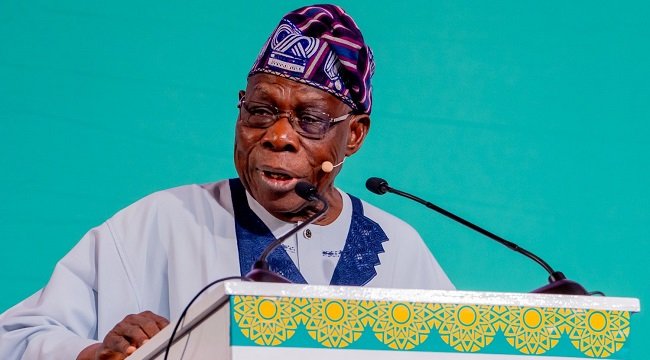
Former President Olusegun Obasanjo has blamed policy inconsistencies, corruption and poor management of Nigeria’s resources for the country’s persistent poverty, saying the nation has sufficient resources to build a prosperous economy.
Obasanjo said Nigeria’s economic difficulties were not primarily caused by a lack of natural or human resources but by the failure of successive governments to properly utilise them.

The former president spoke during an interview on C-Suite Café, where he discussed Nigeria’s economic challenges and the country’s failure to maximise its agricultural, mineral and human resources.
Obasanjo argued that Nigeria has no business remaining poor given its enormous economic potential. He said the country has millions of hectares of arable land, favourable climatic conditions and abundant water resources capable of supporting food production and large-scale agricultural exports.
According to him, Nigeria’s agricultural potential alone could provide a major foundation for economic growth if properly developed and sustained through consistent government policies.
He also identified the country’s human capital as another largely underutilised resource.
Obasanjo said Nigerians’ entrepreneurial and intellectual capacities, both within the country and in the diaspora, represented a significant economic asset that could contribute to national development if effectively harnessed.
The former president further pointed to Nigeria’s abundant solid minerals, crude oil and natural gas as resources capable of diversifying the country’s revenue base.
However, he argued that the availability of these resources had not translated into widespread prosperity because of failures in governance and economic management.
Obasanjo particularly criticised the lack of continuity in government policies, saying successive administrations often abandoned programmes initiated by their predecessors.
He identified agriculture and food security initiatives as areas where policy inconsistency had undermined long-term development.
According to him, governments need to maintain policies beyond individual administrations if Nigeria is to achieve sustainable economic growth.
He also raised concerns about public borrowing, recalling the debt relief secured by his administration in 2005 and 2006.
Obasanjo said the debt relief, which he put at about $30 billion, had provided Nigeria with an opportunity to redirect resources towards development.
He, however, expressed concern about the country’s subsequent return to heavy borrowing.
The former president also identified corruption, crude oil theft and leakages in revenue generation as major factors undermining Nigeria’s ability to convert its resources into development.
He argued that resources meant for public development were being lost through corruption and other forms of economic leakage.
Obasanjo said tackling poverty in Nigeria would require political will, fiscal accountability and consistency in government policies.
He particularly stressed the need for continuity in policies relating to food security, saying frequent changes in government direction had prevented the country from fully developing its agricultural potential.
The former president’s comments come amid continuing concerns over poverty, food insecurity, inflation and the rising cost of living across the country.
Nigeria remains one of Africa’s largest economies and is endowed with significant deposits of crude oil, natural gas and solid minerals, alongside extensive agricultural land.
Yet millions of Nigerians continue to face economic hardship, with many households struggling with rising food, transportation, housing and healthcare costs.
Obasanjo argued that the contradiction between Nigeria’s resource wealth and widespread poverty could be addressed through better management and sustained economic policies.
He said successive governments must look beyond short-term political considerations and implement policies capable of producing long-term economic transformation.
The former president also emphasised the importance of addressing corruption and strengthening accountability in public finance.
He maintained that reducing poverty would require more than government spending, arguing that Nigeria must create an economic environment that allows agriculture, industry and entrepreneurship to thrive.
Read also:
- Atiku Hits Back At Obasanjo, Says History Cannot Be Rewritten
- Stop Using Atiku As Election-Year Scapegoat Every 4 Years, Timi Frank Replies Obasanjo
- Obasanjo Calls Choice Of Atiku As Running Mate His Biggest Political Mistake
Obasanjo’s position places responsibility for Nigeria’s economic difficulties largely on governance and policy choices rather than the absence of resources.
He said the country already possessed the ingredients required for prosperity but had failed to consistently deploy them for the benefit of its citizens.
He therefore called for political will, policy continuity and fiscal discipline, alongside effective management of Nigeria’s natural and human resources.
The former president’s remarks come as the Federal Government continues to implement economic reforms aimed at increasing revenue, attracting investment and reducing pressure on public finances.
Obasanjo, however, suggested that sustainable improvement in Nigerians’ living standards would depend on whether governments could maintain coherent policies and prevent corruption and revenue leakages from undermining economic gains.