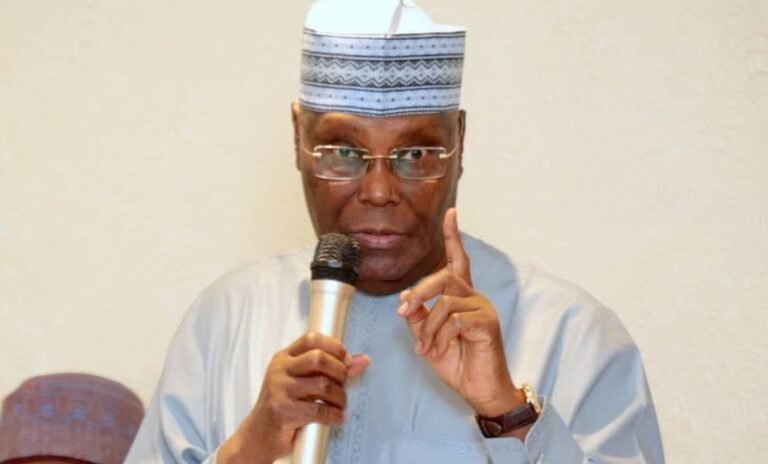
Former Vice-President Atiku Abubakar has hit back at former President Olusegun Obasanjo over his recent criticism, accusing the former president of attempting to rewrite history concerning their political relationship.
Atiku said he stood by Obasanjo during his imprisonment and played a major role in his political comeback after his release,, insisting that his past contributions cannot be erased by what he described as “bitterness” and “revisionism.”

Obasanjo had on Friday, described his decision to pick Atiku as his running mate in the 1999 presidential election as the “biggest mistake” of his presidency.
The former president made the comment in Lagos during a fireside conversation with veteran entertainer and activist, Charles Oputa, popularly known as Charly Boy, at the public presentation of Oputa’s foundation and memoir, 999: A Memoir in Tribute to Late Justice Chukwudifu Oputa.
Reacting in a statement issued on Saturday by his Senior Special Assistant on Public Communication, Phrank Shaibu, Atiku described Obasanjo’s remarks as another attempt to distort the historical record.
Atiku also defended his opposition to Obasanjo’s controversial third-term bid, saying he had no regrets about choosing the constitution over personal loyalty.
He said his opposition to the third-term agenda was not motivated by personal rivalry but by the need to protect Nigeria’s constitutional democracy.
According to Atiku, the defeat of the third-term bid demonstrated that Nigerians and democracy prevailed over an attempt to extend presidential power beyond the constitutional limit.
“If Chief Obasanjo’s bitterness stems from my refusal to support an unconstitutional third term, then I wear that resentment as a badge of honour,” Atiku said.
He added that no individual, regardless of status or achievements, was above the constitution.
Atiku further challenged Obasanjo’s assessment of his contributions to the former president’s political career, saying history would show that he supported Obasanjo, while he was in prison and after his release.
He claimed that he supported Obasanjo’s family during his incarceration, worked with other Nigerians to secure his release and later provided assistance to him when he returned from prison.
Atiku also claimed that he mobilised political structures, built alliances and made significant personal and political sacrifices that contributed to Obasanjo’s emergence as president in 1999.
Read Also:
- Atiku’s son resigns as Adamawa works commissioner
- “No More Glitches”: Peter Obi leads #OccupyNASS protest as Nigerians ask, where is Atiku?
- Atiku reacts as INEC announces 2027 election timetable amid Ramadan concerns
The former vice-president said he did not regret helping Obasanjo despite the eventual breakdown of their relationship.
“Do I regret helping Chief Obasanjo? Absolutely not,” he said, adding that acts of kindness should not be treated as transactions requiring repayment.
Atiku, however, argued that gratitude should not be replaced with what he called “revisionism.”
He also referenced recent remarks by World Trade Organisation (WTO) Director-General, Ngozi Okonjo-Iweala, whom he said had acknowledged the performance of the economic management team he led during the Obasanjo administration.
Atiku claimed it was unfortunate that while Nigeria was currently battling economic hardship, insecurity and unemployment, Obasanjo is busy revisiting old political disagreements instead of contributing solutions.
He said the 2027 election should focus on rebuilding the country, restoring security, reviving the economy and providing hope for young Nigerians rather than reopening old political wounds.
Atiku said he had previously refrained from responding to Obasanjo out of respect for the former president and the office he once occupied.
However, he said he could no longer remain silent in the face of what he described as repeated distortions of historical events.
“Chief Obasanjo is entitled to his opinions. He is entitled to his personal grievances. What he is not entitled to are his own facts,” Atiku said.
He maintained that his focus remained on Nigeria’s future, insisting that history would ultimately judge both men and their roles in the country’s political development.
“History is stubborn. It cannot be rewritten by bitterness, nor erased by repeated falsehoods,” he said.