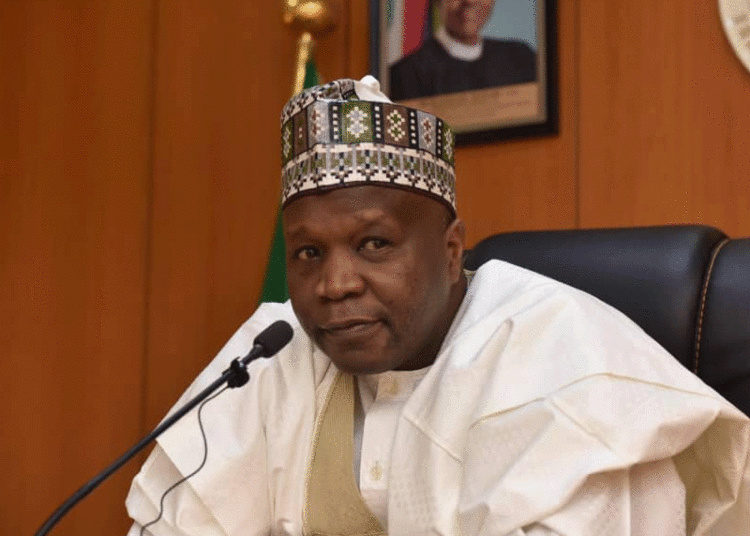
Gombe State Governor, Muhammadu Yahaya, has called for stronger implementation and accountability mechanisms within the North-East Governors’ Forum (NEGF) to ensure that resolutions adopted by the regional body translate into measurable improvements in the lives of citizens.
Yahaya made the call on Saturday in Maiduguri, Borno State, while delivering his opening remarks at the 13th meeting of the NEGF.

The governor said the forum has recorded significant progress since its establishment in 2020, particularly in infrastructure, energy, connectivity, economic development, education, healthcare and regional security.
He said the achievements demonstrated the importance of the six North-East states working collectively to address challenges that could not be effectively tackled by individual states.
According to him, the forum has facilitated the rehabilitation of strategic roads, renewed efforts on regional power and connectivity, revival of the North-East Trade Fair and progress towards establishing a regional airline.
Yahaya said the NEGF was established in response to challenges confronting the region, including insurgency, banditry, cross-border crime, infrastructure deficits, energy shortages and humanitarian crises.
He noted that six years and 12 meetings after its establishment, the forum has evolved into an institutional platform comprising a secretariat, technical working committee of secretaries to state governments, technical working group of experts and sectoral committees.
The governor cited the joint presentation of 17 strategic road projects, the Port Harcourt-Jos-Bauchi-Maiduguri rail corridor and oil exploration opportunities in Kolmani and the Lake Chad Basin to the federal government in September 2025 as a major outcome of the forum’s advocacy.
He said the federal government subsequently commenced rehabilitation of the Dikwa-Gamboru Ngala and Bama-Banki roads, covering almost 99 kilometres, while the Akwanga-Jos-Bauchi-Gombe-Biu-Maiduguri highway has been adopted as a legacy road project of President Bola Tinubu.
On electricity, Yahaya said the forum has helped develop a regional energy agenda, noting that the Dadinkowa Hydropower Plant was now supplying electricity to the national grid.
He added that the new electricity law has created opportunities for states to develop their electricity markets and expand renewable energy initiatives, including solar power and mini-grids.
The governor also identified the revival of the North-East Trade Fair in Bauchi in 2024, as another example of a regional resolution translated into action.
He said the six states have demonstrated their commitment to regional integration through a N30 billion financing plan, with each state contributing N5 billion, for the proposed establishment of a North-East regional airline.
Read also:
- Governor Yahaya Sets Up Panel To Probe Allegations Of Misconduct Against Acting DPP
- Governor Yahaya Charges Newly Sworn-In Commissioners On Service Delivery, Integrity
- Governor Yahaya Inaugurates APC reconciliation committee, targets 1m votes For Tinubu In 2027
- North-East Governors Seek Renewed Federal Action on Infrastructure, Energy and Security
In education, Yahaya said all six states have domesticated the Education Law 2022 and established the North-East Education Council, while state-specific initiatives were being implemented to address the challenges of Almajiri education and out-of-school children.
He also disclosed that the region’s commissioners for health have established a regional health platform aimed at improving collaboration, responsiveness and exchange of best practices.
On security, the governor said the NEGF has transformed insecurity from six separate state concerns into a shared regional responsibility.
He said the approach combines military operations with efforts to address factors contributing to insecurity, including poverty, unemployment, illiteracy, drug abuse and illegal mining.
Yahaya cited community-based security structures, including GOSTEC in Gombe and the Taraba Marshals, as initiatives from which other states could draw lessons.
He said the forum’s collective efforts had also contributed to changing perceptions of the North-East, with the focus gradually shifting from emergency humanitarian assistance to recovery, resettlement, stabilisation and long-term development.
However, the governor said significant challenges remain, stressing that insurgency, banditry, communal clashes, displacement and infrastructure deficits continued to require sustained regional action.
“Boko Haram has been weakened but not defeated, and we still see attacks on our communities. Banditry and communal clashes are emerging as new threats,” he said.
He identified the non-realisation of the Mambilla hydropower project, railway connectivity and broadband infrastructure as outstanding priorities requiring continued advocacy.
Yahaya also called for the Kolmani oil exploration project to translate into actual production, employment and revenue, while urging the responsible exploitation of the region’s solid mineral resources to prevent them from financing criminal activities.
He expressed concern over the persistent number of out-of-school children and weak health indicators in the region, stressing the need for sustained interventions.
The governor welcomed proposals for the establishment of a results and delivery unit within the NEGF secretariat, a dashboard for tracking federal infrastructure commitments, a regional power master plan, a stronger security and intelligence framework and a focused portfolio of flagship projects.
Yahaya further said the challenges confronting the North-East were connected to wider problems across northern Nigeria, including insecurity, poverty, unemployment, climate change, desertification, out-of-school children and infrastructure deficits.
He disclosed that the Northern States Governors’ Forum is being restructured to strengthen coordination, technical capacity and implementation across the 19 northern states.
According to him, the reforms include the establishment of the Northern Nigeria Security Trust Fund to provide sustainable pooled support for security and peacebuilding initiatives.
He also announced plans to reform the New Nigeria Development Company to restore its role as a vehicle for investment, enterprise and economic development across northern Nigeria.
Yahaya stressed that the reforms were designed to complement existing sub-regional platforms such as the NEGF. For the latest updates, follow us on X.