


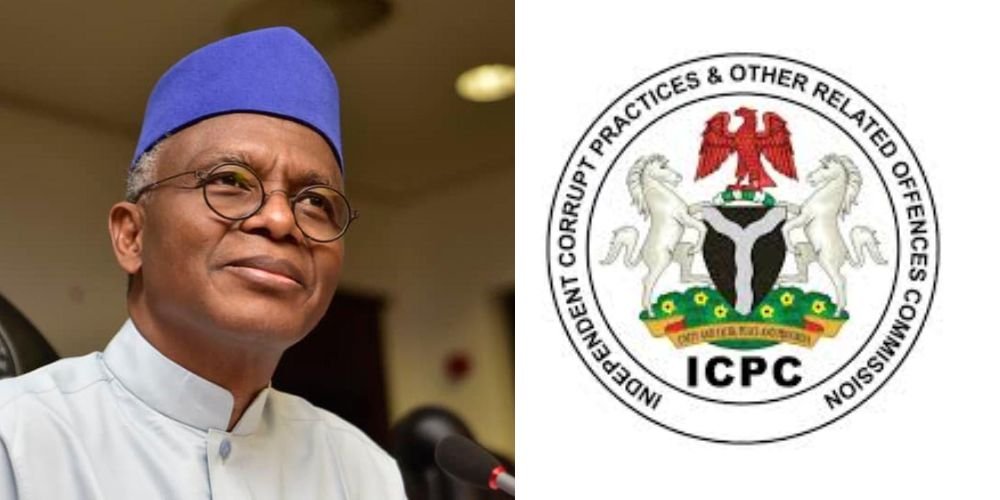
The Independent Corrupt Practices and other related offences Commission (ICPC) has provided new information regarding its ongoing investigation into former Kaduna State Governor, Nasir El-Rufai, stating that items allegedly capable of intercepting communications, along with classified security documents, were recovered from his Abuja residence.
In documents filed before the Federal Capital Territory (FCT)High Court, the commission maintained that El-Rufai’s detention is lawful and based on a remand order issued by a Magistrate Court in Bwari.

The 14-day detention order, granted on February 19, 2026, is scheduled to expire on March 5.
According to an affidavit sworn to by ICPC Litigation Officer, David Efuk, operatives executed a valid search warrant on February 19 at El-Rufai’s residence located at No. 12 Mambila Street, Aso Drive, Asokoro, Abuja.
The search was reportedly conducted in the presence of his wife, Hadiza El-Rufai, and his son, Mohammed El-Rufai.
During the operation, investigators allegedly recovered sensitive security materials described as capable of undermining national security, in addition to electronic magnetic devices said to have the capacity to intercept telephone communications.
Read Also:
- Court adjourns El-Rufai’s arraignment to April 23
- DSS to arraign Nasir El-Rufai February 25 over alleged cybercrime, NSA wiretapping case
- ICPC confirms El-Rufai in custody after EFCC release as corruption probes continue
The commission further claimed that El-Rufai declined to grant access to the devices for forensic examination.
The ICPC also referenced a televised interview in which the former governor allegedly admitted to tapping the phone conversations of the National Security Adviser (NSA), Nuhu Ribadu.
Beyond the alleged surveillance findings, the anti-corruption agency said El-Rufai has questions to answer over suspected financial irregularities.
These include the whereabouts of €1.4 million, 180 transactions totaling over N2.15 billion from a consolidated revenue account linked to Kaduna State’s internally generated revenue, and additional transfers amounting to more than N428 million to undisclosed accounts.
The commission further alleged that the former governor has been intimidating potential prosecution witnesses, noting that one individual had formally requested protective measures.
El-Rufai has approached the FCT High Court, challenging the legality of his detention and claiming violations of his fundamental human rights.
However, the ICPC urged the court to dismiss the application, describing it as baseless and insisting that due process was followed.
Detailing the timeline, the commission stated that on February 18, 2026, El-Rufai was transferred to its custody after being released by the Economic and Financial Crimes Commission (EFCC).
The following day, it secured a 14-day remand order to continue its investigation.
According to the agency, El-Rufai has been confronted with some of the documents obtained, but has allegedly declined to participate in interviews.
The ICPC emphasized that it does not detain suspects arbitrarily and only files charges upon the conclusion of investigations where a prima facie case is established.
The commission pledged to conclude its investigation and, if appropriate, file charges before the expiration of the remand order on March 5, 2026.
It maintained that its actions were taken in response to a petition alleging corrupt practices during El-Rufai’s tenure as Kaduna State governor.
The ICPC stated that initial invitations for questioning were unsuccessful until operatives tracked him to Abuja following intelligence about his arrival at the Nnamdi Azikiwe International Airport.
It added that he had earlier been invited by the EFCC, where he was granted administrative bail but remained in custody after failing to meet bail conditions.
The anti-graft agency insists that all steps taken so far comply with the law as investigations continue.


