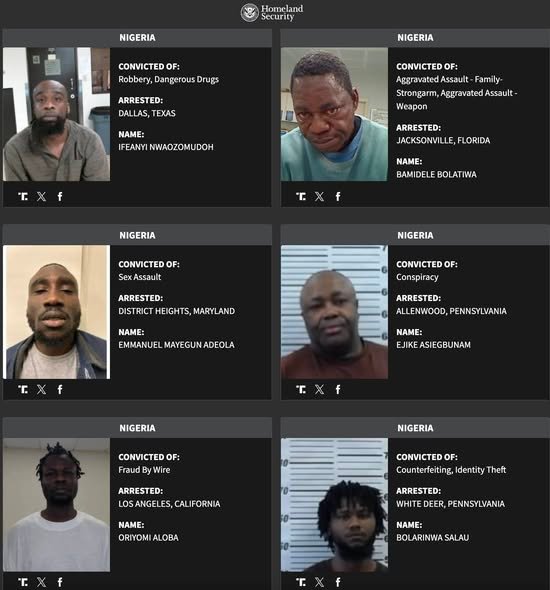
The United States Department of Homeland Security (DHS) has published the names and photographs of 124 Nigerians for deportation as part of an intensified immigration enforcement campaign targeting foreign nationals convicted of serious crimes in the United States. The move forms part of the U.S. government’s renewed crackdown on illegal immigration and the removal of convicted non-citizens.
Key Highlights
- DHS lists 124 Nigerians for deportation over criminal convictions.
- Affected individuals were included in what the agency described as its “worst of the worst” criminal register.
- The U.S. government has not announced a timeline for the deportations.
- The action is part of President Donald Trump’s immigration enforcement policy targeting undocumented migrants with criminal records.
- Nigeria recently faced additional U.S. visa restrictions over identity management, visa overstay rates and security concerns.
According to a statement released by the DHS on Wednesday, the affected Nigerians were included in a list of non-citizens convicted of serious offences in the United States.

While the agency published the identities and photographs of those affected, it did not disclose when the deportation process would commence.
The DHS said the action is part of the administration’s ongoing efforts to enforce immigration laws and remove criminal non-citizens from the United States.
“The U.S. Department of Homeland Security is highlighting the ‘worst of the worst’ criminal aliens arrested by the U.S. Immigration and Customs Enforcement (ICE),” the statement said.
The agency added that immigration officers are implementing President Donald Trump’s directive to prioritise the deportation of undocumented migrants with criminal records.
Among the Nigerians listed are Sunday Adediora, Sunday Kunkushi, Mkpouto Etukudoh, Marcus Unigwe, Olaniyi Ojikutu, Boluwaji Akingunsoye, Ejike Asiegbunam, Emmanuel Mayegun Adeola, Bamidele Bolatiwa, Ifeanyi Nwaozomudoh, Aderemi Akefe, Solomon Wilfred, Chibundu Anuebunwa, Joshua Ineh, Usman Momoh, Oluwole Odunowo, Bolarinwa Salau, and Oriyomi Aloba.
Others include Oludayo Adeagbo, Olaniyi Akintuyi, Talatu Dada, Olatunde Oladinni, Jelili Qudus, Abayomi Daramola, Toluwani Adebakin, Olamide Jolayemi, Isaiah Okere, Benji Macaulay, Joseph Ogbara, Olusegun Martins, Kingsley Ariegwe, Olugbenga Abass, Oyewole Balogun, Adeyinka Ademokunla, Christian Ogunghide, Christopher Ojuma, Olamide Adedipe, Patrick Onogwu, Olajide Olateru-Olagbegi, and Omotayo Akinto, among others.
The latest enforcement action follows President Trump’s return to office on January 20, 2025, when he signed executive orders declaring illegal immigration a national emergency and directing federal agencies to strengthen border security while accelerating the removal of undocumented migrants.
One of the executive orders, titled “Protecting the American People Against Invasion,” instructed immigration authorities to prioritise the arrest and deportation of individuals considered threats to public safety and national security.
The White House has maintained that the policy is designed to strengthen immigration enforcement and remove undocumented immigrants with criminal convictions.
Read also:
- US Blames Nigerians For Immigration Applications Success, Raises Concern On Alarming Document Fraud
- US tightens immigration rules as Work-Permit validity drops to 18 Months, applications from 19 countries face suspension
- Trump orders new U.S. Census to exclude undocumented immigrants in sweeping immigration policy shift
Official U.S. immigration data indicate that Guatemala, Honduras, Mexico and El Salvador have recorded the highest number of deportees since the renewed enforcement campaign began. Deportation operations have also expanded to several countries across Africa, Asia and the Caribbean.
Nigeria has also faced tighter U.S. immigration measures in recent months. In June, the United States imposed partial visa restrictions on Nigerian citizens, citing concerns over identity management, information sharing, visa overstay rates and security screening.