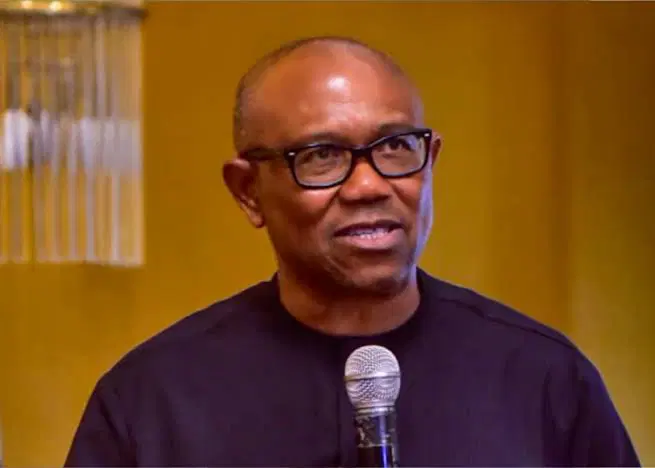
For more than a decade, Peter Obi’s eight-year tenure as governor of Anambra State has been presented by supporters as a case study in fiscal discipline: a governor who inherited a financially troubled state, rebuilt its finances, invested in infrastructure and education, and handed over substantial funds to his successor.
That narrative is now facing its most detailed challenge in years.

Key Highlights
- A 10-page March 2014 handover document shows Obi reported N91.666 billion in local and foreign-currency investments, certified balances and a federal refund, against an estimated N5 billion liability, for a net N86.666 billion.
- The Anambra government says Obi’s administration contracted eight external loans worth about $123.77 million, of which $92.35 million remained outstanding as of June 2026.
- The DMO’s official record put Anambra’s external debt stock at $30.323 million as of December 31, 2013 — a figure that measures something different from a contracted-loan total.
- Disputes also cover unpaid Water Corporation workers, inherited teacher-salary arrears, and competing claims about insecurity during Obi’s tenure.
- Both camps have released documents supporting parts of their case, but no side has published a full facility-by-facility reconciliation.
- The dispute carries added weight because Obi is seeking the presidency in 2027 on a platform built around fiscal competence.
At the centre of the renewed dispute is a 10-page financial handover document dated March 17, 2014, which Obi addressed to his successor, Willie Obiano. The document, portions of which have circulated publicly before but whose fuller details have now re-entered the political debate, provides a snapshot of what Obi said Anambra possessed at the end of his administration.
It listed local investments of N27 billion, foreign-currency investments of $156 million valued at N26.5 billion, certified State and Ministries, Departments and Agencies balances of N28.166 billion, and a Federal Government-approved refund of N10 billion.
Together, the figures amounted to N91.666 billion.
But Obi’s own summary also identified an estimated N5 billion liability covering March salaries, pensions, gratuities and certificates for already executed projects. After that deduction, the document recorded a net balance of N86.666 billion.
That disclosure has become central to a much wider question: What exactly did Peter Obi leave behind in Anambra — a state with substantial assets and manageable obligations, or a state carrying debts and liabilities that his successors had to service?
The answer is complicated by the fact that the two sides are not necessarily measuring the same thing.
Obi’s position has consistently focused on what he personally owed at the point of handover — particularly unpaid salaries, pensions, gratuities and certified contractor obligations. The Anambra government, meanwhile, has focused on external financing facilities contracted during his tenure and still being repaid by the state.
Those two accounting positions can coexist. A government can have cash and investments while also carrying long-term debt. That distinction is now at the heart of the controversy.
The Handover Document
Obi’s March 2014 document is significant because it provides a contemporaneous record of what his administration said it was handing over.
According to the document, the largest component was the $156 million foreign-currency investment portfolio. It was valued at N26.5 billion in the handover summary.
There was also N27 billion in local investments and N28.166 billion in certified balances belonging to the state and its MDAs.
An additional N10 billion was listed as a Federal Government-approved refund, apparently representing money due to Anambra for work undertaken on federal roads.
The gross figure was therefore N91.666 billion. But the document did not say all of that money was immediately available as unrestricted cash.
The N5 billion deduction is particularly important. Obi’s report described it as an estimated liability covering March salaries, pensions and gratuities, as well as certificates for projects that had already been executed.
That meant the headline N91.666 billion figure was not the same as free cash. After the deduction, the document put the net balance at N86.666 billion.
This distinction matters because several components of the reported balances were connected to specific programmes and government obligations.
Among the balances subsequently associated with the handover were funds for education, joint accounts, set-aside accounts and ecological purposes. The status and ownership of some of these accounts have since become contested between the Obi and Soludo camps.
The financial picture, therefore, cannot simply be reduced to a claim that Obi left N86.7 billion in a bank account waiting for his successor to spend.
It was a combination of investments, programme funds, certified balances and expected federal reimbursement, alongside liabilities that had already been estimated.
The $156 Million Question
The foreign-currency investment figure is another important piece of the puzzle. The handover document put the portfolio at $156 million. Earlier accounts of the portfolio have identified investments across banks and securities, including holdings associated with Access Bank, Fidelity Bank and Diamond Bank. Contemporary reporting and later explanations have described portions of the portfolio as Eurobonds and other foreign-denominated securities.
Two documents cited in the renewed discussion are particularly notable. One portfolio associated with Access Bank was valued at about $49.97 million, while another associated with Fidelity Securities was valued at approximately $55.20 million. Together, those two portfolios amounted to roughly $105.17 million.
If they are treated as separate components of the $156 million total cited in the handover summary, they account for about two-thirds of the reported foreign-currency investment.
There were also coupon payments. An Access Bank document reportedly recorded $748,750 in coupon payments as of January 31, 2014, while a separate Fidelity communication referred to $855,400 in total coupon income from investments involving Access Bank and Nigerian sovereign securities.
These details reinforce an important point: at least part of the money described as investments was not simply idle cash. It was placed in financial instruments designed to generate returns.
That also means the value of the portfolio could not necessarily be assessed solely by looking at the original amount invested.
Investment values can rise or fall, while maturity dates, interest income and liquidation conditions can affect how much a government can actually realise at a particular point.
Indeed, later accounts from the Obiano administration said some of the foreign-currency securities suffered changes in market value and that part of the portfolio was subsequently managed or liquidated to meet government obligations. One 2015 account put the portfolio’s then market value at about $132 million, compared with the approximately $155 million invested.
The existence of the investments, therefore, is not in itself evidence that the state was financially debt-free. It is evidence that the state had assets. Debt and assets are separate sides of a public balance sheet.
The Debt That Refuses To Disappear
The strongest challenge to Obi’s long-standing “no debt” narrative comes from the current Anambra government.
In September 2026, Commissioner for Information and Value Reorientation Law Mefor said Obi’s administration contracted eight external financing facilities between 2007 and 2013.
The facilities had an aggregate contracted value of about $123.77 million. According to the state government’s account, $92.35 million remained outstanding as of June 30, 2026, equivalent to approximately N127.4 billion at the exchange rate used by the government.
The loans were linked to development programmes including malaria control, FADAMA, healthcare, education, erosion management, community development and agricultural value-chain development. That is an important qualification.
The mere existence of borrowing does not establish that the money was wasted. Governments routinely borrow to finance projects whose benefits are expected to extend over many years. The more consequential questions are different: How much was approved? How much was actually drawn down? What was spent? What projects were completed? What was repaid before handover? And what balance was legally attributable to the state after Obi left office? Those questions have not all been conclusively answered in the public debate.
Indeed, one recent report quoted Mefor as acknowledging that he did not have precise figures for the amount actually drawn down under Obi’s administration, although he confirmed that eight of the facilities were federally guaranteed.
That admission is significant because a loan’s contracted value is not necessarily identical to the amount actually disbursed. It is therefore imprecise to treat the $123.77 million contracted amount as automatically equivalent to money Obi personally received and spent.
Likewise, the $92.35 million outstanding in 2026 cannot simply be presented as the amount Obi “owed” when he left office without examining repayments, interest, restructuring and the subsequent administrations that serviced the facilities.
The state government’s claim establishes an association between the facilities and Obi’s administration. Determining the precise liability at the March 2014 handover requires a loan-by-loan reconciliation.
The DMO Complication
There is another figure that has become important in the controversy. The Debt Management Office’s official external-debt table for December 31, 2013 recorded Anambra’s external debt stock at $30.323 million.
At first glance, that figure appears dramatically different from the $123.77 million in facilities now cited by the Anambra government. But the difference does not automatically prove that either side is wrong.
A debt stock figure represents outstanding debt at a particular point in time. A contracted-loan figure represents the value of facilities agreed with lenders. They are not interchangeable accounting concepts.
A facility can have a larger approved or contracted ceiling than the amount outstanding at a particular date. The real unresolved issue is therefore not simply whether the number is $30 million or $123 million.
It is what happened between the signing of each facility and the December 2013 debt-stock figure, and then between December 2013 and Obi’s March 2014 handover. That is where the drawdown records, repayment schedules, disbursement certificates and DMO loan-by-loan data become essential.
Without that reconciliation, the political arguments can produce very different numbers while each side selects the figure most favourable to its narrative.
Read also:
- Anambra Releases Debt Records, Disputes Obi’s Account
- Presidency Dares Obi To Quit 2027 Race Over Anambra Debt Claims
- Group Challenges Soludo To Make Public Obi, Obiano’s Loans
What About The N5 Billion Liability?
The handover report itself provides one piece of evidence that complicates the claim that Obi left absolutely no financial obligations. The document expressly identified N5 billion in estimated liabilities.
The description included March salaries, pensions and gratuities, as well as certificates for executed projects. Obi’s argument has been that these were accounted for and provided for in the financial position he handed over. His broader position is that he did not leave unpaid obligations in the sense alleged by the current administration.
A liability does not disappear merely because money has been set aside for it. At the same time, the existence of an estimated liability does not establish that Obi left workers unpaid or that his government failed to meet its obligations. It simply shows that the handover statement itself anticipated payments that remained to be settled. The question is what happened to those liabilities after March 2014.
The Water Corporation Dispute
One of the most emotionally charged elements of the renewed controversy concerns workers of the defunct Anambra State Water Corporation.
The Soludo administration has alleged that hundreds of workers suffered prolonged non-payment of salaries and entitlements under Obi. The government has cited old footage of protests and claimed that more than 200 Water Corporation workers died while awaiting their entitlements. Those claims require careful treatment.
The existence of protests or arrears does not, by itself, establish that every death was caused by non-payment of salaries. Nor does a government’s assertion establish the precise size, duration or legal status of an inherited liability.
But there is documentary evidence that Water Corporation workers were experiencing salary-related concerns during Obi’s tenure.
A memo dated April 25, 2006, attributed to Obi’s Chief of Staff, Chuks Ileogbunam, appealed to the governor to address the corporation’s N15 million monthly salary requirement and avert protests over unpaid salaries.
The memo is important because it places at least part of the salary controversy inside Obi’s own period in office rather than leaving the issue entirely to later political claims. The broader question, however, remains one of duration and settlement: how much was owed, for how long, how much was subsequently paid and what remained when Obi handed over in 2014?
Those questions require payroll, pension and gratuity records rather than political statements alone.
Teachers And Inherited Arrears
The debate becomes even more complicated when liabilities from administrations before Obi are brought into the calculation. The current Anambra government has referred to arrears owed to primary-school teachers under the local government system dating back to the administration of Chinwoke Mbadinuju.
According to the state’s account, Obi’s administration verified 16 months of such salary arrears and agreed to pay them in instalments, but only five months were reportedly paid during his tenure.
If accurate, that would raise an important distinction between liabilities inherited by Obi and liabilities created or left unresolved by Obi. A governor may inherit a debt and still be responsible for deciding how to settle it. But politically and legally, the origin of the liability remains relevant.
That is why a proper audit of Obi’s legacy would need to identify when each liability originated, when it was verified, what payments were made and which administration ultimately settled it.
The Projects Question
Money and debt tell only part of the story. The other question is what Anambra received for the resources deployed during Obi’s eight years.
Obi has repeatedly pointed to roads, schools, hospitals and other infrastructure as evidence of his administration’s performance.
In an interview after leaving office in 2014, he said Anambra had constructed more than 800 kilometres of roads and described infrastructure and access roads as major achievements of his administration.
Education is another major pillar of the Obi legacy. His administration returned many mission schools to their original religious owners, a policy supporters have credited with improving management and educational standards.
Supporters argue that the policy represented a departure from a system in which government was responsible for running a large network of schools without necessarily possessing the institutional capacity to manage them effectively.
Critics, however, argue that physical infrastructure and education rankings do not answer every question about governance.
They point to public health facilities, water infrastructure and access to basic services as areas where the record requires more scrutiny. This is where political memory becomes unreliable.
A governor can simultaneously build hundreds of kilometres of roads and leave some public institutions struggling. A state can also hold substantial financial assets while owing long-term loans. Neither proposition automatically cancels the other.
The Security Argument
Security is another area where Obi’s national political rhetoric has invited comparisons with his record in Anambra. As a national politician, Obi has frequently described insecurity as a major Nigerian crisis and called for improved surveillance, intelligence and institutional coordination.
Critics have countered with allegations about kidnappings and insecurity during his Anambra tenure.
Former Governor Willie Obiano, for instance, previously alleged that Obi handed over a state facing significant insecurity and claimed that more than 69 people had been kidnapped during the period. Such claims are politically contested and should not be treated as established fact without independent records.
The relevant evidence would include police crime statistics, kidnapping cases, prosecution records and contemporaneous security assessments. This illustrates a broader problem with retrospective political arguments: a claim repeated by either supporters or opponents does not become independently verified simply because it has survived for years.
The Contradiction At The Centre
The most interesting feature of the current controversy is that both sides possess pieces of evidence that complicate the other’s story.
Obi’s handover document clearly shows substantial assets. It also clearly identifies a N5 billion estimated liability. The DMO recorded an external debt stock of $30.323 million at the end of 2013.
The Anambra government says eight external facilities associated with Obi’s tenure had a combined contracted value of $123.77 million and that $92.35 million remained outstanding by June 2026. Obi says he left Anambra without the kind of unpaid obligations alleged by his opponents.
The government says subsequent administrations have continued servicing loans linked to his tenure. All of these statements can be examined, but they cannot all be reduced to a single number.
The central missing piece is a comprehensive reconciliation. Such a reconciliation would show, facility by facility, the original loan agreement, amount approved, amount disbursed, date of disbursement, amount repaid by March 2014, outstanding principal at handover, interest accrued and payments made by subsequent administrations.
The same exercise should be conducted for the N27 billion local investments and the $156 million foreign-currency portfolio.
It should identify what each investment was, whether it was liquid, its maturity date, its market value at handover and what happened to it afterward. For the N28.166 billion in certified balances, the state should disclose the underlying accounts and the purpose attached to each balance. That would transform the argument from political accusation into an auditable public record.
The Political Burden Of A Presidential Claim
The renewed dispute matters beyond Anambra because Obi is now seeking the presidency in 2027.
His political identity has been built heavily around competence, frugality, accountability and the argument that Nigeria’s resources can produce substantially better outcomes if managed properly. That makes his gubernatorial record particularly relevant.
But relevance should not become licence for either side to substitute political rhetoric for evidence.
For Obi, the strongest response to the controversy would be a complete publication of the original loan agreements, disbursement records, repayment schedules, investment statements and audited handover accounts.
For the Anambra government, the equivalent burden is to publish the loan-by-loan reconciliation showing precisely how the $123.77 million contracted figure translates into the debt now being serviced, while distinguishing Obi-era liabilities from obligations incurred or modified by later administrations.
The same standard should apply to allegations about unpaid workers, pensions, gratuities and abandoned projects. If the evidence supports the government’s claims, the documentary record should establish it. If the evidence supports Obi’s account, it should equally establish that.
Beyond The Political Theatre
The Anambra dispute is ultimately larger than Peter Obi and Chukwuma Soludo.
It raises a recurring Nigerian governance problem: the absence of clean, accessible and continuous public financial records that allow citizens to track what one administration inherits, what it spends and what it hands over.
When records are incomplete or selectively published, political narratives fill the vacuum. A former governor can point to billions in investments and declare that he left the state financially strong.
A successor can point to loans still being serviced and declare that the former governor left a debt burden. Both can produce documents supporting parts of their arguments. The public is then left to reconcile competing figures that should, in a functioning public accounting system, fit into one continuous ledger.
That is the real significance of Obi’s 2014 handover document. It does not, by itself, settle whether Peter Obi left Anambra “debt-free.” Nor does the current government’s $123.77 million figure, without a detailed drawdown and repayment reconciliation, establish exactly how much debt Obi personally left outstanding on March 17, 2014.
What the document does establish is that Obi handed over a state with substantial reported financial assets and investments, alongside an explicitly stated N5 billion estimated liability. The DMO record establishes that Anambra had an external debt stock of $30.323 million at December 2013. The current state government’s records establish that it is still servicing eight external facilities it associates with the Obi era.
The unresolved question is how those three pieces fit together. And that question cannot be answered by campaign speeches, social-media arguments or partisan press statements.
Until that ledger is placed in the public domain and independently reconciled, Peter Obi’s Anambra legacy will remain what it has increasingly become: a contest between two sharply different political memories, each supported by selected evidence, but neither yet providing the public with the complete financial story.
With the 2027 presidential contest approaching, the stakes of that distinction are considerably higher than a quarrel over the finances of a state more than a decade ago. For Obi, the Anambra record is no longer merely a chapter in his political biography. It is central evidence for the governing philosophy he now asks Nigerians to trust.
And the question confronting that philosophy is no longer simply whether Peter Obi saved money. It is what he inherited, what he borrowed, what he actually spent, what he invested, what he paid, what he owed when he left — and what ultimately happened to everything he said he handed over.
Follow us on X for more updates on this developing story.