More than 160 people have been arrested across France as tens of thousands of demonstrators took to the streets to protest rising fuel prices, the high cost of living and deteriorating public services.
Key Highlights
- 166 arrests recorded nationwide as nearly 33,000 people join 140 protest actions.
- Police fire tear gas in Paris, Marseille and Strasbourg.
- Protesters briefly force their way into Marseille’s historic town hall.
- Unions and Yellow Vest members join student-led demonstrations.
- President Macron appeals for calm and respect for people and property.
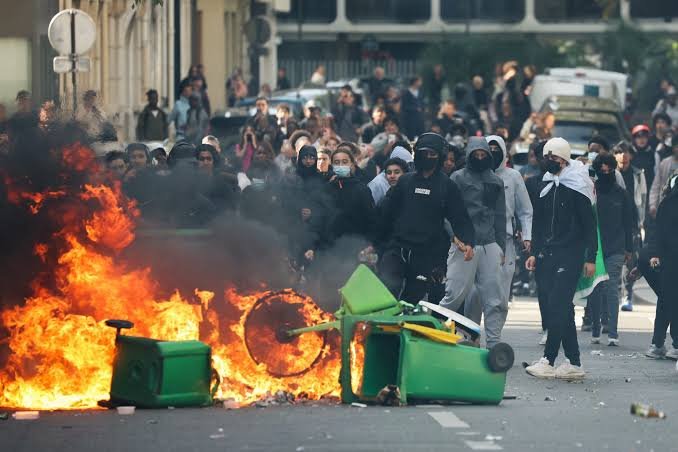
The demonstrations, which spread across major cities including Paris, Marseille, Strasbourg, Rennes, Toulouse and Angers on Saturday, October 17, were marked by clashes between protesters and security forces, with police deploying tear gas to disperse crowds.

France’s Interior Ministry said it has recorded 140 separate protest actions involving nearly 33,000 people, with 166 arrests made nationwide as of its latest update.
The ministry accused some demonstrators, particularly individuals it described as members of far-left groups, of engaging in violence, looting, arson and attacks on police officers and government institutions.
It also alleged that protesters damaged a police station in Marseille, warning that further violence could occur as demonstrations continued.
Clashes in Paris
In Paris, police reported 40 arrests by 9:30 a.m. local time, mainly involving individuals allegedly carrying weapons or prohibited protective equipment.
The French capital witnessed confrontations between riot police and protesters at Place de la République, where demonstrators gathered ahead of a major march.
Officers fired tear gas as some protesters climbed the monument at the square, while others threw flares and projectiles towards security personnel.
Hundreds of demonstrators also gathered around Gare du Nord railway station, with students among those expressing frustration over President Emmanuel Macron’s administration and the country’s economic and social conditions.
From Student Grievances to Nationwide Unrest
The protests have expanded beyond student grievances following weeks of demonstrations over poor school facilities, staff shortages, overcrowded classrooms and inadequate public investment.
Workers’ unions and members of the so-called Yellow Vest movement have joined the protests, broadening the campaign to include rising living costs, limited employment opportunities, public spending cuts and concerns about declining public services.
Speaking to the BBC in Paris, some student demonstrators said their participation was aimed at compelling the government to address their concerns.
One student said the presence of different generations at the demonstrations strengthened their determination to be heard by the authorities.
Another protester said the group was peaceful and wanted to see meaningful changes in the country.
“We’re just tired of all this. We’re just trying to make things change, but nothing is moving,” one student said.
Read also:
- France To Shut Up To 500 Schools As Student Protests Escalate
- Pope Leo XIV Draws Hundreds of Thousands to Open-Air Mass in Paris
- Japan Protests Putin’s Visit to Disputed Kuril Island, Calls Move ‘Absolutely Unacceptable’
Marseille Town Hall Breached
However, tensions escalated in Marseille, where protesters briefly forced their way into the city’s historic town hall.
Footage from the incident showed demonstrators using a metal fence to force open the entrance before some entered the building. One person was seen throwing a chair, while another spray-painted an anarchist symbol on an interior wall.
Police subsequently intervened to disperse the protesters.
Marseille Mayor Benoît Payan said the damage caused during the incident was limited, according to French media reports.
Authorities also deployed tear gas in Strasbourg as confrontations intensified, adding to reports of unrest in several parts of the country.
Macron Appeals for Calm
Amid the growing tension, President Macron appealed for calm, acknowledging the right to peaceful protest while urging demonstrators to respect people and property.
The president’s administration has also expressed concern that political groups could exploit public dissatisfaction for their own interests.
Prime Minister Sébastien Lecornu previously accused the left-wing La France Insoumise party of using student demonstrations for electoral advantage, a claim that has added to the political controversy surrounding the protests.
Education Minister Édouard Geffray also called for an end to violence, insisting that dialogue remained the appropriate means of resolving the dispute.
Meanwhile, France’s largest trade union, the General Confederation of Labour (CGT), had indicated that demonstrators would gather at Place de la République in Paris for the main march.
Organisers and protest groups anticipated hundreds of demonstrations across the country, with estimates suggesting that participation could reach tens of thousands in Paris alone.
The unrest highlights mounting public discontent over economic pressures, education funding, employment prospects and the direction of government policies.
Despite the government’s appeal for restraint, clashes continued in several cities as police sought to contain the demonstrations and prevent further violence.
For more world news, follow us on X.