
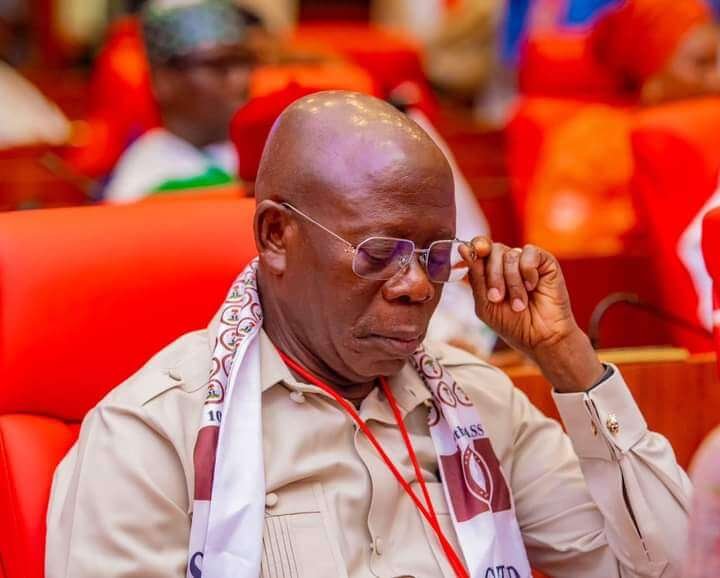
Senator Adams Oshiomhole’s recent comments on xenophobic attacks against Nigerians in South Africa and his renewed push for greater Nigerian control of foreign-owned companies, such as MTN and MultiChoice have once again ignited a familiar national debate not just about policy, but about motive.
On the surface, his argument appears straightforward: Nigerian lives must come first, and foreign investment should never outweigh the safety and dignity of citizens. In a country repeatedly confronted by reports of xenophobic violence against its nationals abroad, such a position naturally resonates with public emotion and nationalist sentiment.
But beneath that emotional appeal lies a more complicated political conversation. Oshiomhole, a former Edo State governor and now senator representing Edo North, has in recent weeks escalated calls for what he describes as stronger economic responses against South African-linked businesses operating in Nigeria. His suggestion that firms such as MTN and DSTV should come under greater Nigerian control has been received with both applause and skepticism.

Supporters see a bold patriot speaking uncomfortable truths about foreign dominance in key sectors of Nigeria’s economy. Critics, however, see something else entirely a politically charged narrative that raises questions about timing, consistency, and underlying intent.
Key Highlights:
- Adams Oshiomhole renewed calls for greater Nigerian control of foreign-linked firms such as MTN Group and MultiChoice following xenophobic attacks against Nigerians in South Africa.
- Oshiomhole argued that Nigerian lives and national interests should take precedence over foreign investment and profit repatriation.
- Supporters view his comments as a strong push for economic nationalism and reduced foreign dominance in strategic sectors of Nigeria’s economy.
- Critics and political observers, however, questioned the timing and motives behind the remarks, suggesting they may be influenced by broader political calculations and elite interests.
- The debate has evolved beyond xenophobia, reflecting wider concerns about nationalism, foreign investment, political credibility, and public trust in Nigeria’s political class.
Some political observers and civil society voices argue that Nigeria’s political class often becomes most vocal on issues affecting ordinary citizens only when it aligns with deeper political calculations or other selfish gains. In this reading, the renewed hardline tone on xenophobia is not just about foreign policy or national dignity, but about positioning, influence, and long-standing elite interests.
These suspicions have been further fueled by speculation circulating in political and social spaces regarding alleged offshore assets and wealth accumulation tied to public office holders including claims that have, over the years, been associated with Oshiomhole. It must be noted that such allegations remain unproven and have not been established in any competent court of law.
The senator has consistently denied wrongdoing in relation to these claims. Still, in Nigeria’s highly charged political environment, perception often competes with fact. And in that space, every major public statement by a prominent political figure is frequently filtered through the lens of history, suspicion, and partisan interpretation.
Read also:
- Sen. Oshiomhole demands Nigerian ownership of MTN following recurring xenophobic attacks in South Africa
- Why I fought Jonathan, by Oshiomole
- Oshiomhole insists retired military generals behind solid minerals looting in northeast
Oshiomhole’s latest engagement with reporters on May 12, 2026, in which he insisted that no foreign investment should be valued above Nigerian lives, has therefore landed in a divided public space. For some Nigerians, it is a justified call for economic nationalism in response to repeated xenophobic incidents. For others, it risks oversimplifying complex diplomatic and investment realities while potentially sending unsettling signals to foreign investors.
What is clear is that the debate goes beyond MTN, DSTV, or even xenophobia. It reflects a deeper tension in Nigeria’s political discourse between nationalism and pragmatism, between advocacy and ambition, and between public trust and elite credibility. As reactions continue to unfold, one thing remains evident: in Nigeria, even the most emotionally compelling political statements rarely escape the shadow of suspicion.