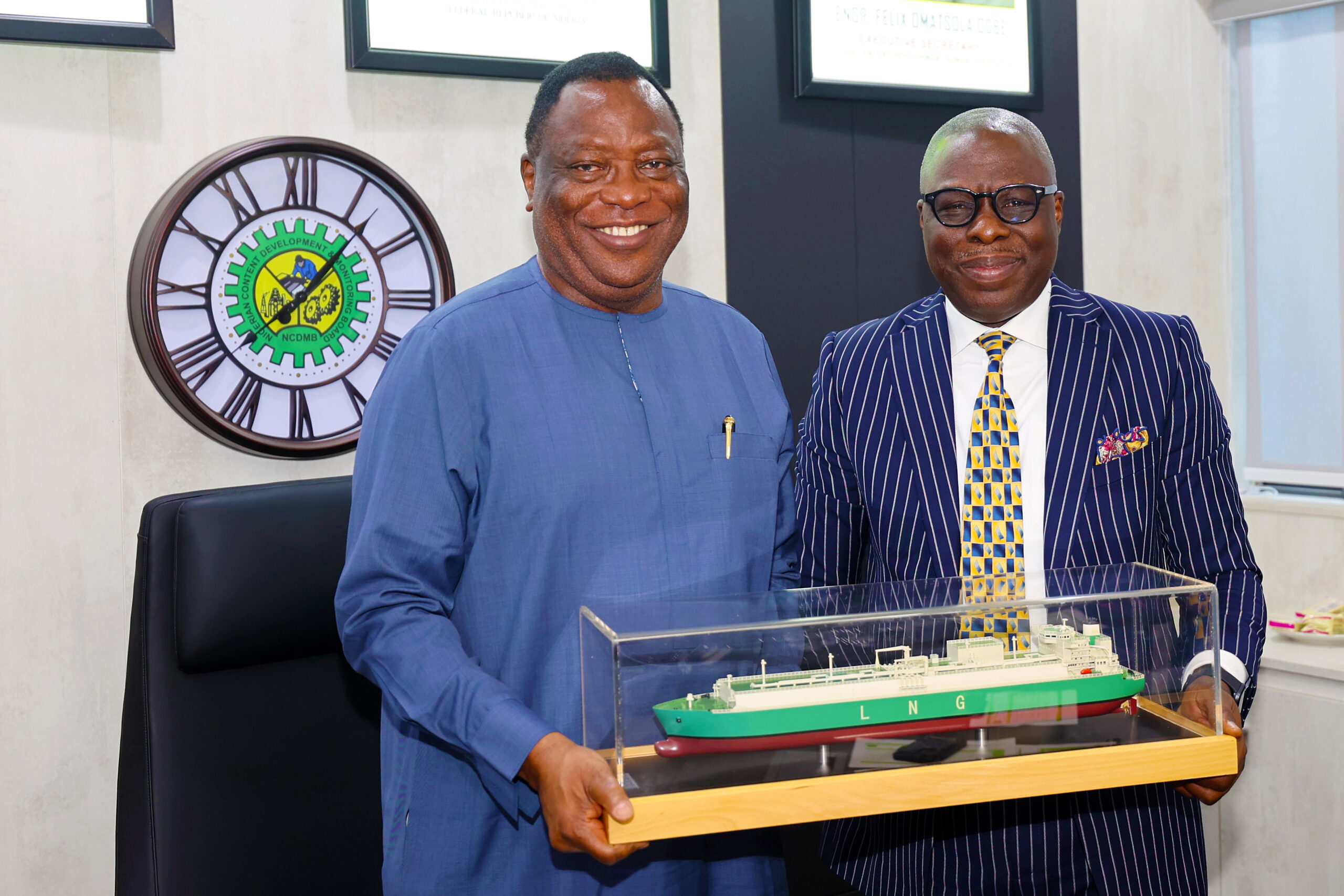
The Managing Director and Chief Executive Officer of Nigeria Liquified Natural Gas, (NLNG) Ltd, Engr Adeleye Falade has said that the expansion being carried out in the company through its Train 7 project has reached 90 percent completion with over 16000 jobs created in the process.
Engr Falade disclosed this when he visited the Executive Secretary of the Nigeria Content Development and Monitoring Board (NCDMB), Engr Felix Ogbe, at the Board’s Liaison office in Lagos on Wednesday.
Falade said the company remains focused on deepening Nigerian Content, strengthening indigenous capacity and retaining greater in-country value across its gas value chain.

He said plans are afoot to commission the new facility in 2027 and increase NLNG’s overall production capacity by 35 percent.
The Managing Director expressed delight that the Train 7 project had created direct employment opportunities for 16,000 persons on the site, reducing insecurity and impacting positively on the nation’s socio-economic stability.
He lauded the close collaboration between NLNG and NCDMB, recalling that they pioneered many initiatives together for the benefit of the sector, affirming that such accomplishments would be surpassed under his leadership.
He assured that NLNG remains committed to sustained engagement with NCDMB in support of Nigerian Content development, local capacity growth, and increased participation of Nigerian companies in the oil and gas value chain.
Engr Falade said the company would continue to pursue partnerships that translate Nigeria’s gas resources into broader economic opportunities for businesses, professionals, service providers, and host communities.
Read also:
- Fubara credits NLNG’s success to public-private partnership model, pledges continued support
- Dangote Refinery, NLNG dominate Nigeria LPG supply as imports drop to 15% — NMDPRA Report
- NLNG, NCDMB seal partnership on major Asset Intervention Programme
“NLNG values its relationship with NCDMB and remains fully committed to the shared goal of strengthening Nigerian Content in the oil and gas industry.
“As a major player in Nigeria’s gas sector, we recognise our responsibility to support indigenous capacity, grow local supply chains, and ensure that our activities continue to deliver meaningful value to the Nigerian economy,” Falade said.
He further stated that NLNG would sustain its focus on practical areas of collaboration with the Board, including vendor development, skills enhancement, technology transfer, local procurement, and value retention.
“Our commitment is to work closely with the Board in a manner that is deliberate, measurable, and impactful. We want NLNG’s operations and partnerships to continue opening doors for Nigerian businesses, building competitive local capabilities, and supporting the long-term growth of Nigeria’s gas industry,” he added.
In his response, the Executive Secretary congratulated Engr. Falade, on his appointment, promised that NCDMB would support him to succeed in his role.
He confirmed that NCDMB and NLNG share a relationship that is beyond regulator and operator, recalling how the Board and NLNG in June 2017 signed the first of its kind Service Level Agreement (SLA) on Nigerian Content project approval timelines and compliance, which later became a template for the oil and gas industry.
He further charged NLNG to enhance its support for the Brass Shipyard project, which is the capacity development initiative (CDI) on the Train 7 project.
He commended the company for collaborating with NCDMB on the project, which will establish a drydock facility, a key oil and gas infrastructure that will benefit NLNG’s business as well as the entire country.
Ogbe expressed hope that the project can be completed within the tenure of the NLNG management, to create employment opportunities and infrastructural development.
The meeting formed part of NLNG’s broader engagement with key industry stakeholders and reinforced the company’s commitment to sustained collaboration, local capacity development and the advancement of Nigerian Content across the oil and gas value chain.