
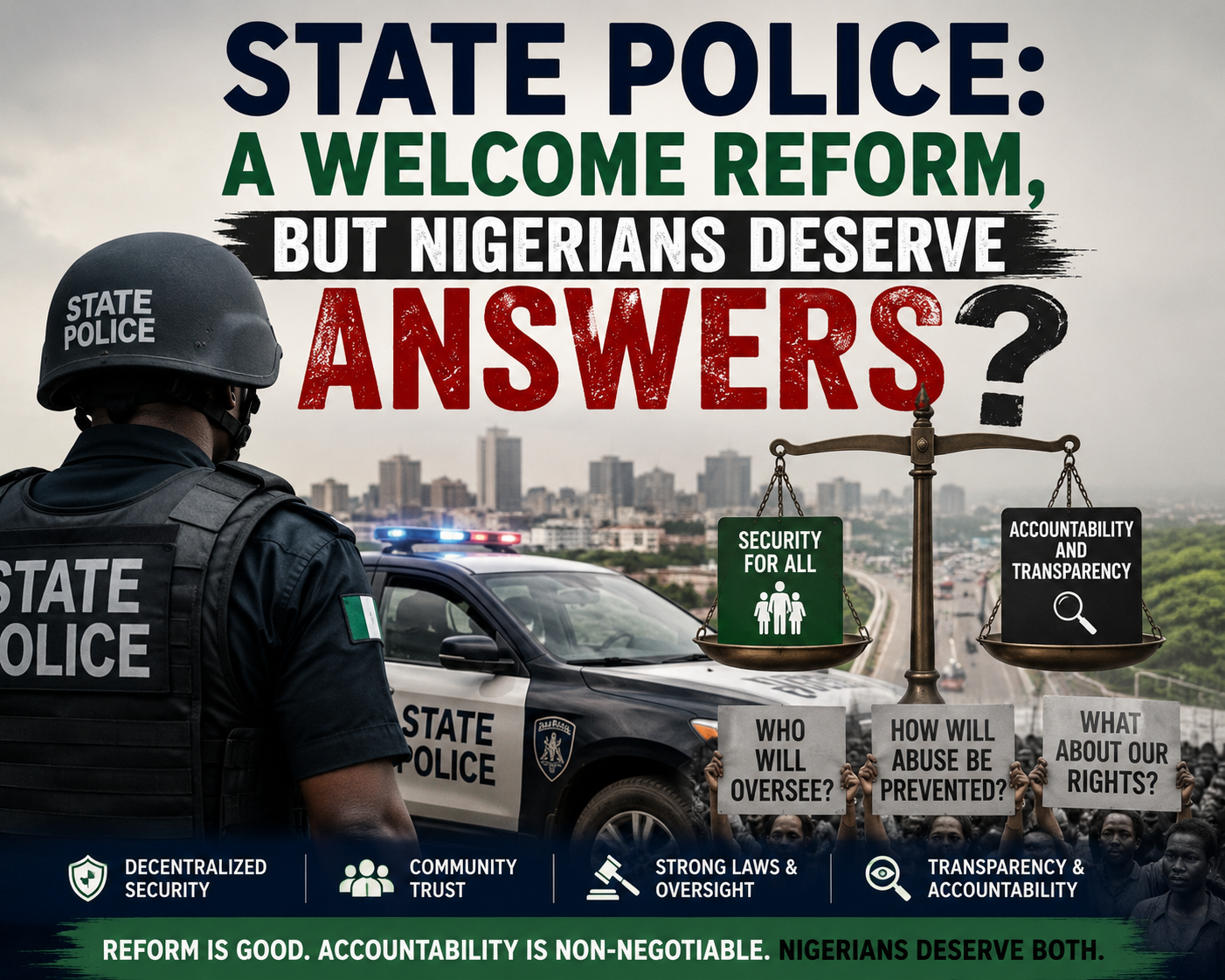
The recent approval of the state police bill by the National Assembly has been celebrated by many Nigerians as a bold and timely response to the worsening security challenges confronting the country.
Key Highlight:

- The approval of the state police bill by the National Assembly has been widely welcomed as a response to Nigeria’s growing security challenges.
- Supporters argue that state police will improve local intelligence gathering, enhance rapid response to threats, and bring security closer to communities.
- Concerns remain over the recruitment process, with fears that political interference, favoritism, and corruption could undermine the effectiveness of state police.
- The article emphasizes the need for rigorous training, thorough background checks, and strong safeguards to prevent infiltration by criminals or extremist elements.
- The success of state police will depend on transparency, professionalism, accountability, and robust oversight mechanisms to prevent abuse and political misuse.
For years, communities across Nigeria have lived under the shadow of terrorism, banditry, kidnapping, armed robbery, farmer-herder conflicts and other forms of violent crimes that have claimed thousands of lives and displaced countless families.
Against this backdrop, the move to decentralize policing appears to be a laudable initiative. Many security experts have long argued that local policing would enhance intelligence gathering, improve rapid response to threats, and bring security personnel closer to the people they are meant to protect.
However, as the nation moves closer to the final approval and implementation of state police, there are critical questions that must not go unanswered.
The first question is recruitment. Who exactly will be recruited into the state police system? Will the process be transparent, merit-based and free from political interference? Nigerians have witnessed countless recruitment exercises over the years that were allegedly influenced by godfatherism, bribery, ethnic considerations, political patronage and personal interests. Such practices have weakened institutions and eroded public trust.
If state police are to succeed, recruitment must be conducted with the highest level of transparency and integrity. Positions must be earned through competence, character and commitment to national service rather than connections or financial influence.
Another pressing concern is training. Are prospective officers going to undergo thorough and professional training before being entrusted with the responsibility of protecting lives and property? Effective policing goes beyond carrying firearms.
It requires discipline, intelligence gathering skills, respect for human rights, crisis management capabilities and a deep understanding of the law.
The government must ensure that every recruit undergoes rigorous screening and comprehensive training that meets modern policing standards. Failure to do so could create more problems than solutions.
Perhaps the most important question is whether adequate safeguards will be put in place to prevent criminals, terrorists, insurgent sympathizers and other dangerous elements from infiltrating the system. Given the country’s security realities, background checks must be thorough and uncompromising.
Nigerians deserve assurance that those entrusted with state police powers will be loyal to the constitution and not to criminal networks or extremist groups.
There is also the issue of accountability. For too long, some security personnel have been accused of engaging in activities that undermine public confidence in law enforcement.
Cases of bribery, extortion, assault, abuse of authority and other forms of misconduct have repeatedly surfaced across the country.
There have also been instances where officers were alleged to have abandoned professional conduct by consuming alcohol while on duty or engaging in other inappropriate behaviors that compromise operational effectiveness.
These concerns cannot be ignored as Nigeria embarks on this new policing era.
State police officers must understand that their loyalty is first and foremost to the people and the constitution. They must not become instruments of political elites, powerful individuals or criminal interests.
The fear among many Nigerians is that some state governments could potentially misuse local police structures for political purposes if proper checks and balances are not established.
Therefore, while the creation of state police deserves commendation, the success of the initiative will ultimately depend on implementation. Recruitment must be credible.
Read also:
- U.S. Congressman Backs Nigeria’s State Police Reform, Says It Will Strengthen Security
- Reactions Trail Rivers Police Boss Action Against Police Officers Mounting Illegal Roadblock
- Police Kill Two Suspected Kidnappers, Recover ₦2.2m In Alleged Ransom Proceeds
- Disu Decries Killing Of Police Officers On Duty, To Increase Deployment Of Police Officers To Enugu
Training must be rigorous. Screening must be thorough. Oversight mechanisms must be strong. Discipline must be non-negotiable.
Nigeria has an opportunity to build a policing system that is closer to the people, more responsive to local security challenges and better equipped to protect communities.
But without transparency, professionalism and accountability, state police could simply replicate the shortcomings that have plagued the country’s security architecture for decades.
The promise of state police is significant. The responsibility of getting it right is even greater.
The views expressed in this article are those of the author and do not necessarily reflect the position of this newspaper.