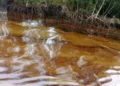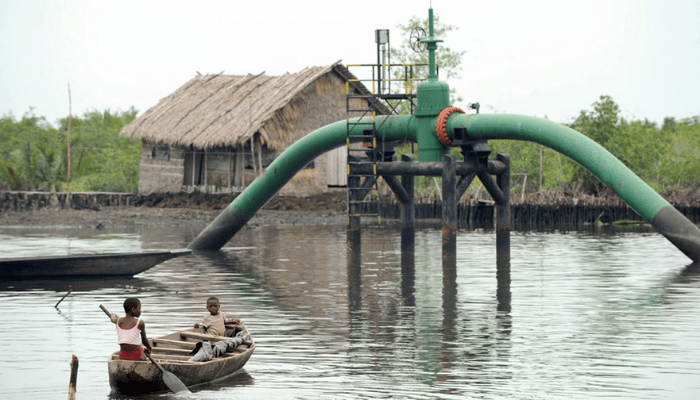
The International Working Group (IWG) on Petroleum Pollution and Just Transition in the Niger Delta on Thursday, described as alarming the impact of oil pollution on the environment and health of the people of Bayelsa State.
Key Highlights:
- An international group raised concerns about oil pollution in Bayelsa State.
- The pollution is reportedly harming health and reducing life expectancy.
- Tests found high levels of harmful substances in residents’ blood samples.
- The group is creating awareness on health risks linked to oil pollution.
- Douye Diri promised support for cleanup and healthcare improvements.
The group, which is carrying out a sensitisation campaign on health hazards associated with oil pollution in the state, disclosed this during a courtesy visit to Governor Douye Diri, at the Government House, Yenagoa.

At the ceremony, the team leader Prof. Engobo Emeseh, expressed concern that average life expectancy in Bayelsa State, has reduced significantly as the “people are forced to live on contaminated land, air and water.”
Prof. Emeseh clarified that the IWG is focusing advocacy on the health of the people in line with the recommendations of the Bayelsa State Oil and Environmental Commission Report, which was submitted in 2023.
She disclosed that laboratory analysis of blood samples taken from indigenes from across the eight local government areas in Bayelsa State, indicated very high levels of hydrocarbon pollution and carcinogenic metals, causing a sharp increase in mortality and morbid rates in the state.
Prof. Emeseh, who commended the Bayelsa State government for being the first sub-national government in Nigeria to set up a high-powered commission on oil and the environment, said the IWG would continue to partner the state and other relevant organizations to mitigate the negative impact of oil pollution on the health of the people.
She said: “Most of us here were constituted as members of the Bayelsa State Oil and Environment Commission.
“We gave our report in 2023; first presented at the House of Lords, and also presented to the Bayelsa State government here in Creek Haven in October 2024, and then presented to the wider public in Abuja.
“In all of this, the Bayelsa State government had given us the space and the support to provide our expertise and advice on how to deal with the challenge of the scourge of oil pollution in our state.
“When we presented our report based on the evidence that we gathered, having gone to all the LGAs in Bayelsa State, and spoken to indigenes and key stakeholders in Bayelsa.
“My colleagues and I, who were members of the expert working group, were quite traumatized at what we found in Bayelsa State, and we called our report an environmental genocide.
Read Also:
- FG, NNPCL complicit in Niger Delta ecological destruction, says environmental activist
- Fubara, Environmental Advocates to lead dialogue on Niger Delta clean-up at NUJ correspondents week
- Niger Delta group vows to expose Nigeria Immigration Law breaches
“Based on that, we committed that even though our commission was de- commissioned in November 2024, that we were going to carry on with this work.”
Responding, Governor Douye Diri, represented by the Deputy Governor, Peter Akpe, described the report of the Bayelsa State Oil and Environment Commission as one of the most important documents to guide concerted actions in the mitigation of environmental hazards from oil pollution in the state.
Gov. Diri thanked members of the International Working Group for partnering the state government by making their expertise available to ongoing efforts towards mitigating the impact of oil pollution on the health of Bayelsans.
While calling on the federal government and international organizations to treat the issue of oil pollution in Bayelsa State, as a special case, he assured the IWG of his administration’s support towards environmental remediation and improved healthcare delivery in the state.
Members of the six-man IWG delegation include Kathryn Nwajiaku-Dahou, representing ODI Global UK; Prof. Michael Watts of University of California; and Isaac Osuoka of York University, Canada.
Others are Prof. Anna Zalik, also from the York University, Canada, and Cautlin Strong of the ODI Global, United Kingdom.