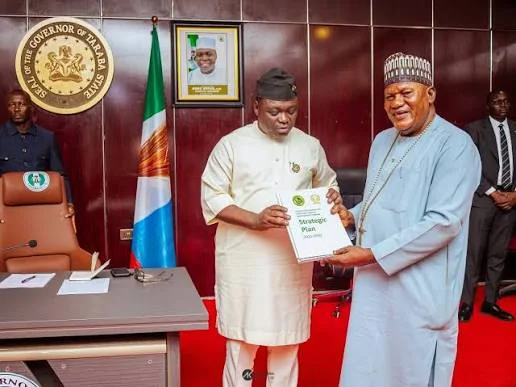
Taraba State has taken what Governor Agbu Kefas described as a decisive step towards confronting the growing realities of climate change, with the launch of the state’s climate change policy and action plan, with a renewed pledge to protect its forests, rivers, farms and communities.
The policy, unveiled by the governor on Friday, is expected to provide a framework for integrating climate considerations into the state’s development planning, while strengthening the resilience of communities increasingly exposed to environmental challenges.

For Kefas, however, the launch is more than the unveiling of another government policy document.
He described it as a decision about the future of Taraba State, particularly the fate of the state’s natural resources and the ability of future generations to inherit a healthy and productive environment.
“We are taking the decision about the future of Taraba. We are deciding whether our forests will still be standing and whether our rivers will still be flowing,” the governor said.
The governor’s concerns are rooted in what he described as visible changes already affecting communities and economic activities across the state.
Read also:
- 2027: Unresolved Primary Grievances Test APC Unity in Taraba
- Taraba Pledges Support For Take Off Of Army’s 10 Division, Offers Land, Infrastructure
- Accord’s Guber Candidate Unveils Agriculture Development Plan To Create Jobs, Boost Taraba’s Economy
According to Kefas, unpredictable rainfall patterns and drying rivers are increasingly creating risks for agriculture and rural livelihoods.
For a state where farming remains central to the lives of many residents, he said, the consequences of climate change could extend beyond environmental concerns to food production, household incomes and the wider state economy.
He therefore insisted that climate policy must be designed around the realities of ordinary people, particularly farmers.
“A climate policy that does not support the farmers cannot succeed,” the governor declared.
He said environmental protection and economic development must be pursued together, rather than treating them as competing priorities, adding that climate action can no longer be left to the Ministry of Environment and Climate Change alone.
He said the policy would cover critical areas such as health, infrastructure and education, requiring climate considerations to become part of government planning across sectors.
Kefas consequently called on ministries, departments and agencies, traditional institutions, local government councils, communities and citizens to take ownership of the policy.
The approach, he explained, is necessary because climate-related challenges cut across virtually every aspect of society.