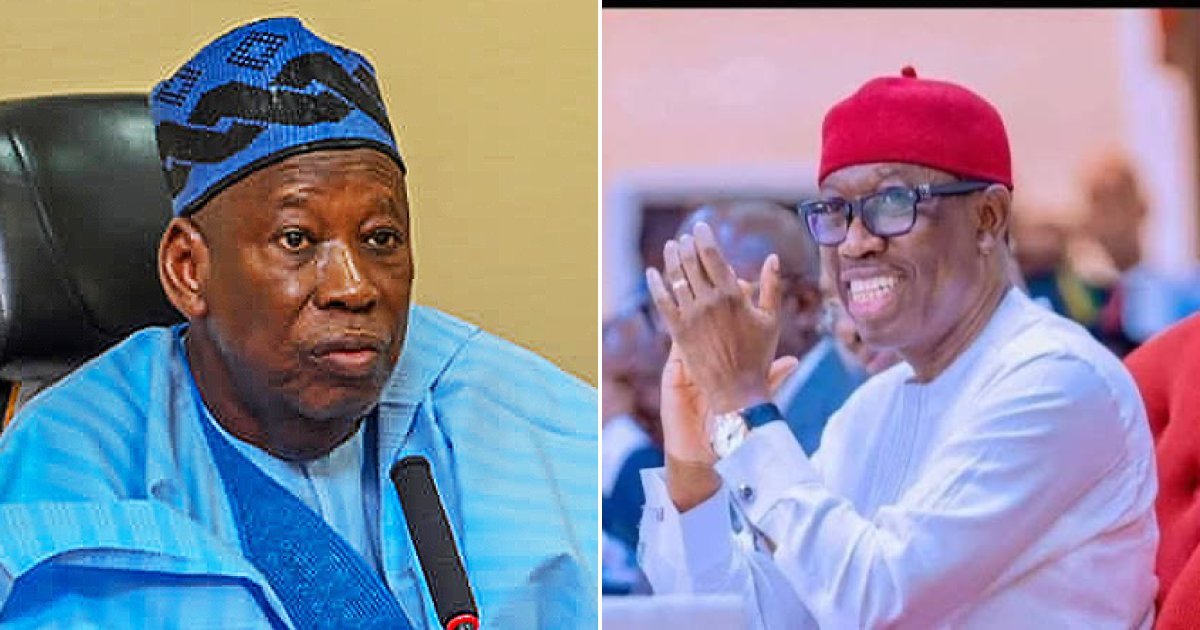
Former All Progressives Congress (APC) National Chairman Abdullahi Ganduje has referred to former Delta State Governor Ifeanyi Okowa as the former running mate of a “defunct” party, drawing attention to continuing political tensions surrounding the integration of former Peoples Democratic Party (PDP) members into the APC in Delta State.
Okowa was the PDP’s vice-presidential candidate alongside Atiku Abubakar in the 2023 presidential election before defecting to the APC in April 2025. The debate over his position within the ruling party has resurfaced amid allegations by former Delta State House of Assembly Speaker Victor Ochei that Okowa and his allies took control of the APC’s political structure in the state.

Key Highlights
- Ganduje’s reported “defunct” party remark has renewed attention to Okowa’s political past.
- Okowa was Atiku Abubakar’s running mate on the PDP ticket in the 2023 presidential election.
- Okowa and Governor Sheriff Oborevwori joined the APC in April 2025.
- Former Speaker Victor Ochei accused Okowa and his allies of taking over the APC structure in Delta State.
- The dispute highlights questions about party leadership, political inclusion and control of local party structures ahead of the 2027 elections.
Okowa’s Defection from PDP to APC
Okowa, who served as Delta State governor from 2015 to 2023, defected to the APC in April 2025 alongside Governor Sheriff Oborevwori and several political officeholders and party stakeholders previously associated with the PDP.
The move marked a major political realignment in Delta State, where the PDP had governed continuously since the beginning of Nigeria’s Fourth Republic in 1999.
At the time, APC leaders welcomed the defectors. Ganduje, who was then the party’s national chairman, expressed support for the new members, while Vice-President Kashim Shettima described the development as a major political shift in the South-South region.
Okowa explained that the decision was motivated by the need to strengthen Delta State’s relationship with the Federal Government and improve access to opportunities and resources from Abuja.
He also cited the PDP’s internal challenges as part of the circumstances surrounding the defection.
The move brought former political rivals and longstanding party members together under the APC platform, creating a new political arrangement in the state.
Victor Ochei Accuses Okowa of Taking Over APC Structure
The question of how the new entrants fit into the APC’s existing structures has become a subject of political debate.
In an interview aired on Arise News, Victor Ochei, a former Speaker of the Delta State House of Assembly and a Nigeria Democratic Congress (NDC) senatorial candidate for Delta North, accused Okowa and his allies of taking control of the APC structure after their defection from the PDP.
According to a report by TheCable published on October 17, 2026, Ochei said the development left members of his political camp aggrieved and contributed to his decision to leave the APC.
Ochei also alleged that the political arrangements following the defection made it difficult for members of his camp to pursue their ambitions within the party.
These claims represent Ochei’s account of the dispute. They should not be treated as independently established findings, and the allegations do not, on their own, establish the motives or position of every APC member in Delta State.
Ganduje’s ‘Defunct Party’ Remark Draws Attention
Ganduje made the remark while delivering a goodwill message at the fifth annual conference of the Forum of Former Deputy Governors of Nigeria, according to a report published by Leadership on October 20, 2026.
While acknowledging Okowa at the gathering, Ganduje referred to him as a former vice-presidential candidate of a “defunct party.” The wording was interpreted in the report as a sarcastic reference to the PDP, the platform on which Okowa contested the 2023 presidential election.
The remark has brought renewed attention to the political identities of former opposition figures who have joined the APC and the relationships they maintain with politicians who built their careers within the ruling party.
However, the comment alone does not establish whether Ganduje was expressing a broader concern about Okowa’s position in the Delta APC or making a passing political joke.
Read also:
- HURIWA Urges EFCC to Conclude Ifeanyi Okowa, Yahaya Bello Probe Ahead of Senate Race
- APC vs NDC: War of Words Erupts on Delta Facebook Pages as 2027 Election Mobilisation Begins
- Delta APC Inaugurates Campaign Council Thursday
Social Media Reactions Reflect Divided Opinions
Online discussions surrounding the political developments in Delta State have reflected different views about the impact of the mass defection on party structures.
Some commentators argue that although the party affiliation of prominent politicians has changed, their existing political networks and grassroots influence remain significant.
Others have focused on the importance of voter preferences, arguing that party structures and alliances do not necessarily determine election outcomes.
Such reactions reflect public commentary rather than verified evidence of how voters will behave in the 2027 general elections.
Delta APC Faces Questions Over Party Integration Ahead of 2027
The developments highlight a broader challenge facing political parties that absorb influential figures from rival platforms: balancing the interests of established members with those of new entrants.
In Delta State, the movement of Oborevwori, Okowa and other former PDP members into the APC altered the state’s political alignment and created new relationships within the ruling party.
The disagreement described by Ochei also illustrates how disputes over party structures, leadership influence and political opportunities can persist after defections.
With the 2027 general elections approaching, the management of internal relationships and the distribution of party responsibilities are likely to remain important issues for political stakeholders in Delta State.
Whether Ganduje’s remark carries any wider political significance remains unclear. What is evident from the reported exchanges is that Okowa’s defection and the subsequent contest over party structures continue to feature in discussions about Delta State politics.
For more Delta politics updates, follow us on X.