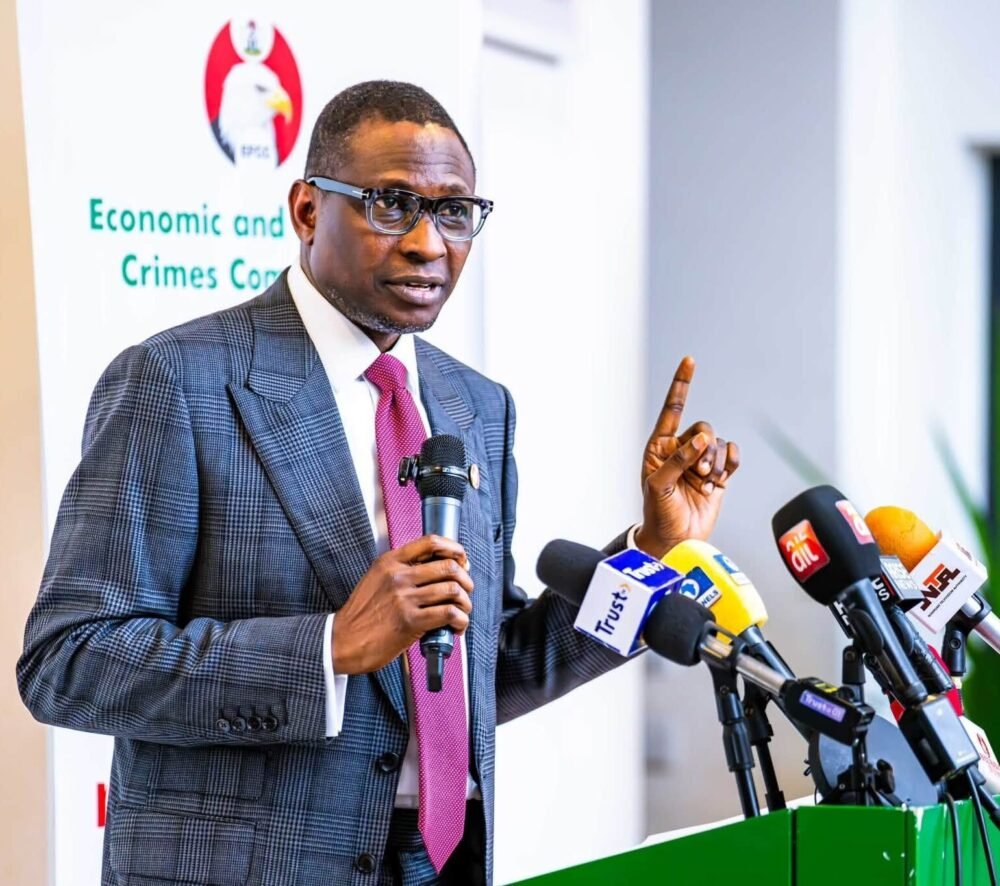
The Chairman of the Economic and Financial Crimes Commission (EFCC), Ola Olukoyede, has urged Christian and Muslim leaders across Nigeria to intensify their preaching against corruption and fraudulent practices.
Olukoyede made the call on Wednesday, September 23, 2026, at the second 2026 Council Meeting of the Nigeria Inter-Religious Council (NIREC) in Abuja, where the Anti-Corruption Interfaith Manual for religious leaders was launched.

Speaking on the theme, “Shared Sacred Flourishing in Nigeria,” the EFCC chairman said the wellbeing of the country depended largely on the actions and moral choices of individual citizens.
He said corruption undermined shared prosperity by diverting resources meant for the public into private hands.
“Corruption privatizes what is shared, converts the commonwealth into private advantage, and allows one person to flourish by making many others poorer,” Olukoyede said.
He added that the EFCC’s role was to protect the integrity of Nigeria’s commonwealth by investigating and prosecuting financial crimes.
The EFCC chairman said religious leaders had a crucial role to play in restoring the value of honesty and integrity in society.
According to him, Christianity and Islam can maintain their distinctive doctrines and traditions while encouraging their followers to work together for peace, justice, human dignity and national development.
Olukoyede said the EFCC had, through its interfaith framework, been engaging religious leaders on the need to incorporate anti-corruption messages into sermons and religious teachings.
“We believe that no religion condones corruption and no faith entertains fraudulent engagements,” he said.
He disclosed that the commission had worked with Christian and Muslim leaders over the years to develop the interfaith manual, which contains teachings from the two faith traditions on corruption and financial crimes.
“We are using this opportunity to launch the manual, which we hope our religious leaders will surely find useful in preaching anti-corruption messages to their members,” he said.
Olukoyede also stressed that corruption and financial crimes did not discriminate on the basis of religion, ethnicity or social status.
“Financial crime has no religion. Corruption has no tribe. Fraud does not become Christian or Muslim because of the identity of the person accused of committing it,” he said.
He explained that stolen public funds affected Nigerians irrespective of their religious affiliations, noting that poorly equipped hospitals, bad roads, unemployment and inflation affected both Christians and Muslims.
The EFCC chairman urged pastors and imams to use the manual to engage their followers on the consequences of corruption and why it should be rejected.
He said religious institutions had a responsibility that went beyond condemning corruption after it had occurred.
“The EFCC can investigate a person’s conduct. Faith communities can influence that person’s character. We can prosecute fraud. Religious teaching can cultivate honesty.
“We can confiscate illicit wealth. Churches and mosques can challenge the values that make society worship wealth without questioning its source. We can punish corruption after the event. Faith can help prevent it before it begins,” he said.
In his remarks, NIREC Executive Secretary, Prof. Cornelius Afebu Omonokhua, said the second edition of the anti-corruption preaching and teaching manual was developed through the Interfaith Anti-Corruption Advisory Committee (IAAC) of the EFCC.
He said the manual and facilitators’ guides were designed to assist Christian and Muslim preachers in presenting authentic religious teachings while promoting peaceful coexistence and the fight against corruption.
Omonokhua thanked Olukoyede for leading the anti-corruption campaign, describing the manual as an important tool for religious institutions.
“No nation can flourish in the face of corruption at all levels,” he said.
He argued that religious leaders who engaged in corrupt practices could not credibly claim to be upholding the teachings of their faith.
Omonokhua expressed optimism that the manual would help curb religious corruption and corruption motivated or enabled by false and unprofessional preaching.
Also speaking, Secretary to the Government of the Federation, George Akume, who represented President Bola Tinubu, said Nigeria’s religious diversity remained one of the country’s strengths.
Akume, however, lamented the security challenges confronting the country, including banditry, kidnapping, communal clashes and terrorism.
“Our nation is still passing through diverse challenges. Violence, orchestrated by criminal activities, banditry, kidnappings, communal clashes, terrorists’ activities have left wounds in our dear country,” he said.
He said insecurity had reached a point where parents in some parts of the country were afraid to allow their children to attend school.
Akume said the Federal Government was committed to protecting Nigerians, adding that the military, police and other security agencies were intensifying operations against criminal groups.
“This government will not relent until every Nigerian can live, work, travel and pray in safety,” he said.
Read also:
- EFCC Chairman Olukoyede Warns Nigerian Youths Against Get-Rich-Quick Syndrome
- Over 40 EFCC Officers Were Sacked For Corruption, Financial Malpractice — Olukoyede
- Olukoyede Lists Achievements, Says EFCC Recovered N1.233tn, Secured Over 10,000 Convictions In 3 Years
He called on religious and community leaders to complement government security efforts by speaking with one voice against violence, banditry and terrorism.
“Whenever leaders of faith, Christians, Muslims, traditional community leaders speak with one voice, it will reverberate across Nigeria to effectively counter the narrative of division and conflict,” Akume said.
He urged all religious groups to strongly condemn banditry and terrorism, describing the practices as a threat to human dignity.
The event was attended by the President of the Christian Association of Nigeria (CAN), Reverend Daniel Okoh; Sultan of Sokoto, Alhaji Muhammad Sa’ad Abubakar; former JAMB Registrar, Prof. Ishaq Oloyede; Emir of Zazzau, Alhaji Ahmed Nuhu Bamalli; and Shehu of Borno, Abubakar Umar El-Kanemi, among other dignitaries.