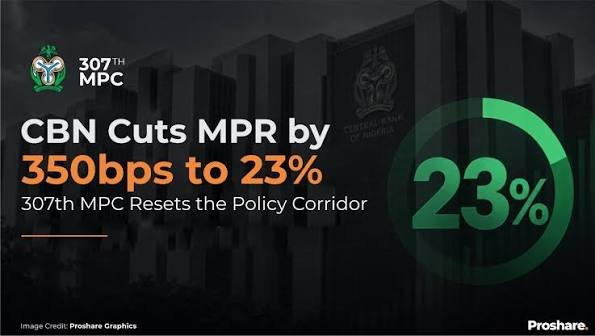
The Central Bank of Nigeria (CBN) has cut its benchmark interest rate by 350 basis points to 23 percent, marking the largest single reduction in the Monetary Policy Rate (MPR) on record.
CBN Governor Olayemi Cardoso announced the decision on Tuesday, September 22, 2026, after the two-day meeting of the Monetary Policy Committee (MPC) in Abuja.

Key Highlights
- CBN cuts the Monetary Policy Rate by 350 basis points to 23 percent.
- The reduction is the biggest single rate cut recorded by the apex bank.
- CBN Governor Olayemi Cardoso announced the decision after the MPC meeting in Abuja.
- The MPC adjusted the standing facility corridor around the MPR to +50/-300 basis points.
- Nigeria’s headline inflation eased slightly to 15.39 percent in August 2026.
- Analysts had previously warned that inflationary pressures could limit the scope for monetary easing.
CBN Reduces Benchmark Interest Rate
Cardoso said MPC members approved the 350-basis-point reduction in the benchmark interest rate as part of decisions taken at the September 2026 meeting.
The CBN also adjusted the standing facility corridor around the MPR to +50/-300 basis points.
The decision marks a significant shift in the direction of monetary policy after the apex bank maintained a tight monetary stance for an extended period in response to inflationary pressures.
Read also:
- Nigeria’s Inflation Slows To 15.39% As Food Price Growth Eases
- Finance Ministry, CBN Sign Agreement To Strengthen Fiscal, Monetary Policy Coordination
- CBN Cuts Interest Rate To 23%, Adjusts Monetary Policy Corridor
- World Bank: Nigeria Can Cushion Petrol Price Shock Without Restoring Fuel Subsidy
- CBN to Offer ₦900bn Treasury Bills on October 7 as One-Year Bill Dominates Q4 Auction
- Nigeria Financial Sector Faces Triple Pressure as Insurers Raise ₦1.08 Trillion, CBN Cuts Rates
t
Inflation Moderates in August
The rate cut comes as Nigeria’s headline inflation rate recorded its third consecutive monthly decline.
According to data from the National Bureau of Statistics (NBS), headline inflation eased to 15.39 percent in August 2026 from 15.43 percent in July.
The moderation in inflation provided the MPC with additional room to consider easing monetary conditions, although concerns over potential inflationary pressures remain.
Analysts Warn of Inflation Risks
Ahead of the MPC meeting, analysts polled by BusinessDay had argued that the decline in inflation was not yet sufficiently strong to support monetary easing.
They cited renewed pressure from higher global oil prices, energy and transportation costs as potential risks to the inflation outlook.
Analysts also raised concerns that increased government spending and other economic activities associated with the approach to the 2027 general elections could create additional inflationary pressure.
The CBN’s latest decision therefore comes amid competing considerations around supporting economic activity while maintaining price stability.
For more updates on this and other developing stories, follow us on X.
Related Stories: