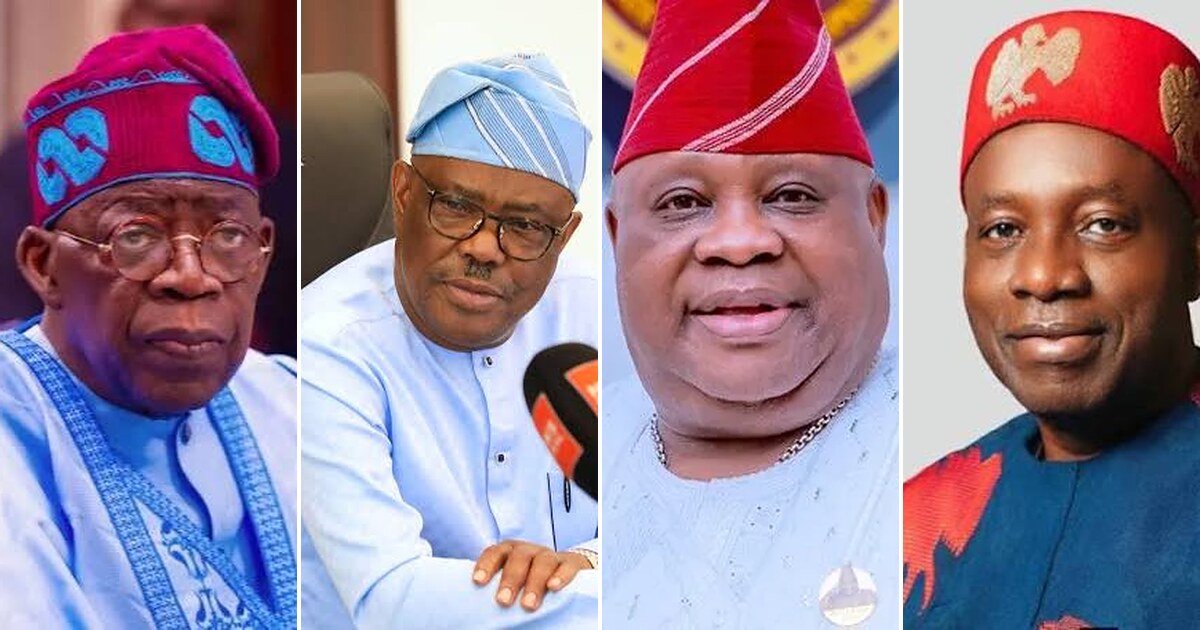
The All Progressives Congress (APC) has faced criticism after expanding its 2027 presidential campaign council to include prominent politicians affiliated with other parties, including FCT Minister Nyesom Wike, Anambra State Governor Chukwuma Soludo and Osun State Governor Ademola Adeleke. The African Democratic Congress (ADC) has condemned the move, describing the inclusion of opposition figures as “political abduction” and accusing President Bola Tinubu and the ruling party of undermining genuine political competition ahead of the January 16, 2027 presidential election.
Key Highlights
- APC expands Tinubu’s 2027 presidential campaign council to include Wike, Soludo and Adeleke.
- ADC describes the inclusion of opposition-affiliated politicians as “political abduction” and “political banditry.”
- Wike reportedly refuses to shake hands with Imo Governor Hope Uzodimma during the council’s inauguration.
- Tinubu says he may not attend every campaign rally, citing the need to focus on governance.
- The expanded council assigns campaign coordination roles to politicians from different states and political backgrounds.
- The move sparks debate over party loyalty, cross-party alliances and political discipline ahead of the 2027 election.
- Social media reactions range from criticism of the arrangement to support for a broader political coalition.
APC Expands Tinubu’s 2027 Presidential Campaign Council
The APC has revised its presidential campaign council as the ruling party steps up preparations for the 2027 general elections.

According to the published list, President Tinubu will head the council, with Vice-President Kashim Shettima and APC National Chairman Nentawe Yilwatda serving as vice-chairmen. Senator Abdulaziz Yari has been named Director-General.
The expanded structure also assigns campaign coordination responsibilities to several prominent politicians whose political affiliations extend beyond the APC.
Wike, a member of the Peoples Democratic Party (PDP) and the Minister of the Federal Capital Territory, is listed as coordinator for Rivers State and the FCT. Soludo, of the All Progressives Grand Alliance (APGA), is assigned responsibility for Anambra State, while Adeleke, associated with the Accord Party, is named coordinator for Osun State.
The appointments have triggered questions about how the ruling party intends to manage campaign responsibilities involving politicians who remain publicly associated with other political platforms.
ADC Accuses APC of ‘Political Abduction’
The African Democratic Congress has strongly criticised the expanded campaign council.
Kola Ologbondiyan, Director of Media and Publicity of the ADC Presidential Campaign Council, described the inclusion of opposition-affiliated governors as “political abduction” and “political banditry.”
He accused Tinubu and the APC of using the influence of the presidency to draw opposition figures into the ruling party’s campaign structure, rather than allowing political competition to develop through clearly defined party platforms.
Ologbondiyan called on Nigerians, the media, civil society organisations and the international community to resist what he characterised as an attempt to undermine opposition politics.
The ADC’s remarks reflect its criticism of the campaign council’s composition. However, the appointments alone do not establish that the named politicians have defected to the APC or formally abandoned their existing party affiliations.
Wike, Uzodimma Encounter Highlights Political Tensions
Tensions also surfaced during the campaign council’s inauguration, when Wike reportedly refused to shake hands with Imo State Governor Hope Uzodimma.
Wike also warned that political actors should not claim victory without delivering electoral support in their respective states.
The exchange attracted attention against the backdrop of Wike’s political relationship with the APC-led Federal Government and his continued association with the PDP.
His Rainbow Coalition and cross-party alliances have also generated disagreements among political actors over the boundaries between cooperation with the government and loyalty to party structures.
Uzodimma and other APC governors had previously expressed concerns about political arrangements outside the party that they believed could weaken its candidates or organisational cohesion.
The reported encounter illustrates the challenges the APC may face in coordinating politicians with different party affiliations and political interests within one presidential campaign structure.
Tinubu Says Governance May Limit Campaign Rally Attendance
Tinubu has also indicated that he may not attend every campaign rally ahead of the 2027 presidential election.
Speaking at the council’s inauguration, the President said he had accepted advice that electioneering should not distract him from his responsibilities as head of state.
He argued that Nigeria required sustained attention, pointing to the government’s financial obligations, creditors and the need to attract investment.
Tinubu therefore asked members of the campaign council to lead mobilisation efforts while he continued to oversee government business and address Nigerians when necessary.
The remarks suggest that the expanded council is expected to take on a significant role in organising campaign activities and coordinating support across the states.
Read also:
- 2027 Elections: Ebonyi APC Criticises Tinubu’s Campaign Council Over Wike, Soludo, Adeleke Appointments
- INEC Releases Final List of 18 Delta Governorship Candidates for 2027 Election as Online Campaigns Intensify
- EFCC Reopens Atiku Abubakar Investigation After Fresh Petition by Ex-Lawmaker
- Shettima Mocks Atiku’s Fuel Subsidy Plan as Akpabio Hails Tinubu’s ‘Unity Government’ Amid Online Backlash
Social Media Debate Focuses on Party Loyalty
The composition of the campaign council has generated mixed reactions on social media, particularly on X.
Some commentators questioned the inclusion of politicians associated with the PDP, APGA and Accord, arguing that the arrangement could blur the distinction between the ruling party and the opposition.
Others raised concerns about internal party discipline and the possibility of conflicting political interests within the expanded council.
Some critics also contrasted elite political cooperation with what they described as the need for broader public support, arguing that electoral outcomes ultimately depend on voters.
Other reactions were more supportive of the arrangement, interpreting the appointments as an attempt to broaden political engagement and build a wider coalition behind Tinubu.
The online responses represent individual opinions and do not necessarily reflect the views of the wider electorate.
What the Expanded Council Means for the 2027 Election
The APC’s revised campaign council highlights the importance of political alliances as parties prepare for the January 16, 2027 presidential election, which will be conducted by the Independent National Electoral Commission (INEC).
For the ruling party, involving influential politicians from different political backgrounds could broaden its campaign network and provide additional state-level coordination.
At the same time, the arrangement raises questions about party affiliation, accountability and the ability of politicians to reconcile campaign responsibilities with their existing political commitments.
The ADC’s criticism adds another dimension to the debate, with the opposition party arguing that the arrangement threatens the principles of competitive multiparty politics.
As the election approaches, the performance of the campaign council, the conduct of political parties and the responses of voters will shape discussions about alliances, party loyalty and the contest for the presidency.
For more updates on the 2027 elections, follow us on X.