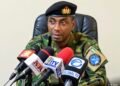
The Chief of Civil-Military Relations of the Nigerian Air Force, Air Vice Marshal Edward Gabkwet, has identified delayed intelligence sharing as a major factor undermining security operations across Nigeria, warning that critical information often reaches security agencies days after criminal elements have relocated.
Speaking at the maiden Delta State Security Summit held in Asaba on Wednesday, Gabkwet said timely intelligence remains the most effective weapon against terrorism, banditry, kidnapping and other forms of criminality.
Delivering a lecture titled: “Communities as First Line of Defence” under the summit theme, “Security: A Collective Responsibility,” the air vice marshal revealed that the Nigerian Air Force receives thousands of intelligence reports from across the country, but lamented that a significant percentage of such information arrives too late for effective action.

“We receive thousands of information at the Air Force, but sometimes more than half of those informations get to us two or three days after the incidents have occurred, which sometimes leads to failed operations and even wrong airstrikes,” he said.
According to him, security agencies do not act on intelligence reports without proper verification and investigation, stressing that by the time some reports are received, the criminals involved may have already left the affected communities.
He urged citizens to promptly report suspicious activities, movements and gatherings to security agencies, noting that criminal activities often exhibit visible warning signs before they occur.
“Signs of criminality are usually obvious. Suspicious movements, unusual gatherings, inflammatory remarks and other indicators are there. Communities must pay attention and report promptly,” he added.
Gabkwet also attributed the increasing prevalence of kidnapping across the country to its profitability and lower risk compared to armed robbery.
According to him, many criminals who previously engaged in armed robbery have migrated to kidnapping because it offers higher returns with less direct confrontation with security personnel.
“An armed robber will ask himself why he should block a highway and risk being killed by the police when he can simply kidnap and demand ransom.
“Kidnapping has become more attractive because it is less risky and more lucrative,” he stated.
The air force chief further warned against excessive disclosure of personal movements and activities on social media, saying criminals now exploit such information to track and target potential victims.
“You see people posting that they are travelling abroad, returning from abroad, going to church or attending events. Criminals monitor these platforms and can easily plan abductions based on such information,” he cautioned.
Earlier, Governor Sheriff Oborevwori, while formally declaring the summit open, emphasized that security remains the foundation of development, economic growth and social stability.
The governor said the summit was convened as part of proactive efforts by his administration to strengthen security across the state through collaboration among government, security agencies, traditional institutions, community leaders and residents.
He noted that while government would continue to provide resources, logistics and policy direction, sustainable security could only be achieved through collective responsibility and active citizen participation.
Governor Oborevwori disclosed that the state had continued to strengthen its security architecture through the restructuring of ‘Operation Delta Sweep’, support for security agencies, establishment of divisional police headquarters in all 25 local government areas and the creation of the Delta State Security Trust Fund.
He said the state government was also procuring operational vehicles, communication equipment and other logistics while investing in the training of security personnel.
Read also:
- NAF redeploys officers under ‘Operation FANSAN YAMMA’, other operational theatres
- NAF hold intelligence, security training for its Special Forces
- NAF investigate alleged civilian casualties in Yobe airstrike
The governor stressed that security agencies depend heavily on credible intelligence from the public.
“If information is not shared, security agencies cannot act effectively. Security personnel are not magicians. They rely heavily on credible intelligence and information from members of the public,” he said.
Governor Oborevwori condemned acts of terrorism across the country and urged residents to remain vigilant and report suspicious activities to law enforcement authorities.
The summit featured goodwill messages from heads of various security agencies, presentations by the state Commissioner of Police, Yemi John Oyeniyi, and representatives of the army, navy, Department of State Services, Defence Intelligence Agency, NSCDC and NDLEA.
Participants drawn from traditional institutions, local government councils, community leadership structures, youth groups, civil society organisations, market associations and transport unions also made contributions and adopted recommendations aimed at strengthening community-based security and intelligence gathering across the state.