As political alignments ahead of the 2027 presidential election continue to take shape, growing conversations around regional alliances and emerging opposition figures have triggered fresh debate over whether President Bola Ahmed Tinubu is facing a coordinated political resistance from the South.
Key Highlights:
•Opposition figures from the South are gaining momentum ahead of 2027
•Peter Obi, Seyi Makinde, Donald Duke and Omoyele Sowore remain influential southern voices
•Atiku Abubakar’s ADC emergence revives North-South political calculations
•Analysts debate whether current alignments amount to a “southern gang-up” against Tinubu
•APC still retains strong structures and incumbency advantage nationwide
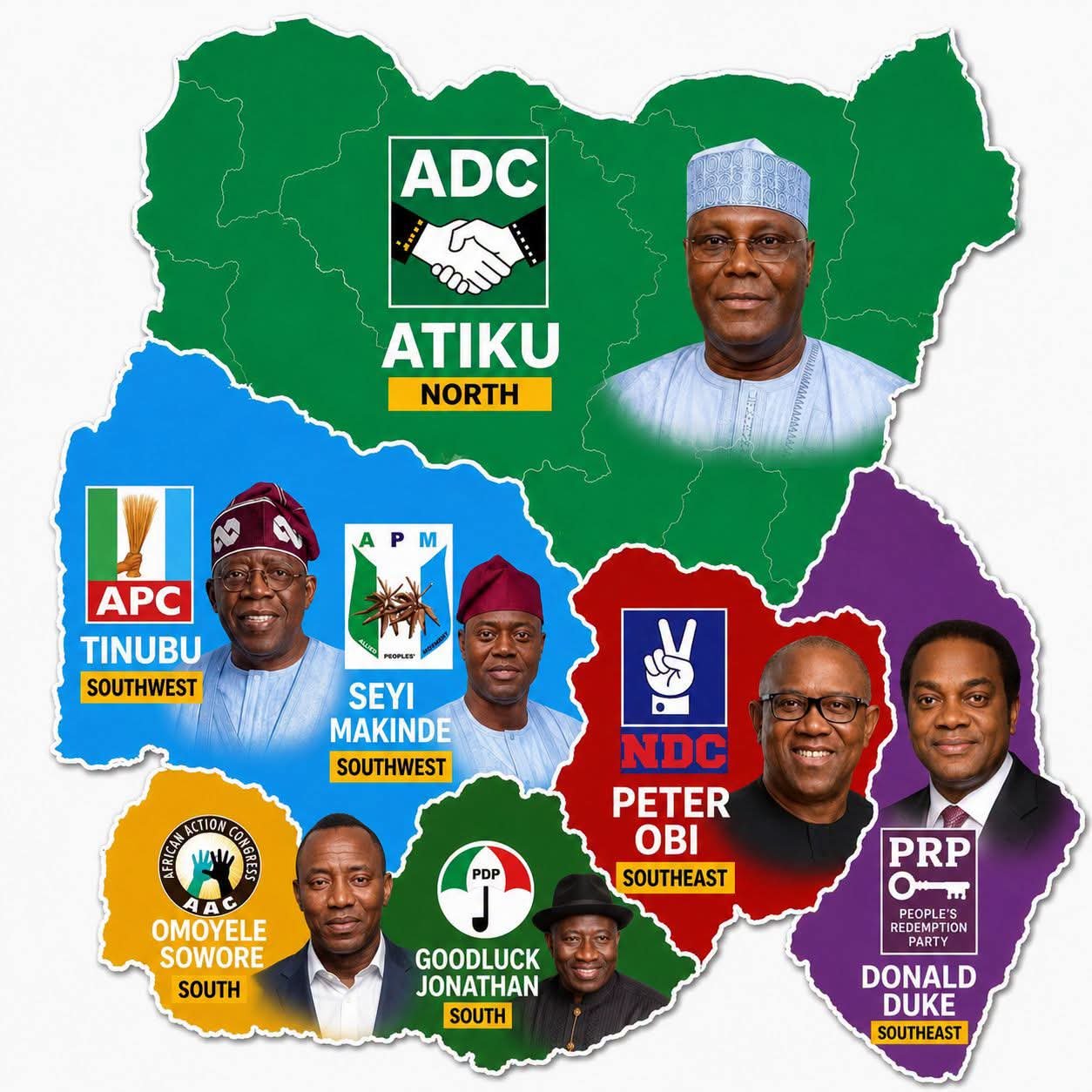
The political map gradually emerging ahead of the 2027 elections presents an interesting picture. While President Bola Tinubu remains the dominant figure within the ruling All Progressives Congress (APC), several influential southern politicians are also positioning themselves or being projected by supporters as possible alternatives in the next presidential contest.

Across the South-East, former Labour Party presidential candidate Peter Obi continues to command strong grassroots appeal, especially among youths and urban voters. His growing association with the Nigeria Democratic Congress (NDC) has further strengthened speculation that a broader coalition may be the likely presidential candidate of the party.
In the South-West, Oyo State Governor Seyi Makinde is increasingly viewed as one of the strongest emerging political figures outside the APC structure. His national profile and strategic influence within opposition circles continue to generate attention. He is likely going to be the presidential candidate of the Allied Peoples Movement (APM).
Former Cross River State Governor Donald Duke has also resurfaced in national conversations under the Peoples Redemption Party (PRP), while activist and African Action Congress (AAC) leader Omoyele Sowore remains vocal in mobilising anti-establishment supporters, particularly among younger Nigerians.
At the centre of the northern bloc remains former Vice President Atiku Abubakar, who recently secured the ADC presidential ticket and appears determined to build another broad-based coalition against the ruling APC ahead of 2027.
Political observers say the situation does not yet amount to a direct southern conspiracy against Tinubu, but rather reflects growing dissatisfaction among segments of the political class and electorate over economic hardship, insecurity, inflation and governance concerns.
Others, however, argue that the emergence of multiple southern political figures outside the APC may indirectly weaken Tinubu’s traditional support base in the South, especially if opposition parties eventually unite behind a single candidate.
The South-East remains one of the biggest battlegrounds. Peter Obi’s continued popularity in the region poses a major challenge to APC’s expansion efforts there. Similarly, pockets of dissatisfaction in parts of the South-West over economic conditions may test Tinubu’s political dominance in his traditional stronghold.
Read also:
- Ogoni Survival: MOSOP warns of renewed opposition over political marginalisation ahead of 2027 elections
- Group launches ‘Presidency Project’ ahead of 2027 elections
- Paul Enenche slams imposition, violence in politics ahead of 2027 elections
Despite these developments, many believe that President Tinubu still enjoys significant advantages as incumbent president. The APC controls a large number of states, possesses extensive grassroots structures, and retains influence across key northern political blocs.
There is also uncertainty over whether opposition figures can truly unite. Historically, coalition politics in Nigeria often collapses under the weight of personal ambitions, zoning disagreements, and party rivalries.
For now, the emerging political landscape suggests less of a coordinated “southern gang-up” and more of a fragmented search for alternative leadership ahead of 2027.
What remains clear is that the next presidential election may evolve into one of Nigeria’s most competitive political battles in recent history, with regional loyalties, economic realities and coalition-building expected to shape the final outcome.