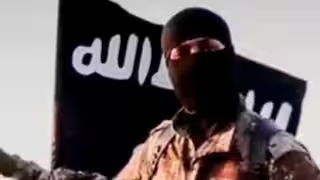
The Defence Headquarters has revealed fresh details about the activities of slain ISIS commander Abu-Bilal al-Minuki, describing him as a major figure in the global terrorist network for more than a decade.
According to the Defence Headquarters, al-Minuki was killed during a joint counterterrorism operation carried out by Nigerian and United States forces.

Key Highlights:
- The Defence Headquarters said ISIS commander Abu-Bilal al-Minuki was killed in a joint Nigerian–U.S. counterterrorism operation.
- He was described as a high-ranking ISIS figure involved in global operations for over 10 years.
- His roles reportedly included weapons production, drone development, propaganda, and financial coordination for ISIS.
- He was previously linked to Boko Haram activities and alleged involvement in major attacks in Nigeria.
- The military called his killing a major setback for ISIS operations in Nigeria, the Lake Chad Basin, and the Sahel.
The operation was earlier confirmed by United States President Donald Trump, who described al-Minuki as “the most active terrorist in the world” and claimed he served as the second-in-command of ISIS globally.
In a statement issued on Saturday, the Director of Defence Information, Samaila Uba, said al-Minuki played a central role in ISIS operations, including weapons production, drone development, media coordination, and economic warfare.
The military said intelligence reports indicated that al-Minuki may have been promoted in February 2026 to head the ISIS General Directorate of States, effectively making him one of the highest-ranking leaders in the organisation worldwide.
Read Also:
- Iran executes man for allegedly spying for US, Israel
- Global Oil prices surge above $104 as Trump rejects Iran’s peace conditions
- Trump rejects Iran’s peace proposal to end war
Before joining ISIS in 2015, the military said al-Minuki was a senior figure within Boko Haram.
The Defence Headquarters also linked him to the 2018 Dapchi schoolgirls kidnapping and accused him of coordinating attacks across West Africa and the Sahel through ISIS-affiliated networks.
According to the military, al-Minuki also facilitated the movement of fighters to Libya between 2015 and 2016 to support ISIS operations in North Africa.
The Defence Headquarters described his death as a major breakthrough in the fight against terrorism in Nigeria, the Lake Chad Basin, and the wider Sahel region, noting that his elimination disrupts a key operational link within ISIS’ international network.