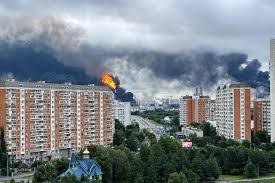
Ukraine has carried out what Russian authorities described as the largest drone attack on Moscow since the start of the war, targeting energy facilities, industrial sites and areas surrounding the Russian capital in a coordinated overnight operation.
Key highligt:

- Massive Drone Offensive: Ukraine launched one of its largest drone attacks on Russia since the war began, targeting Moscow and other strategic locations.
- Casualties and Damage: The strikes injured at least 17 people in the Moscow region, killed one person in Rostov, and caused fires at oil and industrial facilities.
- Russian Air Defenses Activated: Russia claimed it intercepted or destroyed nearly 1,000 Ukrainian drones and four cruise missiles within 24 hours.
- Major Disruptions: The attacks forced the temporary closure of Moscow’s airports, leading to more than 500 flight cancellations and delays.
- Conflict Escalation: Ukrainian President Volodymyr Zelenskyy said the strikes were retaliation for Russian attacks on Ukraine, highlighting the growing use of long-range strikes by both sides in the war.
The strikes reportedly injured at least 17 people in the Moscow region, disrupted air travel and triggered fires at multiple locations. Russian officials also confirmed that an oil depot in the southern Rostov region was hit, resulting in one fatality.
According to Russia’s Defence Ministry, nearly 1,000 Ukrainian drones and four cruise missiles were intercepted or destroyed across the country within a 24-hour period, making it one of the most extensive aerial assaults of the conflict.
Among the reported targets was the Kapotnya Oil Refinery in southeastern Moscow. The facility was reportedly struck for the third time within a month and for the second time in the same week.
Videos circulating on social media appeared to show a large explosion at the refinery, with thick smoke rising above the surrounding area. Reports also indicated that a nearby shopping complex caught fire after being struck by falling drone debris, prompting the evacuation of residents from several high-rise buildings.
The attacks caused significant disruption to air travel, with authorities temporarily suspending operations at Moscow’s four major airports. More than 500 flights were reportedly delayed or cancelled as a result.
Although Russian authorities have restricted the publication of images showing the aftermath of drone strikes, numerous videos shared online appeared to show drones flying over parts of Moscow and explosions near industrial facilities on the outskirts of the city.
Responding to the operation, Ukrainian President Volodymyr Zelenskyy described the strikes as a form of “long-range sanctions” against Russia. He said they were carried out in response to a recent Russian missile attack on Kyiv that reportedly damaged a significant religious site.
Read also:
- Iran suspends military operation against Israel
- Magyar ousts Orbán after 16 years in historic Hungary election
- NSC Boss Dikko Hails Outstanding Performances At ITF World tennis
Zelensky reiterated his call for a diplomatic resolution to the conflict, while warning that continued attacks on Ukraine would have consequences for Russia.
The latest offensive highlights Ukraine’s expanding long-range strike capabilities. Since first reaching Moscow with drones in 2023, Ukrainian forces have increasingly demonstrated the ability to target locations hundreds of kilometres inside Russian territory.
Meanwhile, Ukrainian officials accused Russia of launching more than 200 drones and several ballistic missiles against targets across Ukraine during the same period, underscoring the continuing escalation of hostilities despite growing international appeals for peace negotiations.
Russian President Vladimir Putin, who was attending a regional summit in Kazan at the time of the attacks, had not publicly commented on the incident as of press time.
Ukraine’s Foreign Minister, Andrii Sybiha, also reacted to the strikes on social media, arguing that the attacks were a direct consequence of Russia’s military campaign in Ukraine and urging Russians to press for an end to the war.
The exchange of attacks marks another significant escalation in a conflict that has increasingly extended beyond frontline battlefields to include long-range strikes on critical infrastructure and major urban centres in both countries.