Traffic congestion has returned to the First Niger Bridge linking Anambra and Delta States, barely days after its reopening following emergency repairs, sparking criticism of the federal government’s handling of traffic management on the busy route.
Key Highlights
- Gridlock returns to the First Niger Bridge days after it reopened following emergency repairs.
- The congestion was reportedly triggered by a broken-down vehicle obstructing movement.
- Nigerians on X question the absence of towing vans promised for both ends of the bridge.
- Some users fault the bridge’s design and lane demarcation; others blame driver behaviour.
- Concerns mount over traffic on the route as the festive season approaches.
The renewed gridlock, reportedly triggered by a broken-down vehicle obstructing movement, has raised questions about the availability of towing services and the effectiveness of measures introduced during the bridge’s rehabilitation.

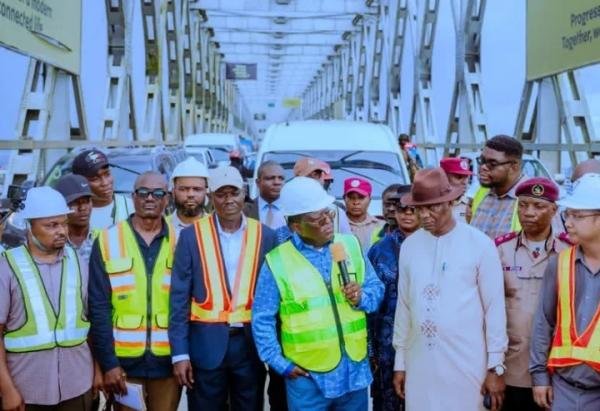
The development has also reignited public debate over the bridge’s design, traffic control arrangements and the durability of the recent intervention supervised by the Minister of Works, David Umahi.
A Critical Link Between The South-East And Other Regions
The First Niger Bridge, which was opened in 1965, is a major transport link between the South-East and other parts of the country.
It serves commuters, commercial drivers and businesses transporting goods between the Southeast, South-South and other regions.
Its importance becomes particularly pronounced during festive periods, when increased travel and commercial activities put additional pressure on the route.
The bridge was reopened in mid-October after emergency repairs led by Umahi. The intervention reportedly included the installation of closed-circuit television cameras, solar-powered lighting and additional traffic management features.
However, the return of gridlock shortly after the reopening has prompted questions about whether adequate contingency arrangements were put in place to deal with vehicle breakdowns and other emergencies.
Nigerians React On X
Reacting to the situation on X, @Chude questioned the absence of towing vehicles, which the authorities were reportedly expected to provide.
“Barely a week after the bridge was opened, this has become the norm. Where is the towing van they said they would station at both ends of the bridge?”
Another user, H.M.C O (@homemadecartel), expressed concern about the potential impact of the traffic situation during the festive season.
“People will suffer greatly on this bridge during the festive season. Nigeria’s rulers are evil incarnates. In their coven, they only plan how to make things harder for the people.
“I wish the people would one day have the mind to challenge them. They are human too but behave like gods to Nigerians. It’s sickening and an eyesore.”
Akinrinmade (@Akinrinmade) questioned the bridge’s design, arguing that the structure should allow traffic to continue moving when a vehicle breaks down.
“Looking at the design of this bridge, you can’t help but question the level of planning that went into it. A major road like this should have enough room to accommodate vehicles when one breaks down without bringing the entire place to a standstill.
“Sadly, proper infrastructure seems to take a back seat while those in charge focus on their own interests. Ordinary citizens deserve better than this,” the user said.
Similarly, Ademola (@AdemolA371) criticised the structure, suggesting that its design contributed to the traffic problem.
“See the structure of the building you will know the person that built it is not professional.
“There should be enough space that can occupy 2/3 cars in one lane, but nah every opportunity they get is all about how to loot’s. Evening ordinary people can construct this bridge like this.”
However, Manasseh Ukeredi (@Master of koin) urged Nigerians to consider the circumstances behind the congestion, drawing attention to driving behaviour and the need for emergency response arrangements.
“Let us learn to assess some situations from a non-critic point of view. I ply this road frequently, and driving in a third lane or overtaking is a major cause of traffic on this bridge.
“The demarcation helps put a check on that. However, there should be two standby towing vans, one at the exit point of each lane, to quickly remove vehicles that break down and obstruct traffic.”
Another X user, @vj3hvcv, also criticised the traffic arrangement and accused the minister of politicising the project.
“Even a mad man would know that demarcating a 2 lane bridge is a wrong idea but for the sake of sycophancy the clueless minister wants to politicize everything.
“There’s nothing wrong in renovating a bridge and credit to them for that but this what I call oversabi. Desperation.”
The reactions reflect differing views about the causes of the congestion, with some users blaming the bridge’s physical configuration and others pointing to driver behaviour and the absence of readily available towing services.
Read also:
- FG Reopens 1st Niger Bridge After Rehabilitation, Orders Reconstruction Of Benin-Asaba Highway
- FRSC Confirms No Life Lost In Crash On Enugu-Onitsha Expressway
- Umahi Says Lagos-Calabar Coastal Highway Is Not Abandoned, Explains East-West Road Realignment
- Tinubu Orders Reconstruction of Benin-Asaba Road as FG Reclaims Highway From Concessionaire
The debate comes amid wider public scrutiny of major road projects under Umahi, including the Lagos-Calabar Coastal Highway, which has attracted attention over construction progress and compensation disputes involving affected property owners.
While the latest gridlock has not, by itself, established that the emergency repairs were poorly executed, it has highlighted the importance of effective traffic management and rapid-response services on critical transport infrastructure.
With the festive season approaching, motorists and other road users are likely to be particularly concerned about whether the relevant authorities will deploy towing vehicles and strengthen emergency response arrangements to prevent minor incidents from causing prolonged traffic disruptions.
For many commuters, the immediate concern is not only the condition of the bridge but also how quickly authorities can clear obstructions and keep traffic moving on one of the country’s most important interregional transport links.
For more updates on roads and infrastructure in the South-East and South-South, follow us on X.