
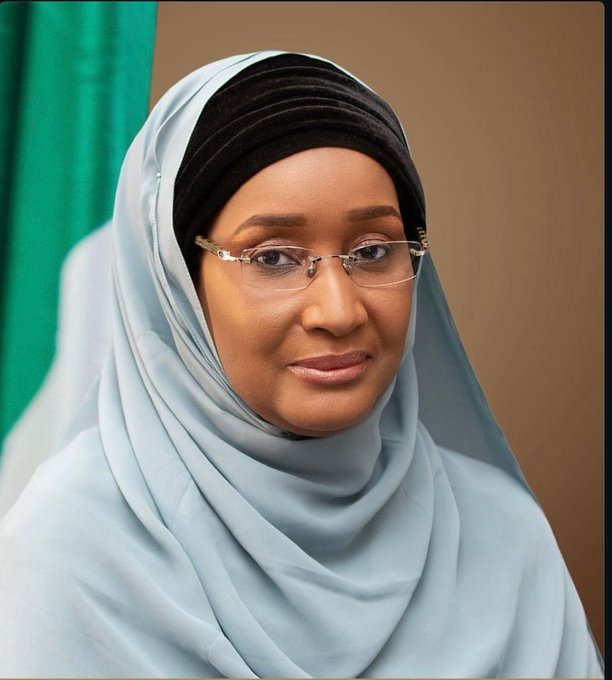
Former Minister of Humanitarian Affairs and Poverty Reduction, Sadiya Umar Farouq, is once again at the centre of intense legal and public scrutiny following reports that the Economic and Financial Crimes Commission (EFCC) has declared her wanted over ongoing corruption investigations linked to Nigeria’s multi-trillion-naira social intervention programmes.
The development marks a dramatic escalation in a years-long probe into alleged financial misconduct during her tenure between 2019 and 2023 under former President Muhammadu Buhari.
Farouq, who supervised major federal schemes such as N-Power, GEEP, Conditional Cash Transfer, and the National Home-Grown School Feeding Programme, is accused of presiding over one of the most controversial social spending portfolios in recent Nigerian history.

Investigators have previously linked her to allegations of laundering about N37.1 billion, alongside broader claims of diversion, abuse of office, and questionable contract awards tied to humanitarian intervention funds.
Key Highlights:
- Sadiya Umar Farouq is reportedly under intensified investigation by the Economic and Financial Crimes Commission over alleged corruption linked to federal social intervention programmes.
- Investigators reportedly linked Farouq to allegations involving about N37.1 billion, including claims of money laundering, abuse of office, diversion of public funds, and questionable contract awards.
- The EFCC reportedly declared her wanted after she allegedly failed to honour invitations, court appearances, and directives connected to ongoing investigations and legal proceedings.
- Major programmes under scrutiny include N-Power, GEEP, Conditional Cash Transfer, and the National Home-Grown School Feeding Programme, all of which faced criticism over alleged irregularities and poor fund management.
- Thousands of N-Power beneficiaries reportedly experienced unpaid stipends, inconsistent payments, and sudden disengagements, leading to public protests and criticism of the ministry’s operations.
- Despite the allegations and ongoing investigations, no court has convicted Farouq, and legal experts stress that any penalties would depend on proof of guilt beyond reasonable doubt in court.
According to reports based on court filings and investigative updates, the EFCC recently declared the former minister wanted after she allegedly failed to respond to repeated invitations, court appearances, and official directives connected to multiple financial crime investigations.
The allegations under probe include:
- Alleged diversion of public funds running into billions of naira
- Abuse of office and breach of public trust
- Money laundering linked to intervention programmes
- Questionable contract awards under humanitarian schemes
Authorities are also said to have secured court-issued warrants following her alleged failure to appear for scheduled hearings in ongoing proceedings.
The EFCC maintains that investigations are still active and no final conviction has been reached.
Court records referenced in the ongoing matter indicate that multiple bench warrants were issued after her alleged failure to appear before judges handling related cases.
Prosecutors have also raised concerns over compliance with judicial directives, including orders relating to attendance in court and the surrender of travel documents during investigation.
Legal representatives, in earlier filings, reportedly argued that the former minister was unavailable due to medical-related travel abroad, a claim that has been subject to legal and public debate.
Under Nigerian law, failure to obey court orders may lead to contempt proceedings, additional charges, or enforcement actions, including arrest and detention upon execution of warrants.
At the heart of the controversy is the N-Power programme, created to provide stipends and skills training for unemployed Nigerian youths.
Under Farouq’s supervision, the scheme became widely criticised due to:
Months of unpaid stipends
Irregular and inconsistent payments
Sudden disengagement of beneficiaries without explanation
Read also:
- EFCC declares ex-minister Sadiya Farouq wanted over alleged fraud
- N-Power beneficiaries demand arrest of ex-minister, lament delayed payment of stipend
- FG to spend N999m daily on feeding 10m pupils
Thousands of young Nigerians who depended on the programme for survival reportedly faced severe financial hardship, triggering protests and sustained public criticism of the ministry’s management.
The National Home-Grown School Feeding Programme also came under scrutiny, particularly during COVID-19 lockdowns when schools were closed nationwide.
Civil society organisations questioned continued expenditure despite school closures, demanding transparency over how funds were disbursed and utilised.
Similarly, the GEEP loan programme, designed to support petty traders and low-income earners, faced allegations of inconsistent disbursement, weak monitoring, and unclear repayment structures.
Although no court has convicted Farouq over these schemes, the controversies significantly eroded public confidence in Nigeria’s social intervention architecture.
The scandal surrounding social intervention funds also drew in public attention to figures outside government, including Nigerian entertainer D’banj, who was previously questioned over alleged links to N-Power fund disbursements.
He denied wrongdoing and was released after interrogation, but the case intensified scrutiny of how intervention funds were managed.
Several contractors and ministry officials were also reportedly investigated over financial transactions linked to humanitarian projects.
During and after her tenure, social media narratives circulated unverified claims alleging personal ties and possible marriage arrangements between Farouq and former President Muhammadu Buhari.
However, no official documentation or credible evidence has ever supported these claims, and they remain unverified political rumours.
Observers have repeatedly noted that such narratives, while widely circulated online, have no bearing on the legal allegations currently under investigation.
Although Farouq has not been convicted, Nigerian law provides strict penalties for offences currently under investigation. If proven guilty in court, possible consequences may include:
Money Laundering (Under Nigerian anti-money laundering laws):
7–10 years imprisonment per count
Full forfeiture of assets linked to proceeds of crime
Criminal Breach of Trust / Abuse of Office:
Up to 14 years imprisonment depending on severity
Restitution of misappropriated public funds
Fraud / Obtaining by False Pretence:
Imprisonment and financial penalties
Recovery of stolen or diverted funds
Contempt of Court / Obstruction of Justice:
Jail term or fines
Additional charges for refusal to comply with court orders
Asset Forfeiture:
- Permanent seizure of assets linked to illegal proceeds
- Legal experts stress that penalties would only apply if guilt is established beyond reasonable doubt by a competent court.
- The ongoing controversy remains one of the most closely watched corruption-related investigations involving Nigeria’s social investment programmes.
- Analysts say the outcome could shape future reforms in how poverty alleviation funds are managed, monitored, and audited.
- Anti-corruption advocates continue to push for stronger oversight systems, independent auditing of intervention programmes, and stricter accountability measures to protect funds intended for vulnerable Nigerians.
- For now, the case remains unresolved defined by allegations, denials, and an ongoing legal process that will ultimately determine the final outcome.