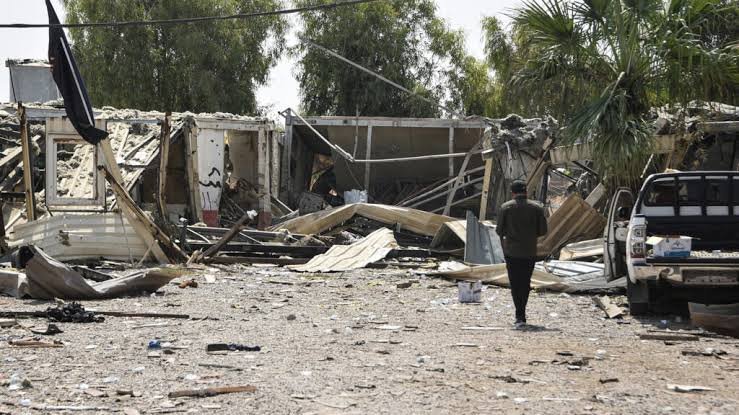
Saudi Arabia has joined the United States in launching coordinated air strikes against Iran-backed militias in Iraq, marking a significant escalation in the widening Middle East conflict.
The US Central Command (CENTCOM) said the operation targeted “Iran-aligned terrorists” allegedly directed by Iran’s Islamic Revolutionary Guard Corps (IRGC) to carry out attacks against American forces and Saudi oil infrastructure.

The strikes came shortly after the US accused Iran of firing missiles at its military positions in the Middle East in what it described as an attempted surprise attack.
According to Washington, all the incoming missiles were intercepted without causing damage.
Iran’s Revolutionary Guard confirmed launching missiles at a US air base and command centre in Jordan, saying the attack was retaliation for what it called continued American aggression.
Tehran also claimed its naval forces targeted three oil tankers transiting the Strait of Hormuz after accusing them of ignoring security warnings.
Reacting to the developments, US President Donald Trump warned that Iran would face a forceful military response, declaring that American forces would “hit them hard.”
CENTCOM said the joint US-Saudi operation struck multiple logistics hubs and weapons facilities belonging to Iran-backed groups across eastern Iraq.
Read Also:
- U.S. launches major Middle East military buildup as Wednesday deadline looms
- US-Iran Ceasefire Talks Begin in Pakistan: First direct negotiations since 1979 amid escalating Middle East conflict
- U.S. redeploys USS Gerald R. Ford to Middle East amid rising tensions with Iran
It said the action was in response to more than 30 drone attacks allegedly orchestrated by the IRGC over the previous 72 hours.
Saudi Arabia’s Defence Ministry also accused Iran-backed militias operating from Iraqi territory of launching drones at oil installations in the Kingdom’s Eastern and Riyadh regions.
It said Riyadh acted within its right to self-defence by targeting specific militia positions in Iraq.
“The Kingdom of Saudi Arabia does not seek escalation but will respond decisively to any aggression directed against it,” the ministry said.
Iraq’s Popular Mobilisation Forces (PMF), an umbrella body of mainly Shia militias integrated into the country’s security structure, said the strikes killed at least 20 of its members and wounded 32 others.
The group said bases in Baghdad, Wasit, Nineveh, Basra, Kirkuk, Karbala and Diyala provinces were hit, with the heaviest casualties reported in Nineveh and Diyala.
The PMF condemned the attacks, describing them as a serious violation of Iraq’s sovereignty and an assault on official state security institutions.
The Iraqi presidency also denounced the air strikes, calling them unacceptable and a breach of the country’s sovereignty. However, President Trump maintained that the operation had been coordinated with the Iraqi government.
Iran’s Foreign Ministry condemned the strikes, describing them as a gross violation of international law and accusing the United States and Israel of seeking to widen the regional conflict.
Tehran warned that Washington and its allies would bear responsibility for any further escalation.
The latest military exchanges underscore the growing rivalry between Saudi Arabia and Iran, whose long-standing competition for regional influence has fuelled conflicts across Yemen, Syria, Iraq and Lebanon.
Although both countries restored diplomatic ties in 2023, relations have deteriorated following repeated missile and drone attacks linked to the ongoing Iran conflict.
The escalation follows renewed attacks by Yemen’s Iran-backed Houthi movement on Saudi oil facilities and commercial shipping in the Red Sea, actions the group says are retaliation for Saudi air strikes in Yemen.
The fresh hostilities also ended a brief lull that had raised hopes of renewed diplomacy between Washington and Tehran over the Strait of Hormuz, a vital global oil shipping route.
Despite President Trump’s recent remarks suggesting positive negotiations, Iranian officials have continued to deny that direct talks are taking place.
Concerns over further disruption to energy supplies pushed global oil prices higher, with Brent crude rising by about five per cent to approximately 88.50 dollars per barrel.
The latest developments coincided with Israeli Prime Minister Benjamin Netanyahu’s visit to Washington, where he met President Trump amid continuing regional tensions and discussions on security in the Middle East.