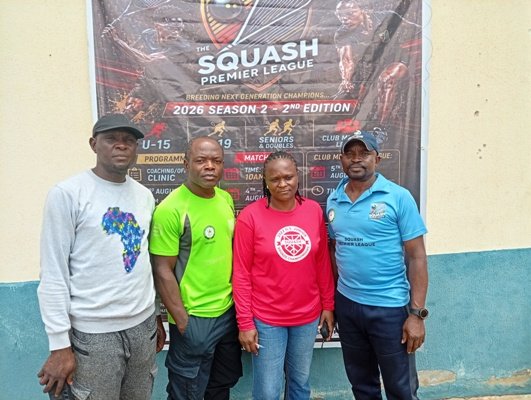
The second edition of the Squash Premier League (SPL) ended in Abuja with 111 players taking part, more than four times the 26 athletes recorded at the inaugural edition, as organisers called for stronger investment in grassroots squash development across Nigeria.
Key Highlights

- 111 players competed in SPL Season 2, up from 26 at the inaugural edition.
- Organisers want the league to expand to three tournaments annually.
- The competition featured junior, age-grade, senior and doubles events.
- Coaches and officials received training during a two-day technical clinic.
- Coaches called for more sponsorship, equipment and squash courts.
- Organisers want to take squash into schools and communities and introduce children to the sport from an early age.
The tournament, organised by the Beacon of Positivity Foundation (BOPF) and hosted at the Package B Squash Courts of the Moshood Abiola National Stadium, Abuja, featured junior, age-grade, senior, men’s and women’s competitions, as well as doubles events.
Founder of Premier Squash Academy and SPL organiser, T’Connor Tupdolo, said the steady rise in participation showed that the league was gaining acceptance among players, coaches and squash academies.
“The tournament has been so impressive. From the initial time when we started, we had only 26 players. The second was about 45 players, then we got to 66 and now 111, a massive number,” he said.
Tupdolo said the SPL was created to provide a structured pathway for player development, academy partnerships, coaching, officiating and regular competitive exposure.
The league also provides opportunities for player registration, academy partnerships, coach certification and referee training as part of its wider grassroots development strategy.
SPL Targets Stronger Age-Grade Development
The 2026 Season 2 competition featured several junior and age-grade categories alongside senior and club events, giving young players opportunities to compete against athletes with different levels of experience.
Tupdolo said the league had initially introduced U-11, U-13, U-15, U-17 and U-19 categories, although some were previously merged because of low participation.
With participation increasing, he said the organisers could now restore clearer age-grade divisions.
“Going forward, we are going to separate them from U-11, U-13, U-15 and so on. If they keep playing tournaments like this three times a year, you will see that the outcome is going to be massive,” he said.
He highlighted the performances of Bassey Etim and 16-year-old Nanme Rindaps as examples of the talent emerging through regular competition.
Players from several academies and states participated in the tournament, including Dasby Squash Academy, Beromich Sports and Project Prodigy Squash Academy. Athletes from Niger, Bauchi and Plateau states also took part.
Coaches Seek More Sponsorship, Equipment
Dasby Squash Academy coach, Longy Dasbak Steven, said the academy recorded improvements in both participation and performance.
“Our number of players has improved compared to the last time, and the level of play has also improved,” Dasbak said.
He identified sponsorship, equipment and additional courts as priorities for the development of squash in Nigeria.
“We need more sponsorship, more tournaments and equipment. More squash courts are also important because that is one of the things limiting access to the game,” he said.
Coach Bernard Mkpeb Richard of Beromich Sports also described the latest edition as an improvement on the previous tournament.
“So far, it’s better than the previous edition we had. As we continue to do this tournament, we keep getting better,” Richard said.
He called for greater media coverage and corporate sponsorship to sustain the sport’s development.
SPL Invests in Coaches and Officials
The second edition also included a Coaching and Officiating Clinic held from August 3 to 4 to improve the technical capacity of coaches and match officials.
Participants included Oluwole Osude, Bernard Mkpeb Richard and Tupdolo.
The clinic focused on current squash rules, technical requirements and officiating procedures.
Tupdolo said player development must go alongside the development of coaches and officials.
“We knew that a lot of coaches need to be abreast with the new rules or the rules of squash, including the players,” he said.
He said the SPL had incorporated coaching certification, officiating courses and player education into its development structure.
Richard also acknowledged the contribution of the Nigeria Squash Federation to coaching development, noting that its programmes had helped coaches progress from national to international levels.
Dasby, Kevina, Agbaye Shine
The tournament produced strong performances across several categories.
Dasby Squash Academy won the Boys U-15 title, finished second in the Girls U-15 category and secured additional third-place finishes in the Boys and Girls U-15 events. The academy also won two bronze medals in the Girls U-19 category.
In the Girls U-19 competition, Amako Kevina emerged champion after defeating Batya Stephen in the final.
Kevina also won the SPL Women’s Singles title after defeating Joy Obanuyiwa 11/8, 7/11, 11/8, 11/9.
Agbaye Daniel won the Boys U-19 title, while Team Bravo claimed the Men’s Doubles crown.
In the Girls U-15 category, Blessing Bassey defeated Palang Agol 3-1 to take the title.
Organisers Target Schools, Communities
Tupdolo said the long-term objective was to take squash beyond established clubs and courts by introducing the sport to children in schools and communities.
He said children as young as five to seven years should be exposed to the fundamentals of squash.
“We discovered that states alone and the government alone cannot run squash sports. We decided to encourage squash coaches and, as we go on, begin to give some incentives to coaches,” he said.
He argued that academies and coaches should remain central to grassroots recruitment while regular competitions provide players with the exposure needed to improve.
The increase from 26 players at the inaugural edition to 111 in Season 2, he said, demonstrated the potential of the model.
Read also:
- Nigeria, DR Congo Make Flying Starts At CAVB Beach Volleyball Youth Cup In Senegal
- Nigeria’s Top Female Volleyball Stars Jummai, Achi Hail NVBF For Securing World-Class Foreign Coach Ryan
- Nigeria Customs Backs New Volleyball Coach Ryan Masajedi Ahead of African Championship
Organisers Call for Investment
The organisers acknowledged the support of Gerritfleuren Ventures Ltd, Blue Iris Clinic, Kambai Bawa Foundation, DFSP Africa, BSL, SwiftSell.Space and Fluntter.Space.
They also appealed to corporate organisations, government agencies, philanthropists and other stakeholders to support the SPL through sponsorships, partnerships and donations.
For the organisers and participating coaches, sustained growth will depend on regular competitions, modern equipment, additional squash courts, coach development and stronger financial support.
With participation increasing more than fourfold since its inaugural edition, the Squash Premier League is emerging as a platform for discovering and developing Nigeria’s next generation of squash players.
For Tupdolo, however, the ultimate measure of success will be the number of young Nigerians who discover squash, receive quality coaching and eventually represent the country at national and international competitions.