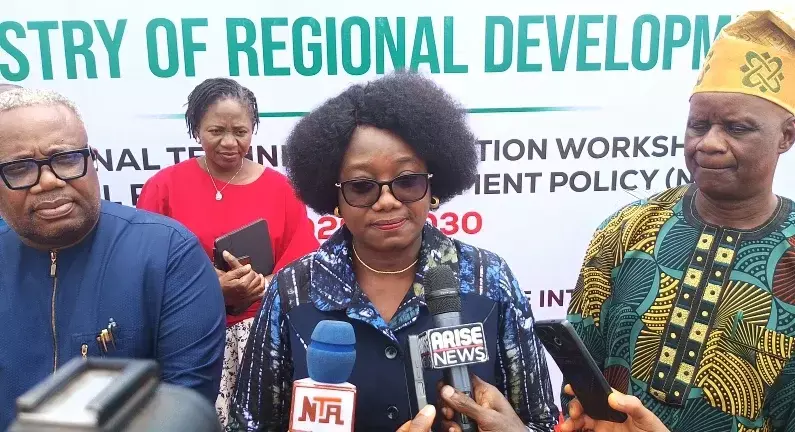
The Federal Government says that it is committed to addressing the persistent regional imbalances and developmental gaps through the National Regional Development Policy (NRDP) 2026–2030 document.
Dr Mary Ogbe, Permanent Secretary of the Ministry of Regional Development, disclosed this in Enugu on Monday at the South-East Regional Technical Validation Workshop for NRDP 2026-2030.

The workshop was attended by various professional, civil society and pressure groups within the five South-East States, which included: Abia, Anambra, Ebonyi, Enugu and Imo.
Ogbe said that the workshop provided a veritable opportunity to reflect, deliberate, and validate the collective wisdom embedded in the NRDP draft policy, a document that represents the aspirations of millions of Nigerians across geopolitical zones.
She noted that Nigeria’s development landscape had been characterised by deep structural disparities in infrastructure, human capital, access to economic opportunities, and quality of public services across regions and states.
She said, “These disparities are not merely statistical observations; they are realities that affect the dignity, livelihoods, and futures of our citizens.
“The National Regional Development Policy (NRDP) 2026–2030 is our Government’s strategic response to these challenges.
“It is a blueprint designed to promote balanced, inclusive, and sustainable development across all regions of our federation.
Key Highlights:
- The Federal Government says the National Regional Development Policy (NRDP) 2026–2030 will address regional inequality and development gaps across Nigeria.
- Mary Ogbe said the policy focuses on balanced development in infrastructure, human capital, economic opportunities, and public services.
- The draft policy was validated in a South-East workshop in Enugu with stakeholders from all five South-East states.
- The United Nations Development Programme supported the drafting process with technical expertise and pledged continued partnership for sustainable development.
- The South East Development Commission highlighted priority areas including the Aba–Onitsha–Enugu economic corridor, erosion control, climate adaptation, and data-driven development planning.
“The policy sets out clear pillars, enabling frameworks, financing mechanisms, and institutional coordination structures that, if faithfully implemented, will transform the trajectory of development across Nigeria.”
The permanent secretary said that it was gratifying that the NRDP draft policy document was not crafted in isolation but highly inclusive.
Ogbe noted that the draft policy benefitted from robust consultations with states, technical agencies, regional development institutions, civil society organizations, development partners, particularly UNDP, and a wide range of subject matter experts.
She believed that the NRDP 2026-2030 draft policy document would be validated and put into full operationalisation before the end of the year.
Speaking, Elsie Attafuah, Resident Representative, United Nations Development Programme (UNDP), said that the UNDP contributed the technical expertise for the crafting of the NRDP draft policy, as the world lead organisation on development.
Attafuah, who was represented by a Technical Advisor in UNDP, Mr Matthew Alao, noted that UNDP remained a strong partner in the country’s quest for rapid development, adding that NRDP holds that reality when fully implemented.
“UNDP will continue to support government, ministries, departments and agencies to ensure uplift of human capital, infrastructural as well as coordinated and sustainable development,” she said.
Earlier, the Managing Director of South East Development Commission (SEDC), Mr Mark Okoye, commended the ministry and the technical team for producing a draft document that was evidence-based, consultative, and forward-looking.
Okoye, who was represented by the Executive Director, Finance and Administration of SEDC, Chief Stanley Ohajuruka, said that from the South East perspective, three elements stand out in the NRDP policy document.
“First, the emphasis on regional growth poles; the policy’s recognition of Aba, Onitsha, and Enugu as a commercial and industrial corridor aligns with our own regional development plan.
Read also:
- SEDC environs ‘Vision 2050’ regional plan for South-East
- Electricity is key to developing South East, Gov. Otti charges SEDC
- Prioritize projects that will bring rapid development, Gov. Nwifuru tasks SEDC
“We must ensure that transport, energy, and digital infrastructure investments are sequenced to reinforce this corridor.
“Second, the integration of climate adaptation: Erosion control and watershed management are not environmental niceties for the South East; they are existential.
“We urge that the policy focuses on financing and technical standards for erosion control as a core regional infrastructure category,” Okoye said.
He also noted that the third was the policy focus on data and results, adding that it was gratifying that “what gets measured gets done”.