The National Youth Service Corps (NYSC) has placed foreign-trained Nigerian graduates on another verification checkpoint ahead of the 2026 Batch ‘C’ mobilisation, with candidates required to physically present their academic and travel documents before they can proceed with national service.
The development is already raising concerns among graduates who spent years studying outside Nigeria and may now have to make additional arrangements simply to prove the authenticity of qualifications they have already uploaded online.

Key Highlights
- NYSC requires foreign-trained graduates to physically present academic and travel documents ahead of 2026 Batch ‘C’ mobilisation.
- Uploading credentials online is not sufficient — original documents must still be examined at designated centres.
- Scanned copies and photocopies will not be accepted; original degree/HND certificates, transcripts and O’Level certificates are required.
- Verification centres have previously included Abuja, Lagos, Enugu, Kano, Bauchi, Osun, Rivers, Sokoto and Adamawa.
- Only candidates who are physically verified and cleared can be deployed, exempted or excluded from service.
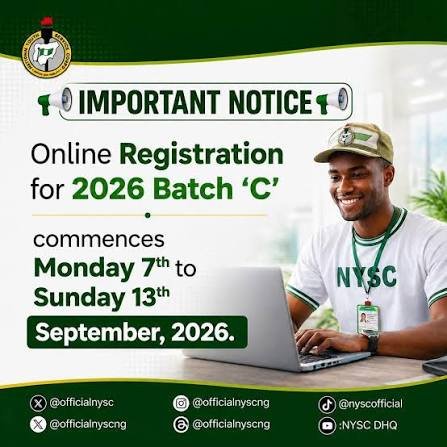
- 2026 Batch ‘C’ online registration is scheduled for September, with orientation expected later in the year.
Physical Verification Still Compulsory Despite Online Registration
According to NYSC’s official requirements, physical verification of credentials submitted by foreign-trained graduates is compulsory. The agency states that the exercise is conducted at designated venues and that candidates who have not undergone the required verification may face delays in deployment.
The NYSC’s official mobilisation process makes it clear that uploading documents online is not the end of the process for foreign-trained graduates. Their credentials and travel documents must still be physically examined by NYSC officials.
The agency also warns that scanned copies and photocopies of credentials are not acceptable for the verification process. Candidates are expected to present original documents, including their degree or HND certificate, official transcript and relevant O’Level certificate.
Concerns Over Access to Verification Centres
The controversy is likely to centre on the additional burden this places on graduates, particularly those who live far from designated verification centres. In previous verification exercises, NYSC has used centres in locations including Abuja, Lagos, Enugu, Kano, Bauchi, Osun, Rivers, Sokoto and Adamawa.
More significantly, NYSC says only candidates whose credentials are physically verified and cleared can be deployed, exempted or excluded from national service.
Read also:
- NYSC Makes NERD Clearance Mandatory for 2026 Batch B Mobilisation
- NYSC releases 2026 Batch ‘A’ Stream II call-up letters as portal faces heavy traffic
- FUTO Warns Against Fake Facebook Account Impersonating Vice-Chancellor
- PAMO University Demands Apology, Retraction From Rivers Speaker Over N6bn Scholarship Claims
- Education Minister Reveals Receiving Leaked NECO Questions Daily In 2025
This means a graduate who has successfully registered online could still find the mobilisation process stalled if the physical verification requirement is not completed.
NYSC’s official website further states that foreign-trained graduates who are exempted from service must also present their academic credentials and international passport for physical verification before an Exemption Certificate is issued. Those excluded from service are similarly required to undergo verification before their Exclusion Letters can be processed.
Batch ‘C’ Timeline
For the 2026 Batch ‘C’ exercise, online registration for foreign and locally trained graduates is scheduled for September, while the orientation programme is expected later in the year. However, the precise physical-verification dates for foreign-trained graduates should be confirmed from NYSC’s official notice or the individual candidate’s dashboard rather than relying on unofficial social-media posts.
The development has therefore left foreign-trained graduates with one pressing question: after years of studying abroad and uploading their credentials online, why must they still travel to designated centres to prove the documents are genuine?
For now, candidates are advised not to rely on viral dates circulating online. They should monitor their NYSC dashboards and official NYSC communication channels for the exact date, venue and reporting requirements.