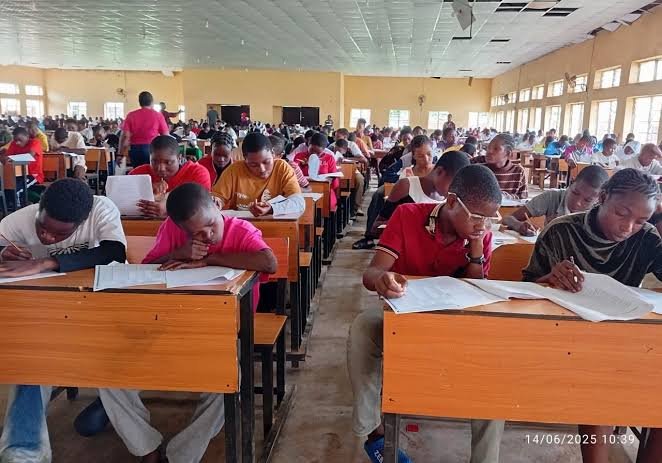
The National Business and Technical Examinations Board (NABTEB) has announced that 75.29 percent of candidates who sat for the 2026 National Common Entrance Examination (NCEE) into federal technical colleges scored at least 50 percent, while enrolment dropped by nearly half compared to the previous year.
Key Highlight:

- National Business and Technical Examinations Board announced that 75.29% of candidates who sat for the 2026 National Common Entrance Examination (NCEE) scored 50% and above.
- Candidate enrolment dropped sharply, with 15,290 registrations in 2026 compared to 29,260 in 2025, representing a 47.74% decline.
- Of the 13,848 candidates who sat for the examination, 41.22% scored 70% and above, while 31 candidates achieved outstanding scores of 96% or higher.
- The examination was conducted in 34 federal and 168 state technical colleges nationwide, covering 28 vocational trades, with electrical installation and maintenance recording the highest enrolment.
- NABTEB Registrar Aminu Mohammed announced that registration for the supplementary entrance examination will begin before the end of July and urged parents to encourage children to pursue Technical and Vocational Education and Training (TVET).
Registrar and Chief Executive Officer of NABTEB, Aminu Mohammed, disclosed the results on Tuesday, noting that the nationwide examination was conducted on June 13 across accredited technical colleges.
According to Mohammed, a total of 15,290 candidates registered for the examination, representing a decline of 13,970 candidates from the 29,260 recorded in 2025.
He said the decrease translates to a 47.74 percent drop in enrolment.
Of those registered, the registrar stated that 13,848 candidates, representing 90.57 percent, participated in the examination, while 1,442 candidates or 9.43 percent were absent.
Providing a breakdown of the results, the registrar said 10,426 candidates, representing 75.29 percent, scored 50 percent and above, while 5,708 candidates (41.22 percent) obtained 70 percent and above.
He added that 3,422 candidates, representing 24.71 percent, scored below the 50 percent benchmark, while 31 candidates (0.22 percent) achieved exceptional scores of 96 percent and above.
Mohammed said the examination was conducted in 34 federal technical colleges and 168 state technical colleges spread across the 36 states and the Federal Capital Territory, adding that the exercise was carried out successfully in line with the board’s quality assurance standards.
Candidates were examined in 28 vocational trades, organised into five broad categories of mechanical technology, electrical technology, construction technology, creative and culinary arts, and agricultural technology.
Among the courses offered, electrical installation and maintenance practice recorded the highest enrolment with 3,870 candidates, followed by computer hardware and GSM repairs/maintenance, which attracted 2,857 candidates.
Other popular trades were catering craft practice with 1,780 candidates, bricklaying, blocklaying and concreting with 1,553 candidates, mutomobile Mechanics with 1,156 candidates, and fashion design and garment making, which recorded 940 candidates.
Read also:
- 52 Kano Inmates Sit For 2026 NECO, NABAIS Examinations
- Adamawa Relocates NECO Examination Centres Over Security Concerns
- UPU Ohio, North America, Donates Medical Equipment to Sapele Hospital, Oghara Orphanage, Empowers Widow in Delta
- NABTEB Records Higher Enrolment In 2026 Examinations – Registrar
At the lower end of the enrolment scale, tiling and cladding had only one candidate, while social media content creation and management attracted two candidates.
Other trades with relatively low enrolment include.fish farming activities with three candidates, motorcycle and tricycle repairs with five, creative media with six, automobile CNG conversion with nine, and leather works with 18 candidates.
The NABTEB registrar announced that registration for the supplementary National Common Entrance Examination would commence before the end of July to provide another opportunity for prospective candidates seeking admission into technical colleges.
He urged parents and guardians to encourage their children to embrace Technical and Vocational Education and Training (TVET), describing it as a critical pathway to employment, entrepreneurship and economic self-reliance.
“The future of work is increasingly driven by skills, innovation, creativity and technology.
“Technical Colleges provide young Nigerians with practical competencies that prepare them for self-reliance, employment, entrepreneurship and lifelong learning,” Mohammed said.