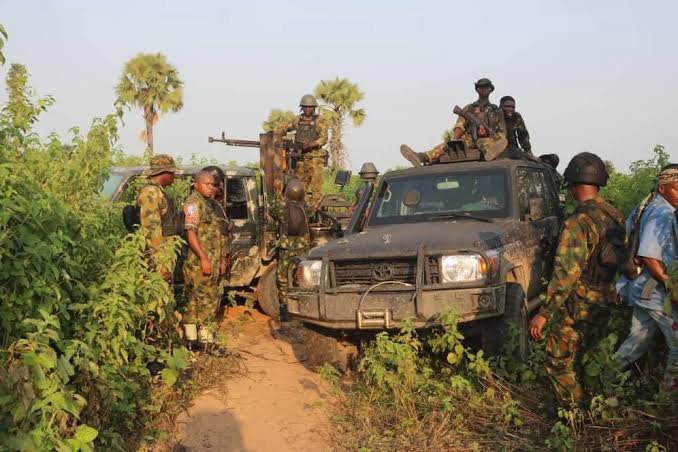
The Defence Headquarters says the military carried out 7,062 operations across the country in July and August, killing 1,487 terrorists and insurgents and rescuing 777 kidnapped victims.
Key Highlights
- 7,062 operations conducted: The military carried out 7,062 operations across Nigeria in July and August 2026.
- 1,487 terrorists killed: Defence Headquarters reported that troops neutralised 1,487 terrorists and insurgents during the period.
- 777 kidnapped victims rescued: Military operations also led to the rescue of 777 kidnapping victims.
- 354 suspects arrested: Security forces arrested 354 suspects linked to terrorism, banditry and other crimes.
- Weapons recovered: Troops recovered 91 firearms, 1,331 rounds of ammunition and 44 IEDs.
The figures were disclosed on Tuesday, September 1, by the Director of Defence Information, Maj.-Gen. Samaila Uba, during the joint security news briefing involving security and law enforcement agencies in Abuja.

According to Uba, the operations were carried out through coordinated land, air and maritime missions targeting terrorism, banditry, kidnapping, arms trafficking, oil theft and other criminal activities.
Beyond the large number of operations conducted, the military said its troops arrested 354 suspects and recovered 91 firearms, 1,331 rounds of ammunition and 44 improvised explosive devices during the two-month period.
Uba said the operations were designed not only to eliminate hostile fighters but also to disrupt their logistics networks, rescue victims, dismantle criminal structures and protect communities and critical national infrastructure.
He said troops sustained offensive operations across the nation’s six geopolitical zones as security threats continued to evolve, including terrorism, banditry, kidnapping, armed robbery, separatist violence and attacks on communities.
The North-East remains a major theatre of military activity, with troops under ‘Operation HADIN KAI’ reportedly neutralising 309 Boko Haram and Islamic State West Africa Province (ISWAP) fighters during the period.
The military also reported the arrest of suspected collaborators and logistics facilitators, as well as the rescue of hundreds of people held in terrorist enclaves.
Uba said sustained military pressure has also forced some terrorists and their families to surrender in several locations.
In other operational theatres, he said troops carried out intelligence-led raids, clearance operations and coordinated rescue missions that contributed to the recovery of hundreds of kidnapped victims and disrupted the movements of terrorist and criminal groups.
Read also:
- Trump Threatens Strong Military Response Against Iran After Strikes On US Bases
- Kogi Commends Rescue Of 21 Kidnap Victims, Including 15 NYSC Members
- Governor Pledges Accelerated Reconstruction of Malam-Fatori, Suspends Village, Ward Heads
- Tinubu Urges AU To Take Decisive Action Against Xenophobic Attacks Against Nigerians In South Africa
The air component, according to the defence spokesperson, continued to provide combat support and reconnaissance for ground troops, helping them identify and engage hostile elements.
But the military’s approach during the period was not limited to kinetic operations. Uba said nine dialogue and peace-building initiatives were undertaken, while 15 stakeholder engagement meetings were held with traditional and religious leaders.
The Defence Headquarters also said it released 137 press statements during the two months and identified and countered 13 misinformation items.
Despite the scale of the security operations, Uba said no major border or transnational security incident, critical infrastructure vandalism, prison break or threat to pipelines, railways and highways was recorded during the reporting period.
He attributed the reported gains to joint military operations, cooperation among security agencies and support from local communities.
The defence spokesperson nevertheless urged Nigerians to remain vigilant and provide security agencies with timely and actionable intelligence.
He also acknowledged the strategic guidance and support of President Bola Tinubu in strengthening the military’s capacity and operational effectiveness.