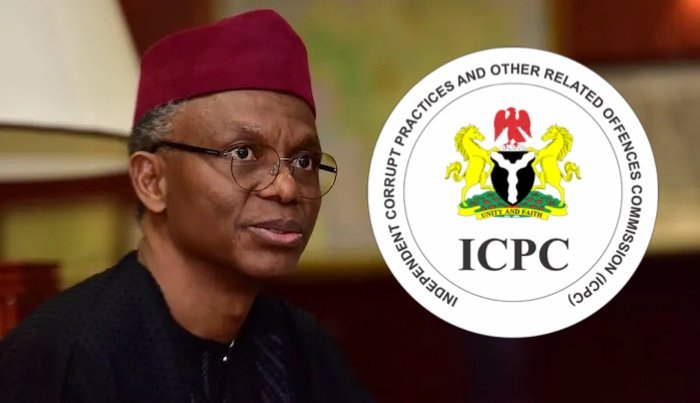
The Independent Corrupt Practices and other related offences Commission (ICPC) has dismissed claims that the detention and ongoing trial of former Kaduna State governor, Nasir El-Rufai, are politically motivated.
Speaking during a media briefing in Abuja on Monday, the ICPC’s Deputy Director and Head of Media and Public Communications, John Odey, said the anti-graft agency was only carrying out its legal responsibilities and had no political agenda against the former governor.

Key Highlights:
According to Odey, El-Rufai remains in custody because he has not yet fulfilled the bail conditions granted by the court.
“The court granted him bail, and he is yet to meet his bail conditions. If he meets his bail conditions today, I can assure you that the ICPC will let him go. So, we are not keeping him,” Odey stated.
Read Also:
- NiMet expands anti-corruption unit, deepens partnership with ICPC
- ICPC files fresh charges against El-Rufai over alleged N11bn fraud, court adjourns for bail ruling
- ICPC tracks ₦21.23tn road, bridge projects to curb corruption — Chairman
He stressed that the matter is strictly judicial, noting that corruption allegations had already been filed before the court and should not be viewed through a political lens.
The commission also denied allegations that El-Rufai was denied food, medical care, or access to family members while in custody.
The clarification followed the circulation of a Hausa-language video in which one of El-Rufai’s wives accused ICPC officials of refusing her entry into the commission’s premises on Friday evening to deliver food to her husband.
Reacting to the allegation, the ICPC described the claims as “false and misleading,” explaining that its visitation policy only allows access between 9 am and 6:30 pm.
Odey revealed that El-Rufai’s family members had visited him multiple times on the same day and had earlier delivered breakfast and lunch, contradicting claims that he was being starved.
The commission further disclosed that the former governor had recently been taken by ICPC officials to see his personal dentist and eye doctor and also had access to the agency’s in-house medical facility.
“He has been allowed to go see the doctors of his choice. Before this incident, he went twice last week, and the ICPC took him there,” Odey added.
The anti-graft agency maintained that the heightened security measures around El-Rufai’s detention were necessary because of his status as a high-profile political figure and insisted it would not compromise its institutional procedures.