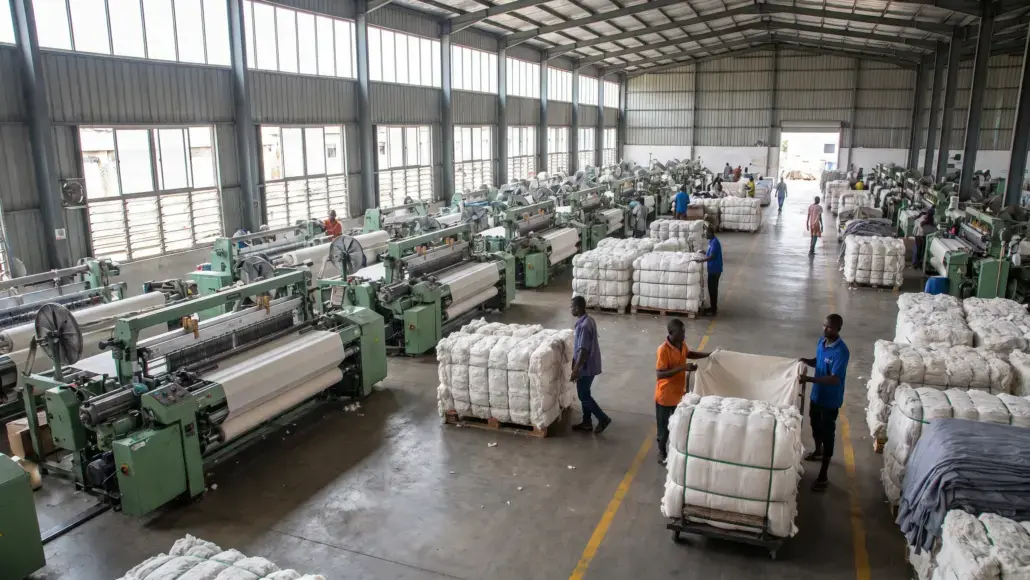
Nigeria’s textile and garment industry has recorded a remarkable 45 per cent increase in local production, marking a significant milestone in the country’s drive to revive domestic manufacturing, create jobs and reduce dependence on imported clothing. Industry stakeholders say the growth reflects rising investment, increased patronage of Made-in-Nigeria products and expanding opportunities for small and medium-sized enterprises (SMEs).

Key Highlights:
- Nigeria’s textile and garment production has increased by more than 45%.
- Rising consumer demand for Made-in-Nigeria products is driving industry growth.
- SMEs, youths and women are leading expansion in garment manufacturing.
- Industry experts urge stronger government support to sustain momentum.
- Poor electricity supply, smuggling and high production costs remain major challenges.
- Stakeholders call for investment in cotton farming, industrial clusters and affordable financing.
The News Agency of Nigeria (NAN) reports that the impressive growth has been fuelled by stronger local investment, increasing consumer confidence in locally produced apparel and the emergence of thousands of entrepreneurs, particularly among youths and women, across the country’s fashion and garment value chain.
Local investment driving industry revival
Industry operators say growing patronage of locally manufactured clothing has encouraged businesses to expand production capacity.
Garment manufacturer, Musa Ibrahim, said Nigerian-made products such as school uniforms, jerseys, trousers, jackets, suits and T-shirts are increasingly competing favourably with imported alternatives.
Read Also:
- FCCPC seals 5 textile warehouses in Kano
- Kaduna revenue board seals textile firm over N1.2bn unpaid taxes
- Proposed NYSC Adire Uniform Sparks Mixed Reactions Online
According to him, the growing acceptance of local products has boosted investments across the textile and garment value chain while creating employment opportunities.
“We are producing quality items that compete favourably with imports,” Ibrahim said.
Nigerians embracing Made-in-Nigeria fashion
The renewed interest in locally produced clothing is also being attributed to changing consumer behaviour.
Industry stakeholders noted that awareness campaigns promoting local content, coupled with affordability and cultural identity, have encouraged more Nigerians to choose locally tailored and manufactured garments over imported clothing.
The trend is helping to stimulate domestic production while strengthening Nigeria’s manufacturing sector.
Youths and women powering Nigeria’s textile growth
Fashion entrepreneur, Aisha Muhammad, said the industry is becoming a major source of employment for young Nigerians and women.
She explained that thousands of small tailoring businesses and garment production centres have emerged across the country, providing sustainable livelihoods and contributing to economic development.
Muhammad urged government to provide better access to production facilities, funding and skills development to further accelerate growth.
“Empowering youths and women with the right facilities will increase production and strengthen the economy,” she said.
Government support remains critical
Although stakeholders acknowledged previous government efforts to revive manufacturing, they stressed that more targeted interventions are needed to unlock the full potential of Nigeria’s textile industry.
Economic analyst Umar Salis described the recent production increase as evidence of the resilience and determination of Nigerian entrepreneurs despite prevailing economic challenges.
He noted that sustained policy support would enable the sector to become a major contributor to industrial growth and employment.
Challenges still confronting the industry
Despite the encouraging performance, industry experts observed that Nigeria’s textile sector remains far below its historic peak.
During the 1980s, Nigeria had more than 100 functional textile mills employing tens of thousands of workers. Today, only a few factories remain operational, many of them functioning below installed capacity.
Cotton production, once the backbone of the industry, has also declined sharply from about 300,000 tonnes annually in the 1980s to roughly 15,000 tonnes in recent years.
Industry stakeholders identified several factors limiting further growth, including:
Unreliable electricity supply
High cost of modern production equipment
Limited access to affordable financing
Poor infrastructure
Smuggling and influx of cheap imported textiles
Experts recommend fresh interventions
To sustain the current momentum, stakeholders urged the Federal Government to introduce targeted policies aimed at strengthening the industry.
Among the recommendations are:
Development of textile industrial clusters
Affordable credit facilities for manufacturers
Stable electricity supply
Revival of cotton farming
Vocational training centres
Subsidies for modern textile equipment
According to Salis, Nigeria possesses the resources, market size and entrepreneurial capacity to emerge as one of Africa’s leading textile manufacturing hubs if the right policies are consistently implemented.
Economic benefits
Analysts believe sustained growth in Nigeria’s textile industry could significantly reduce unemployment, conserve foreign exchange, strengthen local manufacturing and reduce poverty.
With a population exceeding 200 million people and one of Africa’s largest apparel markets, Nigeria has substantial opportunities to expand domestic textile production and reduce reliance on imports.
Although much of the recent growth has been driven by SMEs and garment producers rather than large integrated textile mills, industry observers say the 45 per cent increase represents a positive signal that the sector is gradually regaining momentum.