
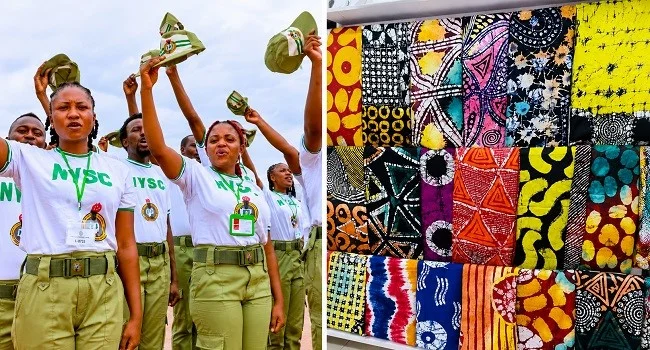
The Federal Government’s proposal to replace the National Youth Service Corps (NYSC) traditional khaki uniform with locally produced Adire fabric has generated mixed reactions, with some Nigerians arguing that the move could elevate a regional cultural fabric into a national symbol, while others have welcomed it as a boost for the country’s textile industry.
The debate followed comments by the Minister of Youth Development, Ayodele Olawande, who said the government was considering adopting Adire as the official NYSC uniform as part of efforts to promote indigenous textile production, create jobs and strengthen local industries.

Key Highlights:
- FG proposed replacing NYSC khaki with Adire.
- The plan sparked mixed public reactions.
- Critics said Adire favours one ethnic group.
- Others said it would boost local textile production.
- Some questioned the government’s priorities.
- The proposal remains under public debate.
Following the announcement, social media users expressed differing views on the proposal. While some praised the initiative as a way to revive Nigeria’s textile sector, others questioned whether Adire, which is traditionally associated with the Yoruba people, should replace the khaki uniform worn by corps members across the country for decades.
Reacting on X, user Odor Maduabuchi, who posts as @CarlosBalee60, wrote:
“It seems you guys are not okay in the head. Why on earth do you want to use ADIRE as the clothing for NYSC? You want to Yorubanise the country… Well, let’s see how you force me to wear it. If you wanted a change, why don’t each tribe wear their own fabric?”
Another X user, Rasaq Hammed, criticised the government’s priorities, writing:
“I swear we are in big trouble in this country. There is a big problem in the country and all they are doing is changing NYSC uniform.”
Read also:
- NYSC begins payment of N77,000 to corps members
- NYSC swears in 1,071 corps members in Enugu
- NNPC empowers 531 NYSC members with ₦531,000, business starter packs in major youth empowerment drive
Other commentators also questioned why attention was being given to a possible change of uniform when many corps members have continued to advocate improved welfare, enhanced security and better working conditions during their service year.
Supporters of the proposal, however, argued that Adire has evolved beyond its Yoruba origins and is now widely recognised as a Nigerian textile. They maintained that adopting locally produced fabrics for official use could stimulate domestic textile production, create employment opportunities and reduce reliance on imported materials.
The Federal Government has maintained that the proposal is aimed at promoting indigenous industries and supporting economic growth through local manufacturing.
Government officials have not directly responded to claims by some critics that the proposal could promote one ethnic culture above others.
If implemented, the proposed reform is expected to remain the subject of public debate as Nigerians continue to weigh its cultural, economic and symbolic implications.