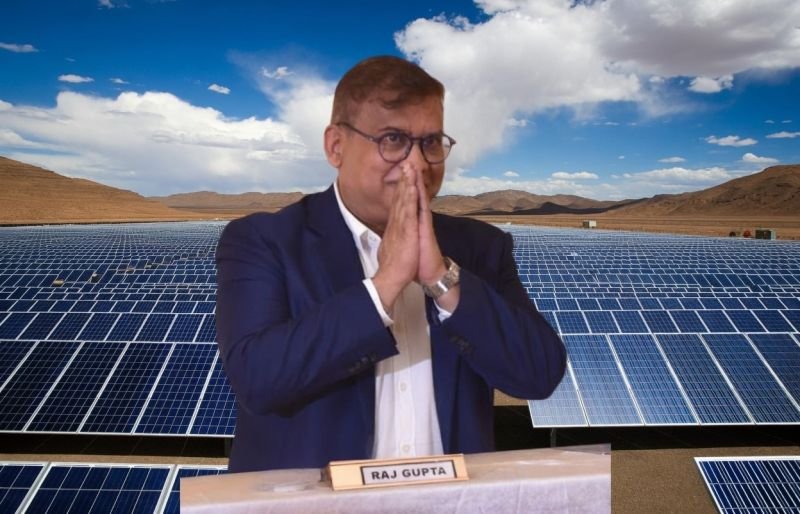
In what could reshape steel production across West Africa, Indian billionaire Raj Gupta is spearheading plans for what is being touted as sub-Saharan Africa’s largest solar-powered steel manufacturing facility in Nigeria.

Gupta, Chairman of the African Industries Group (AIG), has secured 500 hectares of land in Niger State for the ambitious project through the group’s subsidiary, Abuja Steel Mills Limited. The initiative, announced following a formal land handover in late June 2026, integrates large-scale steel production with a dedicated utility-scale solar power plant and a new industrial park.
The project aims to address one of Nigeria’s most persistent industrial challenges: unreliable electricity supply. By powering operations primarily through solar energy — potentially via a 200 MW solar mini-grid — the facility will operate independently of the national grid, slashing energy costs and reducing dependence on expensive diesel generators. This hybrid renewable approach could set a new benchmark for energy-intensive industries across the continent.
A Historic Leap for Nigerian Steel
Raj Gupta described the land allocation as “historic,” stating that the project has the potential to position Nigeria prominently on both the global steel map and the world’s renewable energy map. “This project will perhaps be the largest in sub-Saharan Africa,” Gupta said during the handover ceremony. He emphasized that beyond industrial output, the development focuses on “human empowerment, upliftment, and job creation.”
Read Also:
- Police arrest 5 suspects, recover pistol, 10 bags of suspected Indian hemp in Delta
- Indian Opioid exports fuel West Africa drug crisis as deadly kush epidemic worsens
- Indian-Nigerian filmmaker blends cultures of the 2 countries in new movie
- FG Urges Scrap Dealers to Suspend Strike as Talks Begin Over Steel Sector Dispute
t
AIG, which has operated in Nigeria for over five decades, is already one of the country’s largest steel producers and a major non-oil foreign direct investor in mining and steel processing. The group employs thousands and operates across multiple sectors, including mining, chemicals, and glass. The new solar-powered complex represents a significant expansion, building on the company’s existing footprint.
Niger State Governor Mohammed Umar Bago, who facilitated the allocation, highlighted the state’s broader vision to become a major industrial corridor.
Plans include gazetting an additional 200,000 hectares of land, leveraging the Ajaokuta–Kaduna–Kano gas pipeline, abundant solar resources, and hydropower assets from dams such as Kainji, Jebba, Shiroro, and Zungeru.
Federal government officials have strongly backed the initiative. Minister of Steel Development Prince Shuaibu Audu praised AIG’s growth and its alignment with President Bola Tinubu’s $1 trillion economy target by 2030. Ministers of Power and Industry also underscored the project’s role in reducing steel imports, boosting local manufacturing, and driving productivity through public-private partnerships.
Multi-Billion-Naira Investment with Broader Impact
While the exact investment figure and production capacity have not yet been publicly disclosed, the project is described as a multi-billion-naira endeavor to be developed in phases. It is expected to create thousands of direct and indirect jobs while strengthening Nigeria’s industrial base.
Analysts see the venture as a potential model for sustainable industrialization in Africa, demonstrating how private capital can combine traditional manufacturing with renewable energy to overcome infrastructure bottlenecks. If successful, it could encourage similar investments across energy-hungry sectors.
As Nigeria pushes for greater self-sufficiency in steel and accelerated economic growth, Gupta’s solar-steel vision signals a transformative chapter — one where innovation in clean energy meets the demands of heavy industry.
Construction timelines and further technical details are expected to be released in the coming months as the project moves from planning to implementation.