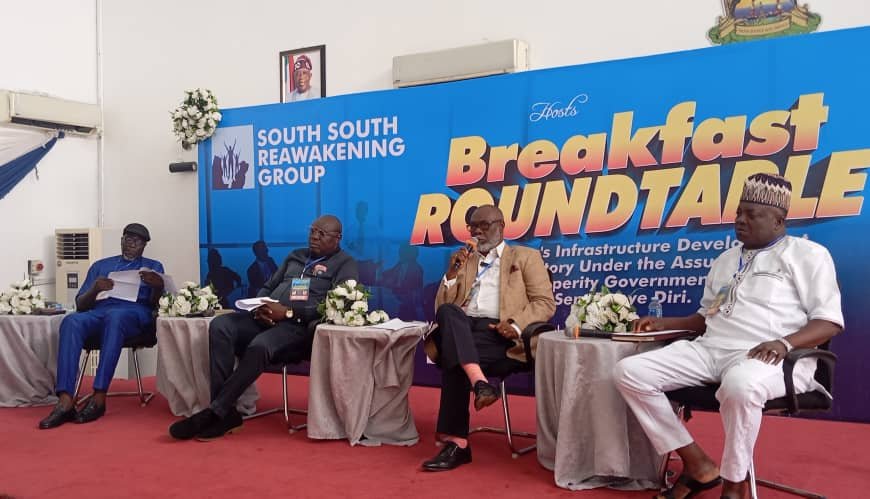
A Niger Delta organization, the South-South Re-Awakening Group has ended a one -day roundtable on Bayelsa State’s infrastructure development trajectory under the administration of Governor Douye Diri, calling on the Ijaw nation to take a more active role in national politics and decision-making processes.
The event, held at the Golden Tulip, Government House, Yenagoa, featured panel discussions and deliberations on governance, infrastructure delivery, and development sustainability in the state.
Convener of the roundtable, Joseph Ambakederimo, said the South-South Re-Awakening Group has existed for over two decades as a platform for dialogue and civic engagement on governance, environmental issues, and the socio-political economy of the Niger Delta.

He explained that the essence of the roundtable is to appraise the infrastructure development efforts of the Diri administration, with particular focus on its vision, milestones, and future direction.
According to him, “government cannot employ everyone, but has the responsibility to create an enabling environment through the provision of roads, stable electricity, potable water, healthcare, security, and good governance to support economic growth.”
Ambakederimo also urged Ijaws to engage more actively in national politics, stressing that “no one can tell our story better than ourselves.”
He commended Gov. Diri for ongoing road projects across the state, the 60-megawatt gas turbine project commissioned by President Bola Tinubu, as well as his inclusive governance style and peaceful disposition, which he said have helped foster unity across political divides in the state.
He further encouraged Bayelsans to continue supporting leaders at all levels of government.
The panel session featured contributions from Morris Alagoa, Technical Adviser to the Governor on Environment and Deputy Director of the Environment Defenders Network; Prof. John Kalama, Head of Department of Political Science, Federal University Otuoke; Prof. Philip Okolo of the Niger Delta University, Amassoma; and Prof. Francis Sikoki.
Speaking on the theme,: “Assessing Progress, Challenges and Opportunities in Road and Transport Infrastructure Development, Urban Planning and Flood Control Systems, Energy and Rural Electrification, Public-Private Partnerships, Financing Sustainability and Maintenance Culture,” the panelists commended the administration for its infrastructural strides and continuity of projects inherited from previous governments.
Prof John Kalama observed that leadership perception is often influenced by proximity to the people, noting that the governor has made notable progress in completing long-abandoned federal and state road projects.
He also urged the governor to leverage the visit of President Tinubu to advocate for the creation of additional local government areas in the state.
Prof. Okolo noted that successive administrations in the state have contributed to opening up the state through infrastructure development, but emphasized that Gov. Diri’s road network projects have significantly improved connectivity between rural communities and the state capital.
He, however, called for accelerated attention to critical projects, including the construction of the road across the bridge behind the Niger Delta University to connect Ebeni and other island communities to Bolou-Orua and Ekeremor.
He also urged the government to prioritize the completion of the NDU Convocation Arena, faculty buildings, staff quarters, and to intensify efforts in addressing flooding challenges in the state.
In his contribution, Alagoa expressed appreciation to the governor on behalf of people of Southern Ijaw Local Government Area, particularly for projects such as the Angiama–Yenagoa Road, the Oporoma Bridge, the Odenwari Road, described as the first in Oladiama clan and ongoing works on the Nembe–Brass Road.
He, however, appealed for the state government’s intervention in the abandoned Okoroba road project.
Prof. Sikoki emphasized that infrastructure remains fundamental to development, commending the administration for its road construction projects, the 60-megawatt gas turbine initiative, and other legacy projects.
Read also:
- Governor Diri is breaking the ice in Bayelsa’s development trajectory
- Bayelsa Education Development Fund donates education materials to 225 schools
- Bayelsa monarch applauds Gov. Diri’s infrastructure, human capacity development
At the end of the roundtable, a communique was issued in which participants unanimously urged the Bayelsa State government to sustain and prioritize investments in major infrastructure projects across the state to drive rapid development.
The communique further called for continuity, urging future administrations to build on the foundations of the Diri administration to ensure sustained progress and development in the state.