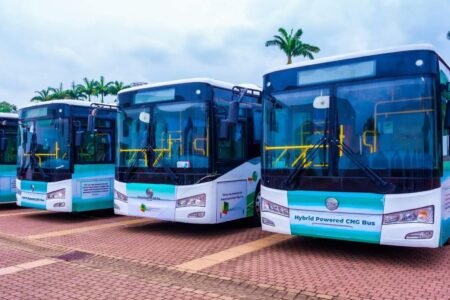
The Federal Government has launched the Northern Corridor of its Compressed Natural Gas (CNG) and electric vehicle transport programme in Kano State, as part of efforts to promote cleaner and more affordable transportation across Nigeria.
The initiative is being driven through the Presidential Initiative on Compressed Natural Gas and Electric Vehicles and is designed to reduce transportation costs, ease logistics challenges, and support the country’s energy transition.
The launch event, held at the Sani Abacha Stadium in Kano, brought together government officials, investors, transport operators, and representatives of the Kano State Government.

Representing Vice President Kashim Shettima, Deputy Chief of Staff to the President, Senator Ibrahim Hassan Hadejia, described the project as a strategic economic intervention aimed at improving transportation efficiency and stabilising costs.
He said rising transport costs had continued to fuel inflation by increasing food prices and logistics expenses nationwide.
According to him, “This transition is not just an energy policy; it is an economic strategy aimed at reducing costs and strengthening long-term growth.”
The Executive Chairman and Chief Executive Officer of the Presidential Initiative on Compressed Natural Gas and Electric Vehicles, Ismaeel Ahmed, said the programme had moved beyond cushioning the effects of fuel subsidy removal to building a sustainable transport ecosystem.
He noted that the initiative had expanded across multiple states through conversion centres, refuelling infrastructure, and workforce training programmes.
Ahmed disclosed that more than 300 conversion partners had been deployed nationwide, including 41 centres in Kano alone, while over 7,000 Nigerians have been trained under the scheme.
He added that the programme had attracted over $2bn in investment commitments, with Kano identified as a key commercial and logistics hub for Northern Nigeria.
According to him, the initiative is guided by affordability, availability, and acceptability, ensuring Nigerians can convert their vehicles without excessive financial burden.
Governor Abba Yusuf of Kano State welcomed the development, describing it as a timely intervention that would reduce transport costs and improve living standards.
Read also:
- Police launch welfare bus scheme, deploy CNG vehicles to ease personnel commute in FCT
- NSE urges a faster adoption of CNG into Nigeria’s energy transition plan
- FG targets additional 500 CNG stations nationwide within 3 years
He said Kano’s strategic position in commerce and transportation makes it a natural hub for clean mobility expansion.
The state government also confirmed ongoing collaboration with investors and relevant agencies to expand gas and electric mobility infrastructure across the state.
As part of the event, two new CNG refuelling stations were commissioned to support cleaner transport operations in Kano and neighbouring states.
The project is expected to accelerate Nigeria’s shift toward cleaner energy in transportation while easing the economic pressure on commuters and businesses.