
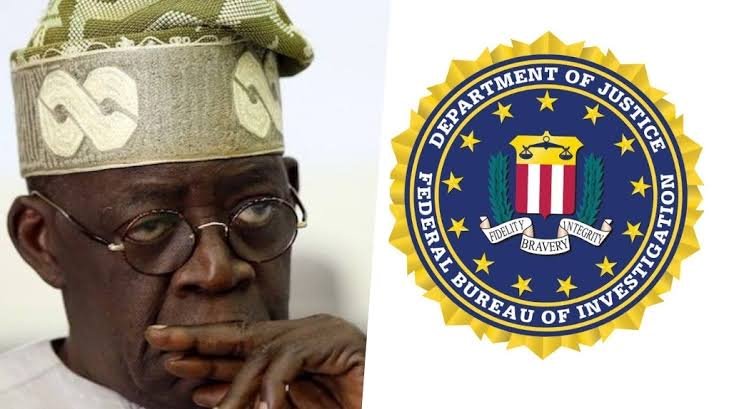
The United States Federal Bureau of Investigation (FBI) has asked a US court for permission to privately explain why it withheld certain records relating to President Bola Tinubu, warning that public disclosure of some of the information could endanger individuals.
The FBI made the request in an application filed before the US District Court for the District of Columbia on August 20, 2026, seeking permission to submit a confidential declaration explaining the basis for withholding the records.
According to the agency, it cannot publicly disclose the full reasons for withholding some of the records because doing so could expose sensitive law-enforcement techniques, procedures and other protected information.

The FBI is seeking permission to submit an ex parte, in camera declaration, which would allow the judge to examine its explanation privately and under seal.
The records are being sought by Aaron Greenspan, founder of PlainSite, who filed Freedom of Information Act (FOIA) requests for documents relating to Tinubu from 1992 and 1993.
Among the requests are Tinubu’s complete FBI file and interview records connected to an FBI case.
In its latest application, the FBI cited several exemptions under the US FOIA, including provisions relating to personal privacy, confidential sources, law-enforcement techniques and information that could endanger an individual.
The agency stated that it had determined that it could not publicly provide the full basis for its reliance on exemptions covering law-enforcement techniques and information that could threaten an individual’s safety.
The FBI said it would submit the confidential declaration before August 28 if the court grants its request.
The development is the latest chapter in a prolonged legal battle over requests for US government records concerning allegations linked to Tinubu and a Chicago drug investigation dating back to the early 1990s.
The dispute began after Greenspan submitted multiple FOIA requests to six US federal agencies seeking records concerning the Nigerian president.
The FBI, Drug Enforcement Administration (DEA) and other agencies initially refused to confirm or deny whether some of the requested records existed.
However, in April 2025, US District Judge Beryl Howell ruled that the FBI and DEA had not sufficiently justified their refusal to confirm or deny the existence of records concerning Tinubu.
The judge subsequently ordered the agencies to lift their so-called “Glomar” responses, which allow agencies in certain circumstances to neither confirm nor deny the existence of requested records.
The latest FBI application comes as the US Department of Justice continues to respond to court orders relating to the requested documents.
Read also:
- FBI Opens Recruitment Drive, Seeks Professionals To Fight Crime
- Nigeria Police, FBI arrest suspect over Microsoft 365 cyberattacks
- FBI exposes UK-based Nigerian Man’s elaborate hack, scam defrauding US University of over $235,000
- OGTAN Presents Award Of Excellence To KEFFESO Trust For Human Capital Development In Host Communities
- ICPC Uncovers Another Fictitious Agency Operating From SGF Office, Tinubu Orders Arrest
- Popular Spar Shopping Mall In Calabar Go Up In Flames
- Oyedepo Declares End to Satanic Agents Behind Attacks, Predicts Strange Happenings In Nigeria
- UBA Graduate Who Called Tony Elumelu ‘Tony’ Gets ₦500k, VIP Trip, Ambassadorial Deal Amid Backlash
Tinubu’s legal team had also sought additional time to respond to the proceedings, but Judge Howell reportedly declined a request for a 10-day extension.
The FBI’s latest application has added another layer to the long-running dispute, with the agency maintaining that at least some of the withheld information requires special protection.
The continued legal battle has intensified public interest in the records and generated calls for greater transparency, particularly over documents concerning a serving Nigerian president.
The central issue now is whether the court will accept the FBI’s request to keep its full justification under seal. If the records can legally be released without compromising legitimate safety or law-enforcement concerns, greater disclosure would help address the public interest surrounding the case.