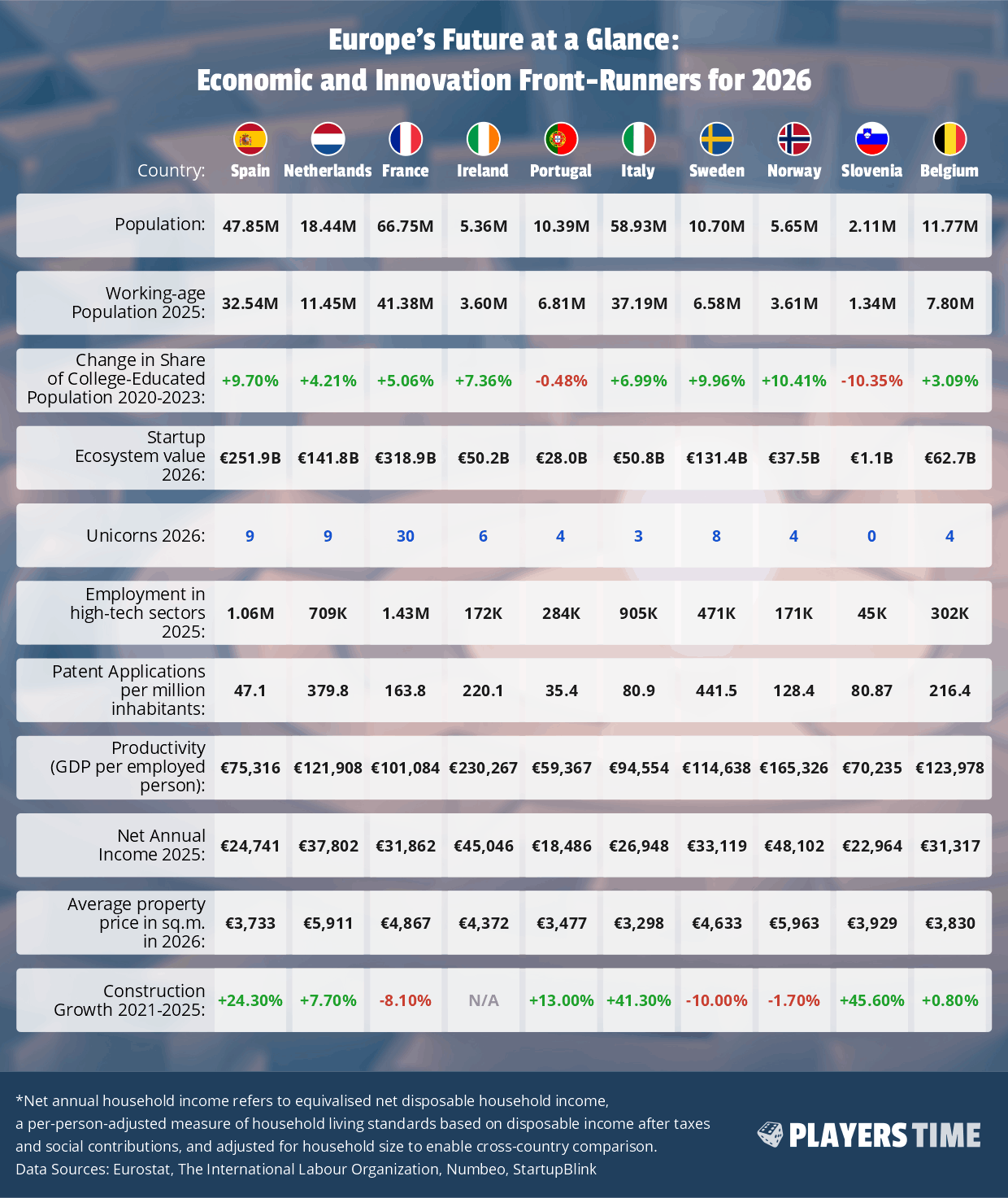
Europe’s technology labour market is undergoing a major transformation despite widespread job cuts by global technology giants, with Luxembourg, Portugal and Norway emerging as the fastest-growing destinations for high-tech employment, according to a new report. The study highlights how Europe’s tech job boom is shifting opportunities away from traditional technology hubs as artificial intelligence (AI), startup investments and remote work redefine the continent’s digital economy.

Key Highlights:
- Luxembourg records the fastest growth in Europe’s high-tech workforce, rising 9.62% between 2024 and 2025.
- Portugal and Norway rank second and third in tech employment growth.
- Germany remains Europe’s largest technology employment market with over 2.3 million high-tech workers.
- Europe’s total high-tech workforce increased from 11.2 million to 11.5 million in one year.
- Latvia, Slovakia and Romania recorded declines in high-tech employment.
- Report says AI, remote work and distributed teams are reshaping Europe’s innovation landscape.
The report, released by data analytics platform PlayersTime, analysed 31 European countries across 11 economic, innovation, demographic and employment indicators to determine the continent’s fastest-developing economies heading into 2026.
According to the findings, Luxembourg tops the ranking after expanding its high-tech workforce from 26,000 employees in 2024 to 28,500 in 2025, representing a growth rate of 9.62 per cent.
The country’s technology workforce has more than doubled since 2015, reinforcing its position as one of Europe’s leading digital innovation centres.
Portugal ranked second with an 8.32 per cent increase, growing from 262,100 technology workers in 2024 to 283,900 in 2025. Analysts attributed the country’s strong performance to increased foreign investment, a thriving startup ecosystem and its growing popularity among international technology professionals and remote workers.
Read Also:
- Artificial Intelligence and Academic Integrity: Where Should We Draw the Line?
- AI Revolution: How Artificial Intelligence rendered Stack Overflow obsolete for developers
- Nigeria bets on artificial intelligence to power Tinubu’s $1Trillion economy vision
Norway secured third position after recording a 7.54 per cent increase in high-tech employment, with its workforce rising from 159,100 to 171,100 within one year.
Lithuania and Germany completed the top five rankings. Lithuania continued its rapid emergence as a startup destination, while Germany maintained its position as Europe’s largest technology employment market, employing approximately 2.32 million workers in the sector.
Other countries making the top 10 include Turkey, Czechia, Slovenia, Belgium and Bulgaria, reflecting growing technology investment across Central and Southeast Europe.
The report also identified countries experiencing declining technology employment. Latvia recorded the sharpest fall, with high-tech employment dropping by 7.89 per cent between 2024 and 2025. Slovakia, Romania and Estonia also posted notable declines, making them among the few European countries to experience contraction in the sector over the past decade.
Despite the slowdown in some markets, Europe’s overall technology workforce continued to expand, increasing from 11.2 million workers in 2024 to 11.5 million in 2025, representing a 2.75 per cent annual growth.
Commenting on the findings, PlayersTime data analyst, Silvana Vladimirova, said the European technology sector is witnessing a redistribution of opportunities rather than uniform growth.
According to her, artificial intelligence, distributed workforces and lower operating costs are encouraging companies to build technology teams across a wider range of countries instead of concentrating talent in traditional hubs such as London and Berlin.
She noted that smaller and mid-sized European economies are becoming increasingly attractive to technology companies seeking skilled professionals while maintaining competitive operating costs.
The report concluded that Europe’s future innovation landscape will likely become more decentralised, creating opportunities for emerging technology ecosystems across the continent as AI continues to reshape global employment patterns.
Top 10 European Countries for High-Tech Employment Growth (2024–2025)
Rank
Country
Growth
1
Luxembourg
9.62%
2
Portugal
8.32%
3
Norway
7.54%
4
Lithuania
7.09%
5
Germany
6.16%
6
Turkey
6.03%
7
Czechia
5.80%
8
Slovenia
5.36%
9
Belgium
5.15%
10
Bulgaria
4.66%