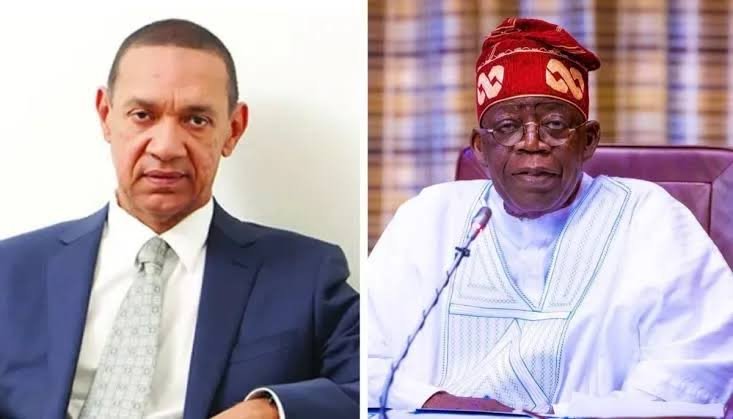
President Bola Ahmed Tinubu has been urged to fundamentally rethink Nigeria’s electricity supply model, with former lawmaker Ben Murray-Bruce arguing that the 2013 power sector privatisation has failed to deliver reliable electricity to Nigerians.
In an open letter to the President, Murray-Bruce called for a decentralised electricity system in which states, communities and private investors generate and distribute power locally rather than relying predominantly on the national grid.

Key Highlights
- Murray-Bruce says Nigeria’s electricity privatisation has failed to deliver reliable power.
- He cites NERC data showing only 4,286MW of 13,625MW installed generation capacity was available for dispatch.
- He criticised the high number of unmetered electricity customers despite billions of naira collected by DisCos.
- He proposed community-based solar power systems backed by government-guaranteed loans.
- He urged states to take greater responsibility for electricity, street lighting and other local infrastructure.
- He cited Aba’s independent power system as evidence that decentralised electricity supply can work.
Privatisation Was a Transfer of Custody’
Murray-Bruce said the problems confronting Nigeria’s power sector could no longer be addressed through repeated interventions, describing the 2013 privatisation as a failure that transferred electricity assets to operators without sufficient financial capacity to transform the sector.
According to him, owning a power plant or distribution company is different from having the financial capacity to invest heavily in its expansion and maintenance.
He argued that Nigeria should have attracted major international utility companies with the technical expertise and financial strength to invest billions of dollars in the sector.
“What did we get? We got PHCN, with debt,” he wrote.
“PHCN could not run the assets and owed nothing. Today, private owners cannot run the assets and the nation is buried in liabilities.”
Murray-Bruce also pointed to the huge financial burden associated with the electricity sector, citing claims that power-generating companies are owed more than ₦7 trillion and government efforts to support the sector through a multitrillion-naira bond programme.
He argued that despite years of public spending and intervention, Nigerians continue to experience prolonged power outages.
‘Nigeria Is Still Billing Darkness’
The former lawmaker also criticised electricity distribution companies over the number of customers who remain without prepaid meters.
He cited data showing that about 5.1 million of Nigeria’s 12.31 million active electricity customers were unmetered as of February 2026.
Murray-Bruce said the situation was particularly troubling because DisCos had collected hundreds of billions of naira from consumers.
He argued that estimated billing creates an unfair system in which consumers can be charged despite not having accurate information about their actual electricity consumption.
“An industry that cannot generate power has discovered it can still generate revenue by billing darkness,” he said.
Murray-Bruce, however, acknowledged that generating companies are owed money by market participants and government agencies.
He argued that the companies must also accept responsibility for operating in a difficult market and investing adequately in the infrastructure needed to improve electricity supply.
Murray-Bruce Proposes Community Power Systems
Murray-Bruce proposed a decentralised electricity model under which estates, communities and local areas could develop their own electricity systems using renewable energy.
Using Dolphin Estate in Lagos as an example, he proposed that a community of about 5,000 families could obtain a bank loan to develop a large-scale metered solar power system capable of supplying the estate.
Under his proposal, state governments would guarantee the loans, while residents would pay regulated electricity tariffs based on the cost of generating the power.
He argued that the model could be replicated across estates, wards and communities nationwide.
According to him, such a system would create new investment opportunities while reducing dependence on the national grid.
“Nigerians are entrepreneurs by nature. They are bold, they are intelligent, they are creative. Give them a guaranteed loan and a customer base and stand out of the way,” he wrote.
States Should Take Greater Responsibility
Murray-Bruce also called for a clearer division of responsibilities between the Federal Government and subnational governments.
He proposed that state governments should take responsibility for powering streetlights, police stations, primary healthcare centres, schools and other state-level infrastructure, preferably through solar power.
The Federal Government, he said, should focus on federal institutions and infrastructure, including federal roads, hospitals, universities and other federal facilities.
He further proposed that the Federal Minister of Power should serve primarily as a coordinator of electricity policy across the federation rather than attempting to control every aspect of electricity generation and distribution.
‘Nigeria Is Already Paying for Electricity’
Murray-Bruce argued that the financial resources required to transform the electricity sector already exist within the Nigerian economy.
He cited estimates of billions of dollars lost annually because of unreliable electricity, alongside billions of dollars spent by households and businesses operating petrol and diesel generators.
He said Nigeria was already paying a high price for electricity, but was doing so through an expensive and inefficient combination of grid power and private generators.
“We are already paying for power. We are simply paying for the most expensive, dirtiest and least reliable version of it ever devised,” he wrote.
Electricity Act Gives States More Powers
Murray-Bruce also pointed to the Electricity Act 2023, which transferred greater responsibility for electricity regulation to states.
He noted that several states have established or moved towards state electricity regulatory frameworks since the law came into force.
According to him, the legal foundation for decentralised electricity generation and distribution already exists.
“What is missing is not law. It is nerve,” he said.
Read also:
- How Gas Turbines Project Ushers In New Era of Electricity Supply in Yenagoa
- Ughelli Community Raises Alarm Over Alleged N500,000 Electricity Bills
- NERC Hosts Zanzibar Electricity Regulators On Study Tour To Strengthen Cooperation
- El-Rufai’s Children At War With Each Other As Political Rift Splits Family
- JAMB Extends Deadline For Acceptance Of Old Admission Offers To September 30
- DSS Directs Counsel To Seek Adjournment In Sowore’s Cybercrime Trial Until After 2027 Presidential Election
- Ohanaeze Youth Council Decries Deplorable State Of Naze-Nekede-lhiagwa-Obinze Road
- 2027: Omoyibo Mobilises Isoko for APC, Backs Gov. Oborevwori, Sen. Joel-Onowakpo
Aba Power Model
Murray-Bruce cited Aba as an example of what he believes can be achieved through decentralised electricity generation and distribution.
He referred to the January 2026 national grid collapse, when generation reportedly fell sharply, while Aba continued receiving electricity through its independent power arrangement.
He attributed the resilience to Geometric Power’s generation capacity and metered distribution network.
“One city solved it. Not with a policy paper. With a plant and a meter,” he wrote.
## ‘Stop Blaming Only Abuja’
Murray-Bruce also urged Nigerians to hold state and local authorities accountable for electricity responsibilities that have increasingly shifted away from the Federal Government.
He argued that since electricity is now a concurrent responsibility, citizens should demand answers from governors and state electricity regulators about electricity supply within their communities.
He maintained that the Federal Government, governors, DisCos and GenCos all have responsibilities in addressing Nigeria’s electricity crisis.
However, he said President Tinubu has the political authority to lead a fundamental reset of the electricity market.
Murray-Bruce concluded by challenging the President to adopt a decentralised model capable of expanding electricity access across the country within four years.
“Do this, and I will say it publicly and plainly: within four years, seventy per cent of Nigeria will have power,” he said.