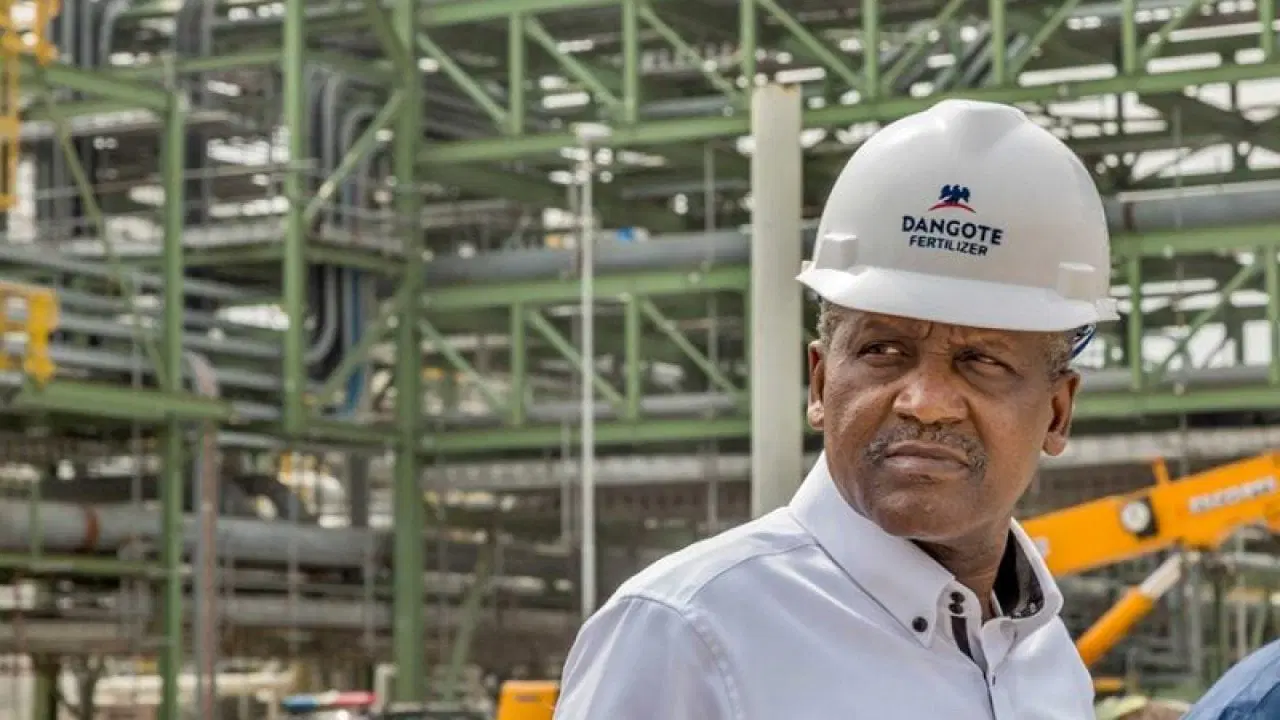
President of the Dangote Group, Aliko Dangote, has revealed that powerful interests within Nigeria’s oil sector almost frustrated the construction of the $20 billion Dangote Petroleum Refinery, describing the resistance as one of the biggest obstacles faced during the historic project.
Key Highlights:
•Aliko Dangote says entrenched interests in Nigeria’s oil sector tried to stop the refinery project.
•Dangote described the opposition as a “mafia” benefiting from fuel importation.
•The refinery project reportedly faced delays, land acquisition challenges, and foreign exchange volatility.
•Dangote says over 67,000 workers participated in the construction process.
•The refinery is expected to reduce Nigeria’s dependence on imported petroleum products.

Dangote made the disclosure during an interview with Nicolai Tangen, where he reflected on the difficulties encountered while building what is widely regarded as Africa’s largest petroleum refinery.
According to the billionaire businessman, some influential players in the downstream oil sector resisted the refinery because it threatened long-established profit channels tied to fuel importation.
“We looked at oil. Africa produces oil, but many countries don’t refine it. They export crude and import refined products, which drains foreign reserves,” Dangote stated.
Read Also:
- Dangote rejects NNPCL bid to increase stake in $20bn Refinery ahead of planned public listing
- Dangote Cement plans London listing as UK IPO rules open door for African firms
- Dangote refinery reverses petrol price hike hours after increase
He recalled that persistent fuel scarcity and endless queues at filling stations despite Nigeria’s status as a major oil-producing nation motivated him to embark on the refinery project.
“In Nigeria, we had fuel queues for more than 50 years. People queued for days during Christmas just to buy petrol in an oil-producing country. Government refineries were not functioning properly, so I decided to take the bold step of building a refinery,” he said.
Dangote disclosed that although the refinery initiative began in 2013, the process of securing land for the project delayed construction by nearly five years.
“Some of these obstacles were created by entrenched interests in the oil business — what you might call a mafia — trying to stop us from solving these problems. But we stayed focused,” he added.
The industrialist also highlighted major financial and infrastructure challenges encountered during the project, including severe exchange rate fluctuations.
“When we started, the naira exchange rate was ₦156 to the dollar. At one point it went as high as ₦1,900, but we still continued,” Dangote said.
He further explained that the company had to construct an entirely new port facility because existing Nigerian ports could not handle the massive refinery equipment imported for the project.
“Some individual pieces weighed up to 3,000 tonnes. We built roads, water infrastructure and other facilities from scratch. The refinery alone uses 440 million litres of treated water,” he explained.
Dangote revealed that approximately 67,000 workers were engaged during the construction phase, describing the refinery as one of the most ambitious industrial projects ever undertaken in Africa.
“Honestly, we were lucky we didn’t fully understand the enormity of what we were building at the beginning. If I had seen the full scale immediately, I might have chickened out,” he said.
He likened the experience to “swimming across the ocean,” noting that there was no turning back once construction had commenced.
Dangote also acknowledged the support of several African and Nigerian financial institutions, including African Export-Import Bank, African Finance Corporation, Zenith Bank, Access Bank, United Bank for Africa, Standard Bank, and Standard Chartered Bank.
The Dangote Petroleum Refinery, located in Lekki, is expected to strengthen Nigeria’s energy security, boost local refining capacity, and significantly reduce the country’s reliance on imported refined petroleum products.