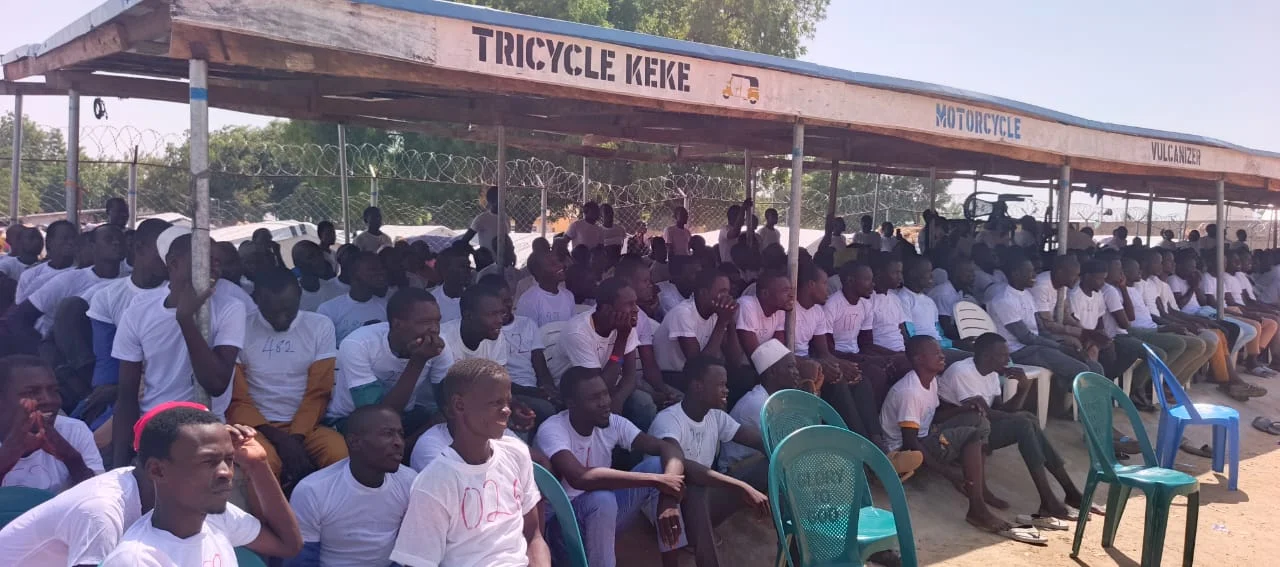
The Borno State Government says it has reintegrated 720 individuals described as “repentant insurgents” who have completed a government-run deradicalisation, rehabilitation and reintegration programme, returning them to communities across the state after months of structured processing.
The latest group, classified as “low-risk and minor clients,” constitutes Batch 9 under the controversial rehabilitation initiative, which officials say is part of a broader non-kinetic strategy to address the protracted insurgency in the North-East.
The beneficiaries were reportedly sworn in using the Holy Quran at an event held Friday at the Hajj Camp in Maiduguri before being released to their respective local government areas.

The Special Adviser on Security to Governor Babagana Umara Zulum, Babagana Umara Zulum, Brigadier General Ishaq Abdullahi (retd.), said the exercise marks another phase in what the government describes as a “peacebuilding model” aimed at reducing armed violence through surrender, rehabilitation and reintegration.
Abdullahi said the programme, which began on July 5, 2021, has since recorded large-scale participation from former fighters who voluntarily left insurgent-held forests and surrendered to security forces.
“It has been a success story since 5th July 2021 when the good people of Borno State, under the stewardship of our dynamic leader, Prof Babagana Umara Zulum, agreed to forgive and accept their sons who are willing to drop arms and embrace peace,” he said.
He further claimed that the model has become “one of the most effective non-kinetic programmes in the history of mankind,” adding that more than 350,000 persons have, at various points, exited insurgent enclaves and surrendered.
With the latest 720 beneficiaries, Abdullahi said the total number of reintegrated persons now stands at 9,680 across nine batches. He also disclosed that 992 spouses and over 2,000 additional individuals have passed through the same system after surrendering.
According to him, the process begins when individuals voluntarily leave insurgent camps and report to military locations, where they are profiled, disarmed and screened before admission into rehabilitation centres.
Inside the camps, he said participants undergo a structured programme combining religious instruction, psychosocial counselling, hygiene education, drug abuse awareness and vocational training.
He outlined the weekly schedule as including Islamic studies and public health lectures on Tuesdays and Thursdays, while Mondays, Wednesdays and Fridays are dedicated to skills acquisition such as tailoring, carpentry, metal work, bricklaying, solar installation, vulcanising, phone repairs, barbing, cap making and other trades.
Authorities also said beneficiaries were provided with starter packs upon graduation to support their reintegration into civilian life.
Community leaders, alongside members of the Civilian Joint Task Force and local hunters, were said to have participated in screening processes before the final approval for reintegration.
Read also:
- Reactions trail graduation of 744 repentant Boko Haram terrorists
- Clash between vigilantes, ‘repentant terrorists’ leaves 14 dead in Katsina
- 117 repentant terrorists graduate from Operation Safe Corridor in Borno
The beneficiaries, according to officials, were drawn from multiple local government areas including Bama, Konduga, Maiduguri Metropolitan Council (MMC), Jere, Mafa, Dikwa, Gwoza, Damboa, Marte, Monguno, Kukawa, Ngala, Kalabalge and Gubio.
Abdullahi urged the released individuals to abide by the terms of reintegration and avoid returning to violence, insisting that communities should accept them as part of ongoing reconciliation efforts.
Earlier, the Commissioner for Women Affairs and Social Development, Hajiya Zuwaira Gambo, represented by Permanent Secretary Babagana Kadai, described the programme as a symbol of “hope and resilience,” praising the state government’s resettlement efforts for displaced populations.
However, the scale and pace of reintegration continue to generate debate among security analysts and victims’ communities, who have repeatedly raised concerns over accountability, vetting standards and the long-term risks of returning former fighters into civilian spaces.