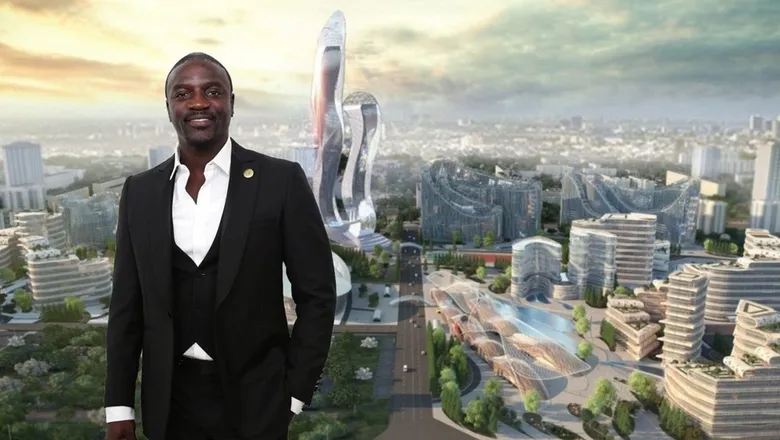
Senegal has officially abandoned Akon City, the ambitious $6 billion futuristic development proposed by Senegalese-American singer and entrepreneur Akon, after years of delays, funding challenges and failure to deliver the promised infrastructure.
The project, which was planned for Mbodiène on Senegal’s Atlantic coast, was promoted as a modern African city inspired by Wakanda, the fictional kingdom in Marvel’s Black Panther. However, in June 2025, the head of Senegal’s tourism development agency, the Société d’Aménagement et de Promotion des Côtes et Zones Touristiques du Sénégal (SAPCO), confirmed that the original project no longer existed. A smaller development involving Akon is now being considered for part of the site.

Key Highlights
- Akon City was announced in 2018 as a proposed $6 billion futuristic city in Senegal.
- The project promised hotels, hospitals, shopping malls, residential areas, technology facilities and renewable energy infrastructure.
- Its proposed cryptocurrency, Akoin, was intended to support transactions within the development.
- Years after its launch, the site remained largely undeveloped, with only a partially completed reception building.
- Senegal’s tourism development agency confirmed in June 2025 that Akon City had been abandoned.
- Akon is expected to pursue a smaller, more realistic property development on an eight-hectare portion of the site.
The Dream of an African Wakanda
Akon, whose full name is Alioune Badara Thiam, first unveiled the idea of Akon City in 2018. The proposal gained international attention because of its ambition to create a futuristic urban centre that would showcase African innovation and attract investment from across the world.
The planned development was located near Mbodiène, approximately 100 kilometres south of Dakar, Senegal’s capital.
Architectural designs presented a city of curved skyscrapers, modern residential districts, hotels, shopping centres, hospitals, schools, entertainment facilities and technology hubs. The development was also expected to feature renewable energy infrastructure and environmentally conscious building designs.
Akon described the proposed city as a real-life version of Wakanda, drawing comparisons with the technologically advanced African kingdom depicted in Marvel’s Black Panther.
The project was expected to create thousands of jobs, attract tourists, encourage investment from Africans in the diaspora and provide opportunities for local businesses.
It was also linked to Akoin, a cryptocurrency developed as part of Akon’s broader vision for technology-driven economic activity in Africa.
A $6 Billion Project That Struggled to Take Off
The project received significant attention in 2020 when a foundation stone was laid at the proposed site, with the involvement of Senegalese authorities through SAPCO.
The development was initially expected to progress in phases, with the first stage projected to include essential infrastructure and public facilities.
However, construction failed to advance according to the announced timetable.
In 2022, Akon maintained that the project was still moving forward and said construction of the first phase would begin in 2023. He projected that the initial phase could be completed between 2026 and 2028.
Those assurances did not translate into substantial construction.
By 2024 and 2025, the site remained largely undeveloped. The most visible structure was an unfinished Welcome Centre, while the promised roads, residential buildings, hospital, shopping facilities and power infrastructure had not materialised.
The lack of progress raised questions about the project’s financing, management and ability to meet its obligations.
Funding Problems and Missed Commitments
One of the major challenges was the difficulty of securing and deploying the enormous capital required for the development.
Although Akon City was promoted as a $6 billion project, the full funding needed to deliver its extensive infrastructure was not publicly demonstrated through completed construction.
The situation also created difficulties in Akon’s relationship with SAPCO, the state agency responsible for promoting and developing Senegal’s coastal tourism zones.
In 2024, SAPCO reportedly gave the project team an ultimatum to demonstrate progress or risk losing a substantial portion of the land allocated for the development.
The agency’s concerns centred on the failure to meet agreed obligations and the prolonged absence of meaningful construction.
The funding difficulties exposed the gap between the scale of the original announcement and the resources required to turn the proposed city into a functioning development.
Akoin Cryptocurrency Added Another Challenge
Akoin was presented as an important part of Akon City’s economic model.
The cryptocurrency was intended to support transactions and business activities within the proposed city, while also promoting the use of blockchain technology in African economic development.
However, the cryptocurrency struggled to gain traction and suffered a steep decline in value. The project also faced complaints from some participants in earlier token campaigns over delays in receiving refunds.
There were further questions about the legal and practical implications of using a private cryptocurrency as the principal means of payment in a city operating within Senegal’s financial system.
Senegal belongs to the West African Economic and Monetary Union, which uses the CFA franc and operates under the monetary authority of the Central Bank of West African States (BCEAO).
The difficulties surrounding Akoin weakened one of the central features of the original proposal.
Akon himself acknowledged management problems with the cryptocurrency initiative, saying it had not been properly managed and accepting responsibility for those shortcomings.
Read also:
- Senegal shuts down Akon’s $6 Billion “Akon City” dream after years of inactivity
- T-Pain Takes Legal Action Against Akon’s Label Over Alleged $489,000 Unpaid Royalties
- Akon’s wife Tomeka Thiam files for divorce after nearly 30 years of marriage
Senegal Officially Ends Akon City
The clearest indication that the project had reached its end came in June 2025.
On June 26, the Senegalese Press Agency (APS) reported that Serigne Mamadou Mboup, Director-General of SAPCO, had confirmed an agreement between the agency and Akon to end the original project.
Mboup was quoted as saying: “The Akon City project no longer exists.”
He explained that the two parties had reached an amicable agreement and that Akon was preparing a different property development that SAPCO would support.
In a further clarification published on June 27, the APS reported that the new development would occupy eight hectares within the original project area.
The announcement effectively brought the futuristic $6 billion city plan to an end, although it left room for Akon to remain involved in a smaller development.
What Will Replace the Futuristic City?
Senegal is now pursuing a more conventional tourism and property development approach for the Mbodiène coastal area.
The broader tourism development proposals reported in the media include hotels, residential accommodation, leisure facilities, a marina and other tourism-related infrastructure.
Reports have placed the wider development plan at around $1 billion, although the precise scope, financing arrangements and implementation timetable of the successor project require further confirmation.
Akon is expected to retain a smaller eight-hectare portion of the site for a separate development, with SAPCO indicating that it will support the revised proposal.
The new approach reflects a shift from the original vision of a cryptocurrency-powered futuristic metropolis towards a more practical property and tourism development.
The change is significant for Mbodiène, where residents had anticipated employment opportunities and major improvements to local infrastructure from the original project.
Lessons From the Collapse of Akon City
The failure of Akon City raises important questions about the challenges of delivering large-scale infrastructure projects through celebrity-backed investment initiatives.
The proposal attracted international attention because of its futuristic designs, ambitious financial projections and promise to demonstrate Africa’s capacity for innovation.
However, the experience showed that global publicity and architectural concepts cannot replace the financial resources, regulatory approvals, technical planning and management systems required to complete a major urban development.
It also highlighted the importance of realistic project timelines and clear accountability between investors, government agencies and host communities.
For residents of Mbodiène, the most immediate concern remains whether the revised development will deliver the jobs, infrastructure and economic opportunities that were promised during the original announcement.
Akon City may have disappeared from Senegal’s development plans, but the future of the land remains important to the country’s coastal tourism ambitions.
Whether the replacement project succeeds will depend on the same factors that proved difficult for its predecessor: adequate funding, credible commitments, effective management and visible progress on the ground.
For more explainers like this, follow us on X.