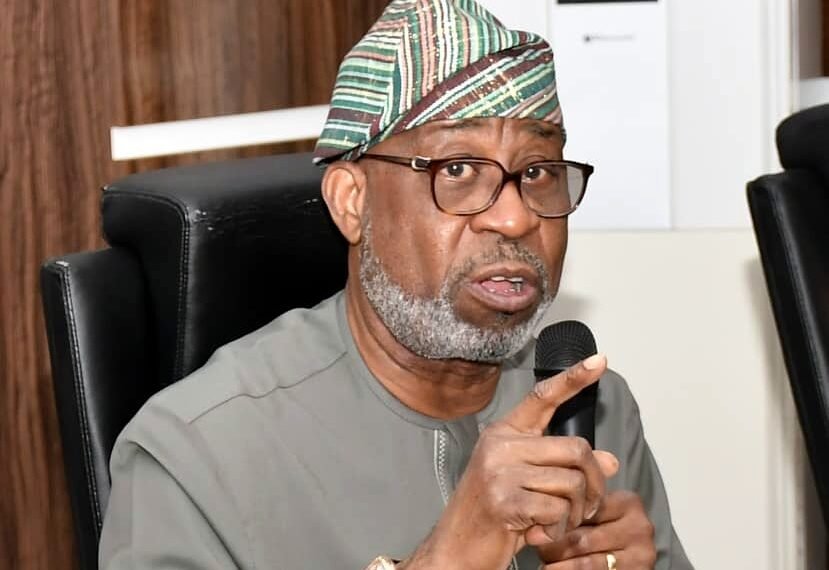
Nigeria’s Minister of Solid Minerals Development, Dele Alake, has warned that Africa risks squandering its vast mineral wealth if countries on the continent continue to operate in silos rather than as a coordinated bloc.
Alake, who also chairs the Africa Minerals Strategy Group, issued the warning during his address at the Kenya Mining Investment Conference and Exhibition 2026, where he pushed for stronger regional integration to reposition Africa within global mineral supply chains.

In a statement released on Wednesday by his media aide, Lara Owoeye-Wise, the minister said Africa sits at the centre of a rapidly evolving global industrial shift driven by rising demand for critical minerals essential for clean energy, digital technologies and advanced manufacturing.
Despite this strategic advantage, he noted that African countries still capture only a fraction of the value generated from their natural resources.
“For decades, Africa has remained largely an exporter of raw materials and an importer of finished products.
“This model has constrained industrial growth, weakened economic resilience and limited job creation across our nations,” Alake said.
He argued that the current structure of the global minerals market presents both a risk and an opportunity, stressing that no single African country can maximise the benefits in isolation.
“The time has come for Africa to redefine its place within the global mineral economy, and that transformation must begin with regional cooperation,” he added.
Alake said fragmentation across the continent continues to undermine Africa’s bargaining power in global negotiations, while a unified front would significantly strengthen its strategic relevance.
He called for harmonisation of mining regulations, development of cross-border infrastructure, and deeper intra-African trade, particularly under the African Continental Free Trade Area framework.
The minister also highlighted the growing role of the Africa Minerals Strategy Group, describing it as a key platform for driving coordinated action across the continent.
According to him, the group, established in January 2023 with 16 member states, has expanded to 31 countries, reflecting increasing commitment to a shared development agenda.
He said the platform is helping African nations negotiate fairer terms with global partners, improve governance standards, and retain more value from their mineral resources.
“The Group is advancing cooperation among member states to harmonise regulatory frameworks, develop shared infrastructure such as mineral corridors and processing hubs, and strengthen geological data systems to attract investment,” he said.
Alake emphasised that Africa must shift focus from raw mineral exports to value addition, warning that failure to industrialise would continue to drain billions of dollars from the continent annually.
Read also:
- Bayelsa cracks down on rampant illegal mining as government warns community leaders of arrest, prosecution
- Rubi Network’s double mining reward to mark 3rd anniversary
- Ortom cautions against illegal mining in Benue
- NSIPA begins release of shortlisted beneficiaries for GEEP FarmerMoni scheme
- Defamation: Roby Ekpo rejects Mayowa Lambe’s ₦100m demand, threatens legal showdown
- Cashew farmers oppose export ban, demand financial support
- “One Inhaler Can Wipe Out Monthly Salary”- Foundation raises alarm over Asthma crisis in Nigeria
- Forum of ex- South-East Councillors hail Gov. Otti for offsetting colleagues’ entitlements
“Value addition is not merely an economic aspiration; it is a development imperative.
“It creates jobs for our youth, stimulates industrialisation, expands government revenues and positions Africa competitively in the industries of the future,” he said.
He added that ongoing global supply chain restructuring presents a rare opportunity for Africa to reposition itself, but cautioned that success would depend on policy consistency, transparency, environmental responsibility, and investor-friendly reforms.
“The conversation around minerals goes beyond mining. It is fundamentally about Africa’s industrial future, economic sovereignty and sustainable prosperity,” he stated.
Africa holds a significant share of the world’s critical minerals, including lithium, cobalt, manganese, graphite and rare earth elements—key inputs in electric vehicles, renewable energy systems and electronics manufacturing.
However, analysts say the continent continues to lose billions of dollars yearly due to weak infrastructure, limited processing capacity and overreliance on exporting raw materials.
Alake expressed optimism that with coordinated policies, strategic partnerships and strong leadership, Africa can break out of its traditional role.
“Through visionary leadership, strategic partnerships and continental cooperation, Africa can transition from being merely resource-rich to becoming truly value-rich,” he said.
Related Stories: