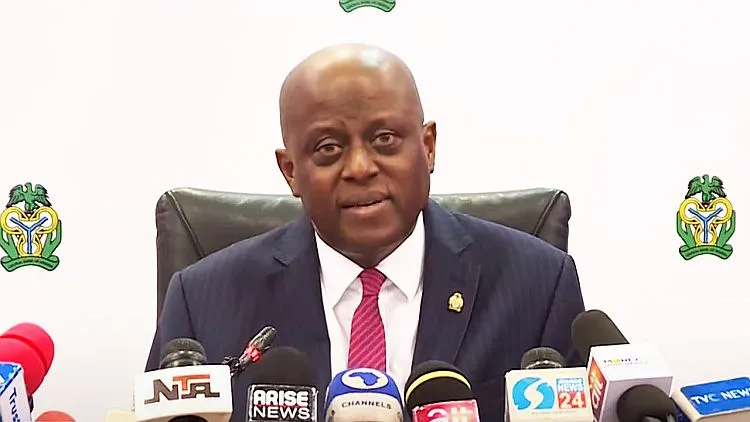
The Africa Finance Corporation (AFC) has appointed the Governor of the Central Bank of Nigeria (CBN), Olayemi Cardoso, as the chairman of its board of directors, succeeding Ireti Samuel-Ogbu, who will remain a member of the board.
Key Highlights
- The AFC appoints CBN Governor Olayemi Cardoso as chairman of its board of directors.
- He succeeds Ireti Samuel-Ogbu, who remains a board member.
- AFC President Samaila Zubairu says Cardoso’s experience will support its “The Africa We Build 2050” agenda.
- Recent AFC deals include the $753 million Lobito Corridor Railway and a $600 million facility for Dangote’s fertiliser expansion.
- The AFC has invested more than $20 billion in 36 African countries since 2007.
The appointment was announced by the corporation in a statement dated October 14, 2026, and signed by its Communications representative, Yewande Thorpe.

Cardoso brings experience in international banking, investment management, economic policy and public sector administration to the role.
He has served as CBN governor since September 2023, overseeing reforms aimed at restoring macroeconomic stability, strengthening policy credibility and improving investor confidence.
Cardoso’s Record at the CBN
Under his leadership, the apex bank has introduced changes to the foreign exchange market, addressed outstanding foreign exchange obligations and strengthened monetary policy transmission.
The CBN has also implemented institutional governance reforms and concluded a banking sector recapitalisation programme intended to improve the resilience of Nigeria’s financial system.
Before becoming CBN governor, Cardoso served as chairman of Citibank Nigeria for 12 years and as Lagos State Commissioner for Economic Planning and Budget, where he contributed to fiscal management and economic planning.
He holds a degree from Aston University in the United Kingdom and a master’s degree in public administration from Harvard Kennedy School. He also served on the latter institution’s alumni board.
AFC’s Development Agenda
The AFC said Cardoso’s appointment comes as it intensifies efforts to finance strategic infrastructure projects, support industrialisation and strengthen economic integration across Africa.
The corporation’s President and Chief Executive Officer, Samaila Zubairu, welcomed the appointment, expressing confidence that Cardoso’s experience would support its long-term development agenda, The Africa We Build 2050.
Zubairu said the corporation remains committed to mobilising African capital for infrastructure and industries capable of generating employment, expanding productive capacity and improving livelihoods.
He also commended Samuel-Ogbu for her contributions to the board during her tenure as chairman.
In his remarks, Cardoso said Africa’s economic stability depended on expanding its productive capacity and developing infrastructure that supports industrial growth.
He expressed his readiness to work with the board, management and member states to advance AFC’s development agenda, stressing the importance of building industries, creating jobs and strengthening the continent’s economic foundations.
Read also:
- Cardoso Holds Talks With Monetary Authority Of Singapore To Strengthen Nigeria–Asia Financial Connectivity
- Oyedele, Cardoso Meet World Bank President to Discuss Nigeria’s Economic Growth Strategy
- InfraCredit Secures $50m IFC Facility to Boost Local-Currency Infrastructure Finance in Nigeria
AFC highlighted several recent investments as evidence of its expanding infrastructure portfolio.
They include achieving financial close on the $753 million Lobito Corridor Railway Project in Angola, supporting a $600 million facility for Dangote Group’s $7 billion fertiliser expansion programme in Nigeria, and committing $300 million alongside Vision Invest to WIOCC Group to expand digital infrastructure across Africa.
Established in 2007, the AFC provides financial and technical advisory services, project development, structuring and risk capital to support infrastructure and industrial investments across the continent.
The corporation said it has 49 member countries and has invested more than $20 billion in 36 African countries since its establishment, with projects spanning power, natural resources, heavy industry, transport and telecommunications.
For more business and economy news, follow us on X.