
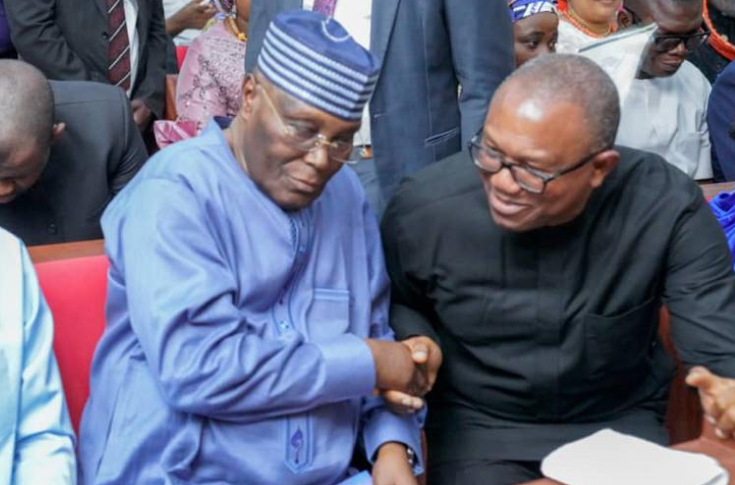
Former Vice-President Atiku Abubakar, former Governors Peter Obi, and Rabiu Kwankwaso may be weighing alternative political platforms as the crisis rocking the African Democratic Congress (ADC) deepens ahead of the 2027 general elections.
The ongoing deliberations come amid mounting uncertainty over the ADC’s leadership structure, following the intervention of the Independent National Electoral Commission (INEC) and a Court of Appeal ruling that has left all factions of the party without formal recognition.
The development has heightened concerns within opposition circles that the ADC may struggle to meet critical electoral timelines, including the conduct of valid primaries and submission of candidates for national and state elections.

Political insiders warn that if the legal disputes persist, aspirants contesting under the ADC risk disqualification should the party’s status remain unresolved, with no room for post-deadline defections.
Amid this uncertainty, coalition actors have intensified consultations, with high-level meetings expected in Abuja after the Easter period to determine a unified political strategy.
As part of contingency planning, the Labour Party (LP), Action People’s Party (APP), and the New Democratic Congress (NDC) have emerged as possible fallback platforms under consideration.
The LP is gaining traction in some quarters, particularly given its performance in the 2023 presidential election where, with Peter Obi as candidate, the party won 12 states, including a landmark victory in Lagos, widely regarded as Bola Tinubu’s stronghold, and also secured the Federal Capital Territory (FCT), Abuja. The party further consolidated its presence with several legislative seats across the South-East and South-South, as well as producing a state governor in Abia.
The party’s internal stability has also improved following the Supreme Court’s affirmation of Senator Nenadi Usman as its authentic national chairman. However, some coalition stakeholders are said to harbour reservations, citing concerns that the LP structure is largely dominated by loyalists of Obi, which could trigger internal resistance.
Read also:
- 2027: ADC presidential ticket uncertain for Obi amid Atiku influence — NDI-ABAT
- 2027: Governor Peter Mba losing ground in Enugu as core support group switches allegiance to Obi, ADC
- Kwankwaso hosts Obi, Gov. Makinde, Sen. Dickson in Kano
The New Democratic Congress (NDC), led by Senator Seriake Dickson, a former governor of Bayelsa State, was recently registered by INEC in early 2026 and is widely seen as free of internal leadership disputes. Nonetheless, analysts note that the party currently lacks a strong national footprint beyond Bayelsa State.
Meanwhile, the Action Peoples Party (APP) has recently drawn attention after securing two legislative seats in Imo State following the defection of House of Representatives members Ikenga Ugochinyere and Matthew Nwogu. Despite this momentum, concerns persist in some circles over alleged legal issues surrounding its deregistration—claims the party’s officials have dismissed.
Analysts say the eventual choice of platform by the opposition coalition could significantly reshape the political landscape ahead of 2027, with unity under a stable and legally secure party seen as critical to mounting a credible challenge against the ruling party.