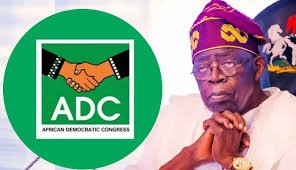

The African Democratic Congress (ADC) has issued a sharp critique of President Bola Tinubu’s administration, declaring that democracy has not improved the lives of ordinary Nigerians and describing the current situation as a failure of governance in the country.
Key Highlights:
- ADC issues strong ADC blast Tinubu statement on Democracy Day
- Says Nigeria’s democracy has failed to improve citizens’ lives
- Raises concerns over worsening insecurity and economic hardship
- Accuses government of weak response to rising criminality
- Claims cost-of-living crisis is deepening nationwide suffering
- Calls for results-driven governance and accountability
In an open letter released by its National Publicity Secretary, Bolaji Abdullahi, to mark Democracy Day, the opposition party said the true measure of democracy is not the number of years under civilian rule but the impact on the lives of citizens.
The party urged Nigerians to reflect critically on their living conditions, asking whether they feel safer, more prosperous, and more confident in government than before.
“Twenty-seven years after the return to democratic rule, and three years into the administration of President Bola Tinubu and the All Progressives Congress, we ask you these simple questions: Is your life better today than in the past? Do you feel safer today than you felt in the past? Do you trust the government more than before?” the statement read.
Read Also:
- Atiku Running Mate: Amaechi reportedly emerges as ADC Vice Presidential pick for 2027 election
- ADC VP Race Heats Up: Atiku faces tough choices as Dele Momodu joins running mate calculations
- Ebonyi ADC crisis deepens as Silas Onu faction declares Jennifer Adibe’s tenure expired
The ADC argued that the answers to these questions, in its view, reflect deep public dissatisfaction with the state of the nation.
The opposition party accused the APC-led government of presiding over worsening insecurity, economic hardship, and declining trust in democratic institutions.
It said insecurity had reached alarming levels, with citizens exposed to killings, kidnappings, and violent attacks across different regions.
“The most important job of a government is to protect the citizens. But is there any one of you today who believes that this government can protect anybody?” the party asked.
The ADC further claimed that criminal groups were gaining strength while state institutions were becoming less effective in responding to security threats.
On the economy, the party described the cost-of-living crisis as severe, pointing to rising prices of food, transport, housing, healthcare, and education.
It said many households are struggling to survive as incomes lose value, while small businesses face increasing pressure and families are forced into difficult daily choices.
The party also expressed concern over youth unemployment and migration trends, stating that many young Nigerians no longer see a viable future within the country.
According to the ADC, the challenges facing Nigeria are not accidental but the result of policy failures and weak leadership decisions over time.
It accused the government of focusing on rhetoric rather than delivering concrete solutions to insecurity and economic hardship.
Presenting its alternative direction, the party called for security reforms that are intelligence-driven, technology-based, and community-focused, while insisting that government spending should be judged by outcomes rather than budget size.
On the economy, it proposed policies aimed at reducing energy costs, supporting small businesses, protecting low-income earners, and strengthening food security through improved agricultural systems.
The ADC also called for stronger transparency, accountability, and measurable governance outcomes as the basis for evaluating leadership performance.
It maintained that Nigeria’s democracy can only regain public trust if citizens begin to see real improvements in safety, livelihoods, and national development.
The party said the best way to honour the June 12 democratic struggle is through honest reflection and reforms that deliver tangible benefits to Nigerians.