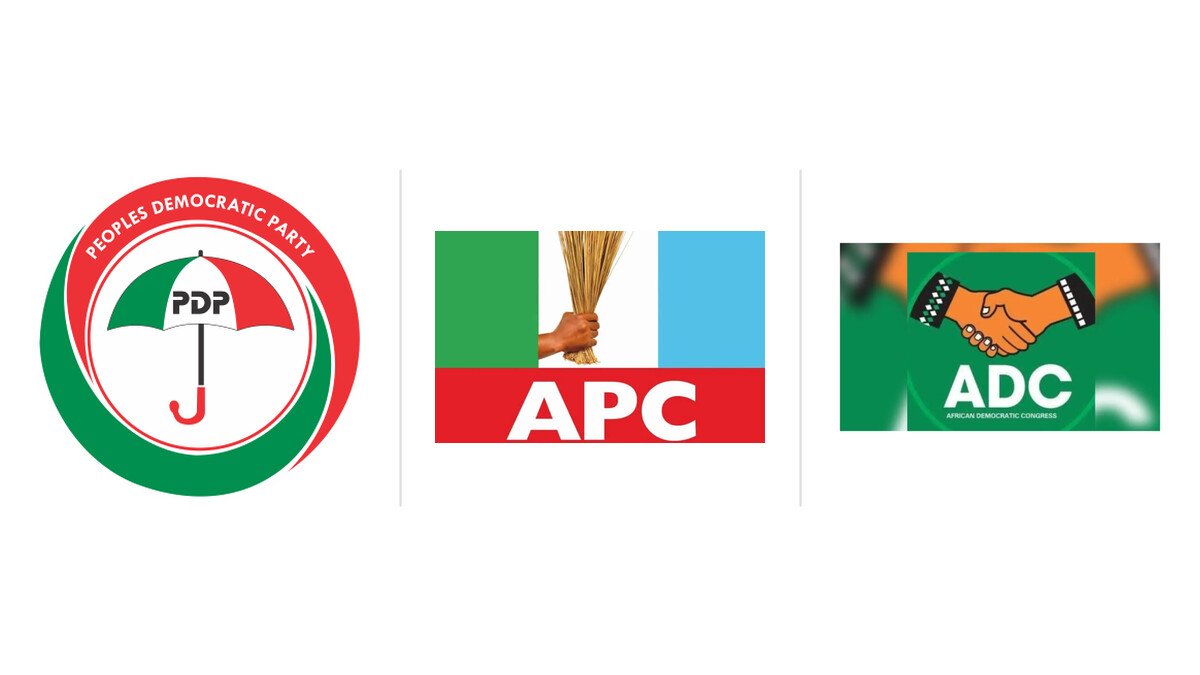
As Adamawa State prepares for the February 2027 governorship election, the race to succeed Governor Ahmadu Fintiri is emerging as a major political contest involving the will of the electorate, party machinery, political alliances and competing visions for governance. The three major political parties — the All Progressives Congress (APC), the Peoples Democratic Party (PDP) and the African Democratic Congress (ADC) — have presented candidates whose political backgrounds and electoral strategies reflect the changing dynamics of the state.
Key Highlights
- Ahmed Galadima is relying on the APC’s political structure and Governor Fintiri’s support.
- PDP candidate Maurice Vunobolki is seeking to capitalise on indigenous groups’ agitation for political representation.
- Vunobolki’s nine-point agenda focuses on people, prosperity and peace.
- ADC candidate Modibbo Ribadu is banking on the political influence of former Vice-President Atiku Abubakar.
- A court dispute over the ADC governorship primary could affect Ribadu’s campaign.
- The February 2027 election will determine the political direction of Adamawa State.
Ahmed Galadima, the APC candidate, enters the race with the advantage of the ruling party’s machinery following Fintiri’s defection from the PDP to the APC in February 2026. Chief Maurice Vunobolki, the PDP candidate, is seeking to benefit from the agitation among indigenous ethnic groups to produce one of their own as governor, his professional experience, the PDP’s record in government and a campaign centred on human capital development, prosperity and peace.

Meanwhile, Modibbo Ribadu, whose emergence as the ADC candidate was challenged by another aspirant, represents an opposition platform seeking to translate its growing national political influence into electoral support in Adamawa.
Beyond the personalities, the election presents voters with three major choices: maintaining political continuity through the APC, returning to the PDP under a new candidate or embracing the ADC as an alternative political platform.
Galadima Banks On APC Political Machinery
Galadima’s emergence as the APC governorship candidate places him at the centre of a contest that could determine whether the party consolidates its political influence in Adamawa following Governor Fintiri’s defection.
The 62-year-old candidate reportedly won the APC governorship primary with 414,444 votes, defeating House of Representatives member Abdulrazak Namdas, who scored 86,004 votes, and Abdulrahman Haske, who reportedly secured about 65,000 votes.
However, his emergence and the extent to which his candidacy appeals to a broad spectrum of Adamawa voters will be tested at the polls.
Despite enjoying the support of the incumbent governor and several influential stakeholders previously associated with the PDP, Galadima faces challenges beyond the strength of the APC’s political machinery.
His relatively low public profile before the election season could make it difficult for him to establish a personal connection with voters who are more familiar with other contenders.
His electoral prospects are also closely tied to public assessment of the outgoing administration and the political implications of the APC-led Federal Government’s economic policies.
Vunobolki Seeks To Capitalise On Indigenous Groups’ Political Agitation
Political observers believe that prevailing political permutations and the mood of voters, particularly among indigenous ethnic nationalities, could favour PDP candidate Chief Maurice Vunobolki if the election is free, fair, peaceful and credible.
Vunobolki, who previously sought the APC governorship ticket, left the party before its primary over allegations of delegate manipulation. He reportedly complained that the process had been manipulated to pave the way for the imposition of a preferred aspirant.
Following the development, he left the APC and emerged as the PDP’s governorship candidate.
Before his departure, various interest groups, including the Gongola Peoples Forum, had called on political parties in Adamawa to conduct transparent and credible governorship primaries.
At different public engagements, the forum consistently opposed the imposition of candidates, insisting that party members should be allowed to freely choose their preferred aspirants.
The organisation also declared that it would not support any governorship candidate perceived to have emerged through imposition, adding that it would mobilise indigenous ethnic nationalities against such a candidate.
Vunobolki belongs to the Bwatiye, also known as Bachama, ethnic group, one of the indigenous communities in Adamawa State.
The agitation reflects a broader political demand among indigenous ethnic nationalities seeking greater participation in determining the state’s political leadership.
Some of these groups reportedly view the 2027 governorship election as an opportunity to influence their political future rather than allow other ethnic groups to determine their leadership choices.
Vunobolki Unveils Nine-Point Agenda On People, Prosperity And Peace
At his November 19 campaign flag-off, Vunobolki unveiled a nine-point development agenda built around three major pillars: people, prosperity and peace.
Human capital development is a central component of his proposed administration. He promised to establish a dedicated agency for human capital development that would provide beneficiaries with starter packs to help them become economically productive.
The proposal is designed to connect government interventions with practical economic opportunities for residents.
Rather than concentrating exclusively on infrastructure development, the PDP candidate has emphasised building individual capacity and creating opportunities for residents to participate meaningfully in economic activities.
His agenda also covers education, healthcare, agriculture, job creation, industrialisation and security.
These priorities could appeal to voters seeking an administration capable of addressing infrastructure deficits alongside unemployment, economic hardship and other challenges affecting households.
Vunobolki has also pledged to sustain the development initiatives of the outgoing Fintiri administration.
He maintains that the projects and achievements associated with the governor were made possible through the implementation of the PDP manifesto.
He has therefore promised to consolidate those achievements while pursuing additional development opportunities.
The position gives the PDP an opportunity to campaign on its record under Fintiri, despite losing control of the state government following the governor’s defection.
The party is also presenting Vunobolki as a candidate capable of maintaining development continuity without being tied to the political arrangements that accompanied Fintiri’s departure.
His professional experience could further strengthen the PDP’s argument that effective governance requires more than political popularity.
Read also:
- Adamawa Governorship Candidates Sign Peace Accord In Yola
- No Child Will Be Left Out of School, Adamawa PDP Governorship Candidate Pledges
- Adamawa YPP Gobernatorial Candidate Unveils 17-Point Agenda
Ribadu Relies On Atiku’s Influence As ADC Faces Legal Challenge
The ADC has entered the Adamawa governorship race hoping to benefit from growing opposition activity and the political influence of former Vice-President Atiku Abubakar.
Modibbo Ribadu, the party’s governorship candidate, is a former director and chief executive of the Nigerian Financial Intelligence Unit (NFIU).
His professional background in financial intelligence and public administration provides experience in institutional management and financial accountability.
The ADC’s growing national profile also presents an opportunity to attract voters dissatisfied with the APC and PDP.
One of Ribadu’s major political advantages is Atiku’s influence in Adamawa State, his home state. The former vice-president remains an influential political figure whose support could strengthen the party’s grassroots mobilisation.
However, Ribadu’s candidacy has been complicated by a dispute over the ADC governorship primary.
Omar Suleiman, who claimed to have won the party’s governorship primary, challenged Ribadu’s emergence as the candidate in court.
A prolonged legal disagreement over the authentic candidate could negatively affect the ADC’s campaign preparations and create uncertainty within the party as the election approaches.
Beyond the internal dispute, the ADC faces the challenge of translating its national political appeal into grassroots electoral support in Adamawa.
Although Atiku’s political influence could provide a significant advantage, the former vice-president is not the candidate on the ballot. Ribadu must therefore establish his own appeal among voters.
The party’s relatively limited organisational structure in the state could also make it difficult to compete with the APC’s incumbency advantage and the PDP’s established political network.
Adamawa 2027: Who Will Succeed Governor Fintiri?
The February 2027 governorship election is shaping up as a major test of political strength for the APC, PDP and ADC.
Galadima’s chances will depend largely on the APC’s ability to consolidate its political structure following Fintiri’s defection and translate the incumbent governor’s support into votes.
Vunobolki will be counting on the PDP’s established political network, his nine-point development agenda and the support of indigenous ethnic groups seeking greater representation in the state’s leadership.
Ribadu, meanwhile, must overcome the challenges surrounding his emergence, strengthen the ADC’s grassroots presence and translate Atiku’s political influence into electoral support.
For more updates on the Adamawa governorship race, follow us on X.