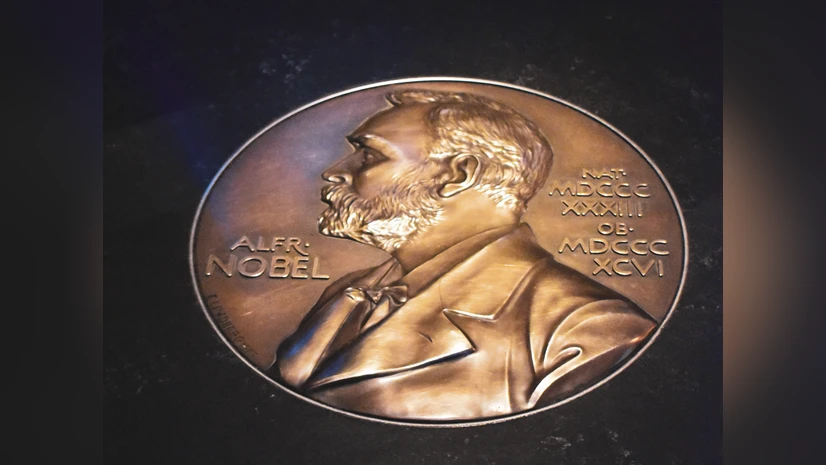
American scientist Karl Deisseroth and German researchers Peter Hegemann and Georg Nagel have won the 2026 Nobel Prize in Physiology or Medicine for groundbreaking discoveries that have transformed scientists’ understanding of how nerve cells communicate and how brain activity can be controlled using light.
The three scientists were announced as the recipients of the prestigious 2026 Nobel Prize in Physiology or Medicine on Monday, October 5, following their pioneering work on light-gated ion channels and optogenetics.

Key Highlights
- Karl Deisseroth, Peter Hegemann and Georg Nagel win the 2026 Nobel Prize in Physiology or Medicine.
- The scientists were honoured for discoveries concerning light-gated ion channels and optogenetics.
- Their research allows scientists to activate or silence individual nerve cells with high precision.
- Optogenetics has become an important tool for studying the brain and neurological disorders.
- Researchers are exploring applications of the technology in restoring sight and improving cochlear implants.
- The three laureates will share an award of 12 million Swedish crowns.
The Nobel Assembly at Sweden’s Karolinska Institutet said the scientists were honoured for their “discoveries concerning light-gated ion channels and optogenetics.”
Their research has opened new possibilities in neuroscience by allowing scientists to activate or silence individual nerve cells in living brains with remarkable precision.
Optogenetics, the technique that emerged from their work, has become an important tool in laboratories studying the brain, neurological disorders and the way different groups of neurons influence behaviour and bodily functions.
Possible Medical Applications
The breakthrough could also have implications beyond laboratory research.
Scientists are investigating how optogenetic approaches could be used to restore sight in people suffering from retinitis pigmentosa, an inherited eye disorder that can lead to severe vision loss.
In some clinical trials, researchers have attempted to restore visual function by introducing light-sensitive proteins into the retina, allowing remaining retinal cells to respond to light.
The technology is also being explored as a possible way of improving cochlear implants by enabling more precise stimulation of the auditory nerve.
How The Discovery Unfolded
The path to the Nobel recognition began decades ago.
In the early 1990s, Hegemann studied the green alga Chlamydomonas and investigated how it responds to light at extraordinary speed. His work led him to propose that a specific protein could detect light and function as an ion channel.
Nagel later tested the hypothesis by introducing genes from the alga into frog eggs. His experiments helped identify channelrhodopsin-2, a light-sensitive ion channel that opens when exposed to light.
Hegemann and Nagel subsequently demonstrated that the protein could be introduced into mammalian cells, where light could be used to trigger electrical activity.
The discovery attracted the attention of Deisseroth, a neuroscientist at Stanford University. In 2005, he demonstrated that the technique could be used to control nerve cells in living organisms.
The approach later became known as optogenetics, combining genetics with the use of light to control cellular activity.
The technique has since become a major research method in neuroscience, giving scientists a way to investigate the brain with a level of precision that was previously difficult to achieve.
Read also:n
- Nobel Prize to announce winners this week, beginning with winners in medicine today
- 3 scientists win Nobel Prize in Chemistry for work on metal-organic frameworks
- 3 scientists win Nobel Prize in Physics for work on quantum computing
Thomas Perlmann, Secretary-General of the Nobel Assembly, said the method makes it possible to switch the activity of individual nerve cells on or off in a living brain.
He added that optogenetics is now being used by researchers around the world to investigate some of the brain’s most complex mysteries.
The three laureates will share the Nobel Prize award of 12 million Swedish crowns, equivalent to about $1.2 million.
According to Perlmann, all three scientists expressed surprise and delight after being informed of the award.
He said they were particularly pleased to receive the honour together, describing one another as friends.
The 2026 Nobel Prize in Physiology or Medicine marks another major recognition of research that has reshaped modern medicine and biological science.
The medicine prize has historically honoured discoveries that have fundamentally changed understanding of the human body and disease, including Alexander Fleming’s discovery of penicillin and Karl Landsteiner’s identification of human blood groups.
The Nobel Prize announcements continue throughout the week, with the prizes for physics, chemistry, literature, peace and economics scheduled to follow.
The laureates will formally receive their awards during ceremonies in December, culminating on December 10, the anniversary of Alfred Nobel’s death.
For more breaking news and updates, follow us on X.